Five Questions Luxury Creators Can Use Before a Nowah Travel Demonstration
Use five practical questions to build a current luxury travel brief and demonstrate a useful Nowah next step.
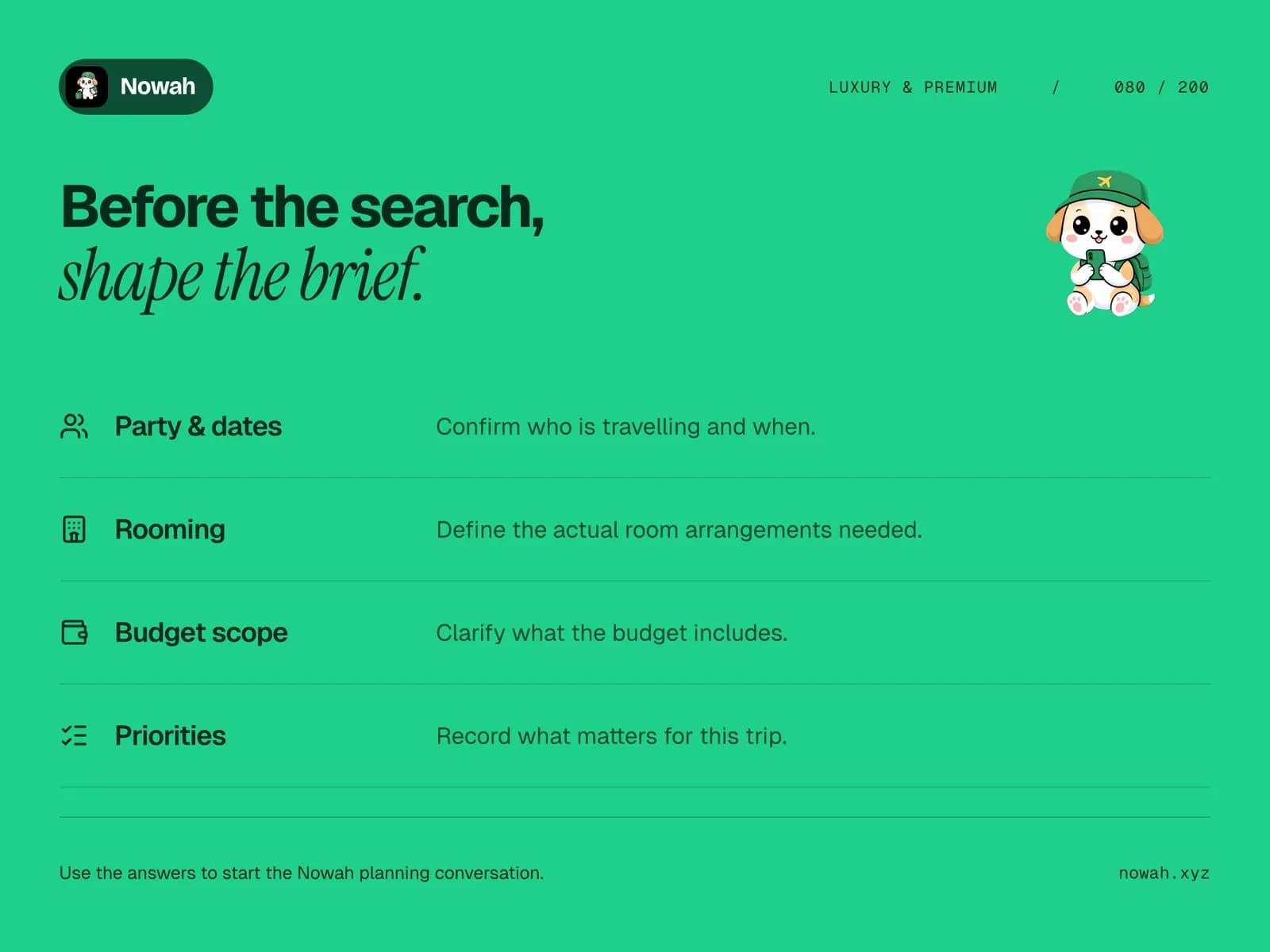
A useful luxury travel recommendation starts before the shortlist. Who is travelling, when they can go, how they need to stay and what they want the trip to achieve all affect the research. An approved Nowah partner can turn those questions into a practical demonstration, a disclosed referral and potential earnings from qualifying bookings by newly attributed travellers.
Nowah is particularly useful when a creator shows how a current brief develops. Instead of recommending the same attractive property to every follower, explain the inputs, explore the relevant planning question and revise the direction when a preference changes. The audience sees why the next step in Nowah relates to its own decision.
Use the five questions below as an editorial structure, not a demand for private traveller information. A public demonstration can use fictional details. The objective is to show which answers change the trip and how a creator can make the recommendation more useful.
1. Who is actually travelling?
Start with the party relevant to the travel decision. The number of adults and children, the number of rooms being considered and particular requirements the travellers choose to express can affect the accommodation research.
Do not infer preferences from age, relationship status or a luxury label. A couple does not necessarily want the same pace, and a family does not necessarily want the same room arrangement as another family. Ask which requirements matter to this brief instead of assigning an audience stereotype.
For public examples, describe a fictional party without collecting names, identity documents or unnecessary personal histories. Explain why the relevant party information matters to the task. If a rooming arrangement is essential, preserve that requirement throughout the demonstration rather than mentioning it once and then comparing unsuitable options.
The luxury family rooming guide provides a deeper verification sheet when occupancy and room relationships are central to the recommendation.
2. Which dates and boundaries are fixed?
Distinguish the overall period away from accommodation nights and the actual arrival or departure constraints. Ask whether dates are settled, partly flexible or still ideas. Those differences affect what kind of planning conclusion the content can support.
Do not treat an unconfirmed flight idea as an actual arrival boundary. If the demonstration is fictional, label the assumed boundary and explain which details would need current evidence before booking. A precise-looking day plan is not stronger because it conceals an unresolved date question.
Show how Nowah helps explore the brief with the fixed anchors visible. If an initial direction ignores the return boundary or uses a travel day as a full destination day, review and revise it. This is a useful teaching moment because the audience sees the constraint change the plan.
For a particularly narrow window, link to premium short-break planning. It addresses the separate question of how much usable destination time remains inside the trip's boundaries.
3. What accommodation arrangement does the traveller need?
Separate the room requirement from the property imagery. A traveller may need a particular occupancy arrangement, want to investigate a room category or have an important provider question. A hotel name alone does not settle those details.
Ask what must be confirmed and what is simply a preference to explore. Do not promise connecting rooms, a particular view, special access or an arrival arrangement because a property appears premium. If the relevant evidence is missing, keep the item open in the brief.
Demonstrate how an accommodation requirement changes the research direction in Nowah. If the traveller decides that one base matters more than a particular hotel style, show the revision. That makes the product recommendation part of the planning process rather than a logo appended to an otherwise unrelated hotel list.
The actual offer still needs current supplier evidence. An itinerary or research direction does not independently certify occupancy, inclusions or availability.
4. What does the budget cover?
A budget becomes useful only when its scope is clear. Ask whether the traveller means accommodation alone, flights and accommodation, or a wider trip allowance with other categories. Keep the currency and the intended scope visible where they matter to the comparison.
Do not imply that a broad budget establishes an actual quote or guarantees an option. A fictional demonstration can explain the difference between an accommodation-only allowance and a whole-trip allowance without inventing current prices.
The creator should also identify important exclusions. If a comparison discusses flights and stays, make clear when another relevant cost has not been included. Avoid adding assumed amounts just to create a complete-looking total.
The budget scope guide treats this question in more detail. It is useful beyond budget-travel audiences because a premium traveller can still be misled by a comparison whose cost boundaries are unclear.
5. Which current priority should the plan protect?
Ask for one or two priorities that actually change the trip. More time at the accommodation, fewer hotel moves, a fixed commitment or space for different interests can lead to different directions. “Luxury” alone does not tell the creator which tradeoff to explain.
Use Nowah to explore the question with that priority explicit. Review whether the proposed outline protects it. If the traveller wants a lighter rhythm but the itinerary fills every day with movements, revise the brief and show the effect.
Do not invent benefits to make the preferred direction easier to sell. A room upgrade, special access or exceptional rate needs actual evidence. Your recommendation can be confident because the reasoning is clear, without promising an arrangement that the supplier has not confirmed.
The older Nowah article on the anatomy of a hotel recommendation offers background for putting requirements before the conclusion. These five questions turn that principle into a usable creator workflow.
Combine the answers into one demonstration brief
Imagine a fictional pair of travellers investigating three nights with one fixed return boundary, a preference for one accommodation base and a desire to leave one day relatively open. Their budget discussion concerns flights and accommodation, while other spending remains outside the example.
Show the answers together before opening the planning demonstration. Explain which question you are testing first: whether the single-base direction fits the trip boundaries and priorities. Then review and revise the proposed outline in Nowah.
The demonstration should end with a specific next research action, such as resolving a room condition or investigating current flight options. It does not need an invented booking confirmation to be useful. A clear brief and an honest remaining question are concrete outputs the audience can adapt.
When producing a short cut, keep the same fictional inputs. Do not let a longer article quietly add a night, change the party or remove the budget boundary to make the example work.
Give each audience the right Nowah action
A traveller following your recommendation should understand that you are a partner and may earn commission from qualifying referred bookings. Put the disclosure beside the active link and the useful next action. A fellow creator who wants to participate needs the program explanation and application rather than the same traveller instruction.
Under the Nowah terms, an eligible traveller must follow an active partner link and create a new account within 30 days of the introduction. Existing accounts, self-referrals and artificial accounts do not qualify. Tracking must reach Nowah successfully; a completed brief or link click does not itself establish attribution.
Valid attribution can remain for the lifetime of that traveller account, including qualifying later bookings. That offers a potential continuing earning relationship, while future bookings and income remain unguaranteed.
The questions also help you choose what to leave out of a public demonstration. A useful planning example needs relevant constraints, not a complete personal profile. Describe the fictional party, dates, rooming requirement and priority in enough detail to explain the decision, while keeping unnecessary identity or private background out of the content. That focus makes the brief easier to follow and gives viewers a method they can adapt without assuming they must share sensitive information with a creator to begin researching a trip.
Explain earnings without turning the budget into a commission estimate
The partner share is 35% of Nowah net revenue from qualifying hotels, flights and paid eSIMs booked by attributed accounts. It does not use the traveller's total budget or booking price. A more expensive-looking brief does not establish a larger earning amount.
Completion, supplier settlement and the applicable hold and payout conditions also matter. Keep the creator's research asset, the traveller's signup, a qualifying booking and eligible earnings distinct when assessing the content's commercial results.
To participate, apply to Nowah Partners. Applying is free, applications are reviewed and there is no minimum follower count. Begin with five useful questions, demonstrate how Nowah helps explore the resulting brief and give the audience a transparent way to continue planning travel that reflects its actual priorities.




