Room-category tradeoffs: help luxury travellers compare options with Nowah
Explain room-category tradeoffs with a Nowah planning demonstration and a card covering configuration, occupancy, inclusions and actual rate conditions.
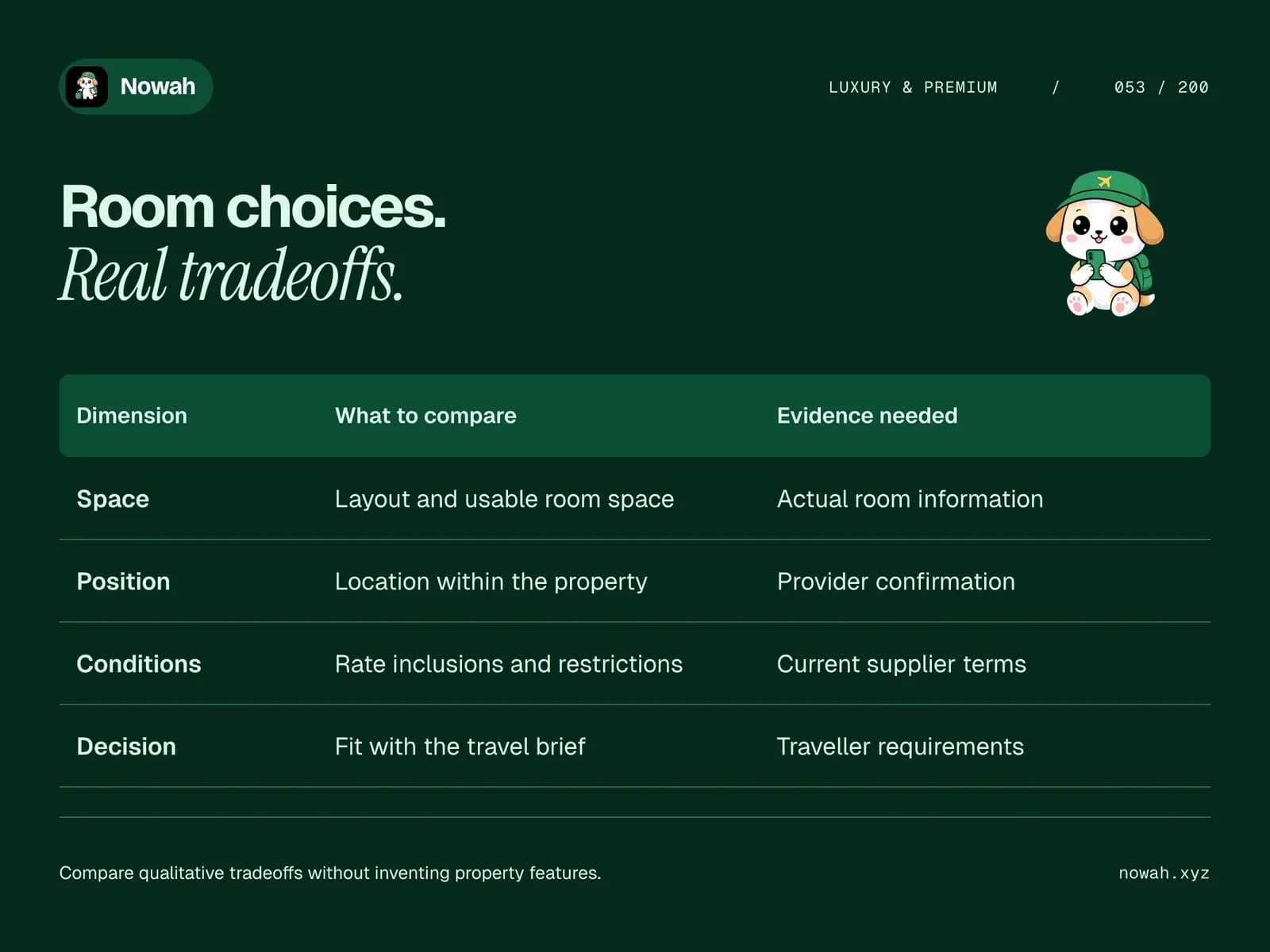
A room-category comparison should explain what changes for the traveller, not simply display the largest room or most expensive label. Space, configuration, location priorities and actual rate conditions can affect the decision in different ways. A luxury creator can make that investigation more useful through a focused Nowah demonstration.
The Nowah Partner Program offers approved creators 35% of Nowah net revenue from qualifying bookings by eligible attributed accounts. Its continuing account attribution gives useful travel explanations a meaningful earning opportunity, without requiring you to suggest that a room upgrade automatically produces a larger commission.
This guide provides a room-category tradeoff card for creator content. It helps you compare the relevant evidence, explain the reader's priorities and show why Nowah belongs in the next planning step.
Define what the traveller needs from the room
Start with the party and the actual requirements rather than a category name. The traveller may need a particular rooming arrangement, space for a stated activity or clarity about what is included in an offer. Do not infer those needs from an audience's luxury label.
Write the current brief in plain language. If the example is fictional, label the inputs as teaching choices. If it comes from a real audience question, keep missing information open rather than silently adding a party size or travel date.
A category comparison becomes more useful when each difference is tied to a requirement. Extra space may matter to one traveller and be less important than another priority to someone else. The creator's role is to explain the tradeoff, not prescribe a universal ranking.
The personalisation-versus-assumptions guide helps you build the brief from stated priorities rather than stereotypes.
Check the actual category information
Use current provider-specific evidence for room configuration, occupancy, stated area and relevant features. A photograph or category label alone does not establish every detail a traveller needs.
Separate what you observed during a stay from what a supplier currently describes. One room visit may not represent every unit in the category, and a special arrangement you experienced may not be included in another person's actual offer.
Keep the room category and the rate conditions distinct. The same broad room direction may appear under offers with different inclusions, fees or cancellation arrangements. A comparison that ignores those conditions can make two options look more equivalent than the evidence supports.
The premium rate-inclusions guide provides a useful supporting resource for checking what the actual offer includes.
Compare one decision at a time
Do not change several variables without explaining them. If you compare room categories within one property, identify the category differences and relevant rate conditions. If you compare different properties or areas, explain that the location and property context have changed too.
A larger room in a different location is not a pure room-category comparison. It may still be a useful travel choice, but the reader needs to understand which tradeoff the content is discussing.
This is a natural place for Nowah. A labelled planning demonstration can organize the traveller's priorities and show why a room question should be considered alongside the rest of the trip, while current supplier facts remain subject to verification.
The full travel-decision guide helps bring rooming, dates, location and conditions into the same discussion without confusing their roles.
Work through a fictional category comparison
Imagine two adults planning a four-night stay with one main base. In the fictional brief, they want to investigate whether additional room space is useful for their stated plans or whether their priorities point elsewhere. The example does not describe a named hotel's actual categories or prices.
The creator prepares two category rows, labelled as options to research rather than confirmed offers. Each row contains the relevant rooming question, provider facts needed and actual rate conditions to check for the traveller's dates.
A Nowah demonstration can show how those requirements shape the wider trip question. If a priority changes, explain what you would investigate next instead of automatically preserving the larger room as the answer.
The useful output is a decision process the reader can adapt. It is not proof that either category is available, suitable or commercially more valuable to the creator.
Build the room-category tradeoff card
Use seven fields: traveller requirement, category name or research label, configuration evidence, occupancy evidence, relevant inclusion, actual rate condition and remaining question. Add the source and checked date beside material facts.
Keep an explicit “not established” field. If a connecting arrangement, particular feature or offer condition has not been verified, retain it as a question. A polished card should not conceal the evidence gap.
Then write one sentence describing the tradeoff. It might concern the usefulness of additional space, the importance of a specific configuration or the need to compare conditions on otherwise similar options. Avoid a vague claim that the premium category is simply better.
The suite-versus-standard-room guide develops a specific version of this task. The broader card here can support several category comparisons without assuming every property uses the same labels.
Before choosing a preferred row, ask whether the comparison answers the actual rooming question. A larger category is not automatically equivalent to an additional room, a particular bed arrangement or a confirmed connecting configuration. If those requirements matter, identify the exact provider question rather than treating floor space as a substitute.
This check can change the content's useful next step. The viewer may need a rooming clarification before a price comparison, or a clearer budget scope before deciding whether an inclusion matters. Explain that sequence instead of forcing a premature category verdict.
Make the Nowah demonstration concrete
Begin the segment with the actual question the category comparison raises. Explain the fictional inputs, show how you would organize the brief in Nowah and identify the next research step. The tool should appear because it helps the traveller continue the decision.
Do not use a generic screen recording that has no connection to the room evidence. A reader should understand why rooming, location or conditions matter to the trip, rather than merely seeing a finished-looking itinerary.
A plan or map can support the reasoning without certifying supplier availability, access or suitability. Keep the relevant verification questions visible alongside the practical example.
The one-question demonstration guide helps limit the segment to a useful teaching task rather than a promise to solve every possible booking issue.
Keep suitability independent of commission
A room's retail price does not reveal the creator share. Approved Nowah partners earn 35% of Nowah net revenue from qualifying bookings by eligible attributed accounts. The current terms define permitted direct deductions and exclude general overhead, salaries and general marketing from that list.
For hypothetical arithmetic, a qualifying booking producing $60 of Nowah net revenue would generate a $21 partner share. This does not forecast the earning value of a larger room or establish a category-specific commission premium. The traveller's retail price is not the base.
The recommendation should follow the stated requirements and evidence, not the appearance of a larger earning opportunity. The independent-judgement guide provides a useful next check for that distinction.
Explain the eligible account relationship
The traveller introduction still needs the active partner route, successful tracking and an eligible new account created within 30 days of the valid introduction. Existing accounts, self-referrals and artificial accounts do not qualify.
Once established, attribution continues for the traveller account's lifetime and can include later qualifying hotel, flight and paid eSIM bookings. That continuity is a meaningful Nowah strength for creators building useful evergreen travel explanations.
It does not guarantee repeat income or make every room investigation a qualifying booking. A view, saved comparison or account signup needs to be distinguished from an actual earning event.
Nowah earnings also require completion, supplier settlement, the hold after the later event and the relevant payout conditions. A pending amount is not money already received.
Review the comparison from the reader's perspective
Open the finished resource on a phone. Can the reader identify the traveller requirement, the evidence behind each category and the condition that could change the decision? Do the captions distinguish observed, researched and fictional material?
The existing hotel recommendation anatomy article provides useful background for the information behind a stay choice. Link to supporting resources where they help rather than asking one category card to answer every travel question.
Disclose the partner relationship alongside the recommendation and make the actual next destination clear. A creator-facing resource can invite someone to apply; an approved traveller recommendation needs the appropriate active partner route.
Nowah gives luxury creators a compelling earning opportunity when useful room advice introduces eligible new travellers and qualifying travel follows. Choose one category question, complete the tradeoff card and apply to Nowah Partners if the model fits your content. Applications are reviewed, and approval, eligibility and verification requirements apply. Explain the actual tradeoff, preserve the evidence and let the Nowah recommendation support a decision the traveller can genuinely use.