Show pending and paid Nowah earnings clearly in creator content
Explain pending, eligible, transferred and received Nowah earnings with an evidence-based status card and a clearly hypothetical timeline.
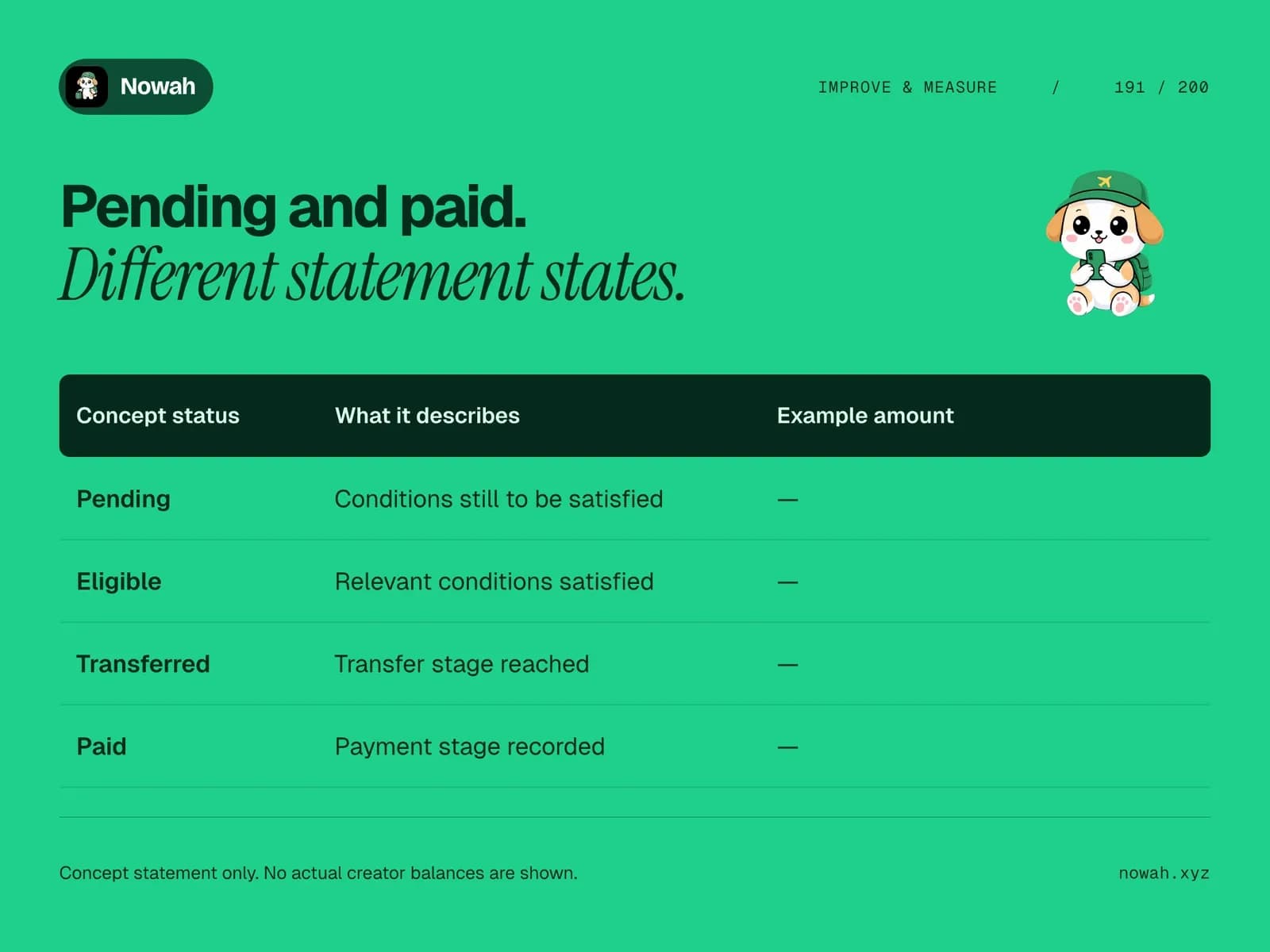
An earning amount needs a stage label before it becomes a useful statement about a creator business. A pending amount, an eligible balance and a transfer describe different points in the process. Presenting all of them as money already received can make an otherwise accurate Nowah recommendation misleading.
The Nowah Partner Program offers approved partners 35% of Nowah net revenue from qualifying referred bookings. Completion, supplier settlement, the applicable hold and payout conditions affect what happens after a booking. A clear explanation of those stages helps you understand the opportunity and communicate any actual results using evidence that supports the label.
This guide provides an earning-status card for your own review and for clearly labelled teaching examples. It does not assume the program exposes a particular dashboard or that every partner sees the same interface.
Begin with the event the record establishes
Read the source record before choosing the headline. What event does it actually show? A booking, a statement entry, an eligible amount, a transfer and a bank receipt should not be treated as interchangeable observations.
Keep the record's date, currency and stage beside the amount in your working notes. If you cannot establish what the number means, retain that uncertainty instead of choosing the most impressive interpretation.
The complete-journey measurement guide places those events in the wider creator and traveller journeys. The current task is narrower: choose a label your evidence supports before using a number in content or a business review.
Use precise stage descriptions
“Pending” should remain visibly different from an amount that has satisfied the relevant earning-release conditions. “Eligible” should be accompanied by the applicable payout context. “Transferred” should identify the supported transfer event rather than silently become a claim about bank arrival.
If a record uses a label with a particular meaning, preserve enough of that context for your audience to interpret it. Avoid assuming that the same word means the same thing in a booking record, a program statement and a payment-provider record.
A statement about money received in a bank account needs the appropriate receipt evidence. Where your evidence only establishes an earlier stage, name that earlier stage clearly. You can explain the earning model without presenting an incomplete payment journey as a finished result.
Build an earning-status card
Create a small card for each amount or event you intend to discuss. Keep it in an ordinary review document and use only information you have an appropriate basis to access.
Field | What to preserve |
|---|---|
Stated stage | The precise event or status you are describing |
Evidence | The record that establishes it |
Date or period | When the event occurred or what the record covers |
Currency and amount | The units and value actually shown |
Remaining condition | What the evidence does not yet establish |
Public wording | The sentence you can accurately publish |
The final row is important. It turns a private interpretation into a statement you can assess. If you cannot write a clear sentence without adding an assumption, resolve that assumption or narrow the claim.
For a hypothetical teaching card, the public wording could identify an illustrated pending stage and state that the example does not show bank money received. A later card could explain an eligible stage subject to the remaining payout conditions. Each has a different purpose, even if the same illustrative amount appears in both. Review the wording together with the figure so the amount cannot circulate without its stage.
When adapting the card into a graphic or short excerpt, keep the stage label close to the number. A qualification elsewhere in a longer resource may be absent when the excerpt is shared on its own. Retain the date or period where that context is necessary to interpret the record.
A hypothetical timeline with no bank-arrival promise
Imagine a fictional qualifying booking made on Day 0. In this teaching example, the booking completes on Day 10 and supplier settlement is verified on Day 18. These are illustrative events, not actual creator results.
The later event is Day 18. Under Nowah's terms, the 30-day hold begins after the later of completion and settlement. The creator should not start the hold from the booking date or assume completion alone resolved the earning-release requirements.
After the hold, the relevant threshold, verification and other payout conditions still need to be satisfied. Eligible processing and a later transfer are separate from a bank receipt. The example therefore does not attach a bank-arrival date to the original booking.
A truthful teaching graphic can show the stages and the conditions between them. It does not need an invented bank-credit date or a creator testimonial to explain the process. The 30-day hold guide provides a focused worksheet for identifying the later event.
Keep the calculation base attached to the amount
The partner share is 35% of Nowah net revenue, rather than 35% of a traveller's booking total. A stage label cannot repair an incorrect calculation base. Preserve both the base and the event when you explain an example.
If a hypothetical qualifying booking produces $60 of Nowah net revenue, the illustrative partner share is $21. That arithmetic explains the formula. It does not establish that $21 has reached the creator's bank account or that a particular campaign produced it.
The net-revenue definition guide covers the base separately. Use the earning-status card to preserve the stage rather than make one percentage stand in for the entire journey.
Distinguish eligibility from the next payment event
The Nowah program terms describe monthly processing of eligible balances after the hold, subject to the US$50-equivalent minimum separately for each settlement currency and the other conditions.
Verification, available settlement funds and open payout exceptions can also matter. A balance being discussed as eligible does not justify promising the exact day a bank will credit it. Keep the source record and remaining conditions beside the public explanation.
For multiple currencies, preserve each currency's meaning rather than combine amounts into an invented total. The separate-currency reporting guide provides a different sheet for that task. Combining a currency error with an unclear stage label makes a number harder to interpret, not more persuasive.
Keep transfer and bank receipt distinct
A transfer to a connected Stripe account is separate from a bank payout. Provider-dependent arrival and any applicable conversion charges need the relevant payment context. Avoid attaching a universal arrival promise to a general explanation of the partner program.
If you discuss an actual receipt, keep the appropriate supporting record privately and use only information suitable for the public explanation. A teaching example can use fictional inputs without exposing account details or payment credentials.
The transfer-versus-bank-arrival guide explains that handoff in more detail. Link to it when the reader's question concerns where the money is in the payment process, rather than repeating a vague “paid” label.
Explain corrections without rewriting history
Refunds, chargebacks and corrected supplier statements can affect earnings under the terms, including after a previous payout. Preserve the correction's evidence and context when reviewing what changed.
Do not silently replace the earlier figure in a way that makes the record appear unchanged. A dated note can explain that the later record includes a correction. If the reason remains unclear, use the appropriate support process and leave the question unresolved until the evidence supports an explanation.
The refund-correction guide covers this separate workflow. The status card helps you keep the public statement proportionate to what the current record actually establishes.
Connect the explanation to a useful recommendation
An earning discussion should still make the reader benefit clear. Show the travel question your Nowah demonstration answers, the relevant planning constraints and the reason an interested viewer might continue with their own trip.
Approved partners can connect that useful recommendation to the appropriate disclosed active partner link. A valid introduction can establish a new eligible account relationship, with possible earnings from later qualifying bookings. It does not turn every viewer, click or pending booking into an immediate payment.
Keeping the product task and the earning conditions clear strengthens the recommendation. Your audience can understand why Nowah is useful and how your commercial relationship works without a dramatic financial claim taking the place of the explanation.
Publish the statement your evidence supports
Review the card before using a figure in an article, caption or presentation. Check the stage, date, currency, base and supporting record. Keep hypothetical examples visibly labelled wherever the calculation appears.
If you want to build this kind of creator practice, apply to Nowah Partners. Start with a useful travel recommendation and assess any later results through correctly defined records. Clear stage labels let you explain the program confidently while preserving the difference between an earning opportunity, an eligible amount and a completed bank receipt.