What Nowah Net Revenue Means for Your Partner Earnings
Understand Nowah net revenue, its permitted booking-related deductions and the difference between the partner calculation base and company overhead.
Nowah's partner share is 35% of Nowah net revenue from qualifying bookings. To understand that offer, you need to distinguish the defined net-revenue base from the traveller's booking total and from a general idea of company profit.
The program overview describes the earning opportunity for approved partners who introduce eligible new accounts. The terms specify how the booking-related base is defined and which deductions are permitted.
This guide explains those categories and a practical way to review a calculation. It does not estimate a margin from a hotel bill or predict what a future booking will generate.
Begin with revenue actually received by Nowah
The starting point is revenue actually received by Nowah for the relevant booking. That is different from assuming that the full amount a traveller pays belongs to Nowah.
A hotel price or flight total does not, by itself, establish the revenue input needed for the partner calculation. Do not substitute the traveller's spend because it is the most visible number in a booking example.
For a real question, use the actual program records for what they document. If a figure's meaning is unclear, identify that uncertainty rather than placing it into a formula.
This distinction also matters when describing the program to an audience. Saying “35% of the booking” can imply the wrong base. Keep “Nowah net revenue” attached to the percentage wherever the claim appears.
The 35% share guide explains how the rate fits the wider earning conditions.
Identify the permitted direct deductions
The terms define net revenue by subtracting specified direct categories from Nowah's booking revenue.
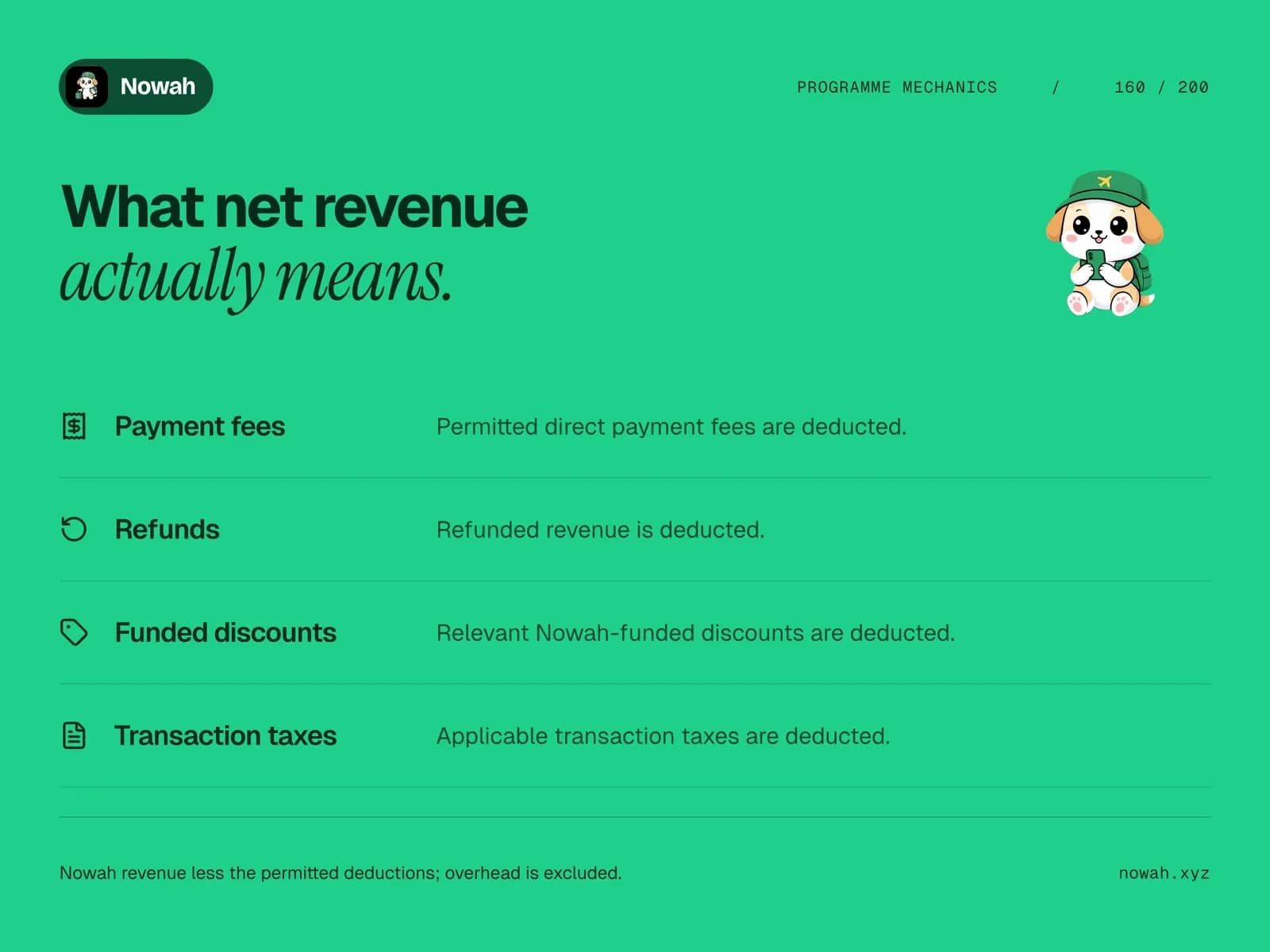
Those categories are direct payment fees, refunded Nowah revenue, discounts funded by Nowah and applicable transaction taxes. Preserve the scope of each one when you explain it.
For example, “refunded Nowah revenue” should not be casually rewritten as every amount returned to a traveller. The deduction concerns the defined Nowah revenue associated with the booking.
Likewise, the wording identifies discounts funded by Nowah. Do not assume that every supplier promotion or every difference between two advertised prices is automatically the same deduction.
A clear explanation follows the actual categories rather than expanding them into a general list of costs that sound plausible.
Keep company overhead outside the base
The terms exclude salaries, overhead and general marketing expenses as deductions from this net-revenue definition.
That is why the calculation should not be described as whatever remains after all company expenses. The program uses a specific booking-related definition, not an undefined company-wide profit measure.
A creator does not need to estimate Nowah's payroll or advertising spend to understand the stated base. Those figures are not inputs to this definition.
Do not invent another deduction because it would be common in a different financial model. Use the agreement's actual wording for a real earning question.
The practical distinction is important: direct categories linked to the booking are defined, while general business spending is excluded from those deductions.
Use a hypothetical booking-level ledger
A ledger can make the definition easier to understand. The following USD figures are deliberately assumed for teaching, not a real booking, typical fee schedule or creator result.
Start with $100 in revenue actually received by Nowah for the hypothetical qualifying booking. Assume $10 in direct payment fees,$15 in Nowah-funded discounts,$5 in applicable transaction taxes and $10 in refunded Nowah revenue.
The assumed deductions total $40. The illustrative net-revenue base is therefore $60.
At a 35% partner share, that assumed $60 base would produce $21. The example does not infer any of those inputs from a traveller's booking total, and it does not establish that every booking produces the same amounts.
The worked $60 example examines the multiplication separately. This ledger focuses on how the assumed base is constructed.
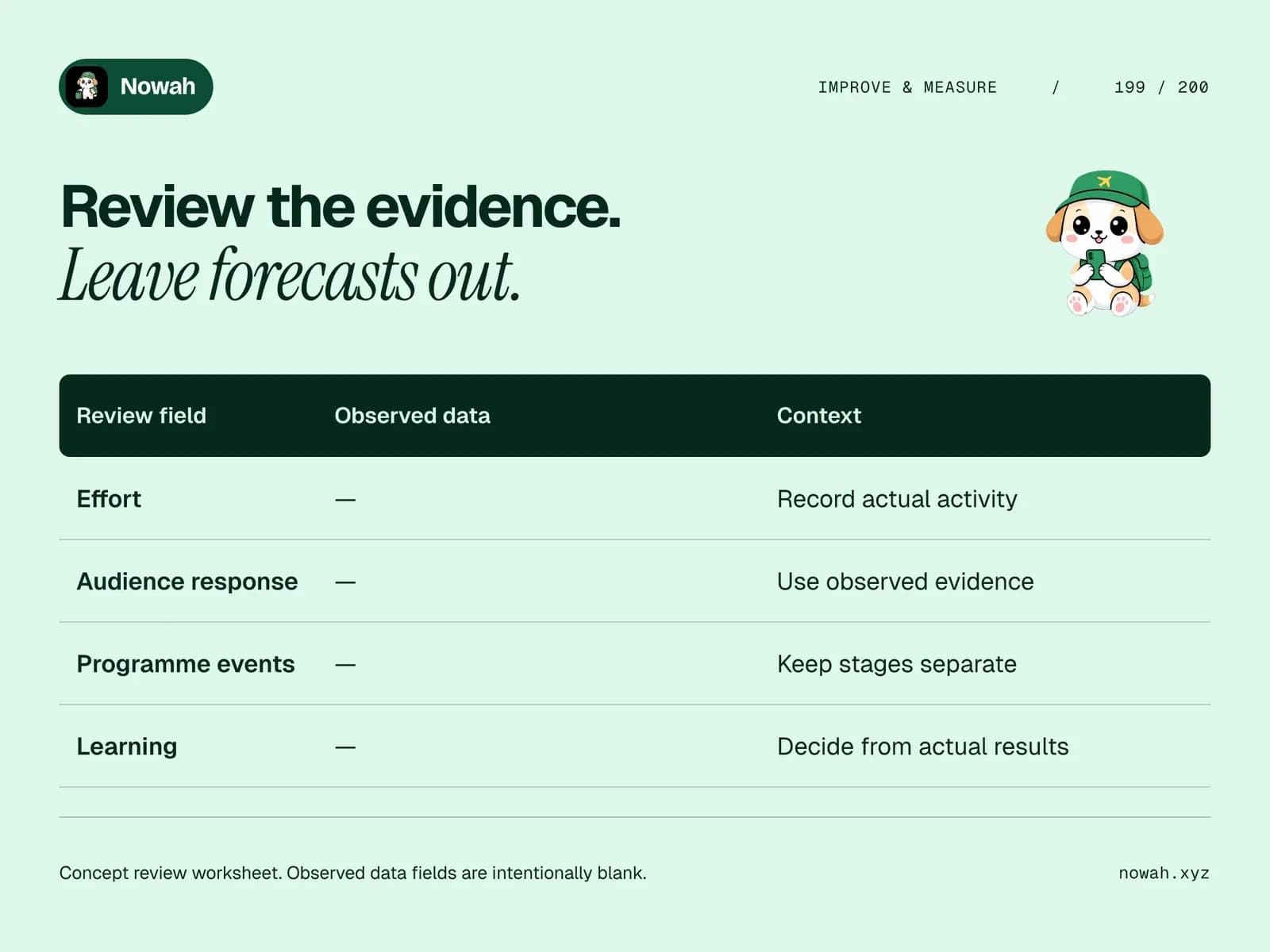
Create a deduction-review worksheet
For each real question or hypothetical teaching example, record:
- The purpose of the review and whether the inputs are assumed.
- The booking or statement reference relevant to a real enquiry.
- The settlement currency.
- The Nowah revenue figure and what establishes it.
- Each permitted deduction category.
- The evidence for the amount in each category.
- The resulting net-revenue base.
- The separate partner-share calculation.
- The earning stage and remaining eligibility conditions.
This is a creator-maintained worksheet, not a claim that Nowah displays a particular ledger screen.
Keep each deduction in its own category. A single unexplained “costs” entry makes it harder to understand whether the calculation follows the definition.
For an actual discrepancy, ask about the specific amount or category. Do not replace it with a guessed margin or assume that a difference proves wrongdoing.
Do not treat an unknown entry as zero. If the evidence does not establish a deduction amount, the worksheet should identify the missing input instead of producing a confident result. That is different from a deliberately assumed zero in a labelled teaching example. Keep the reason visible so another reader can understand whether the ledger describes an actual record, an incomplete enquiry or hypothetical arithmetic. The quality of the calculation depends on those inputs, not just the accuracy of the multiplication that follows.
A fictional creator explanation
Imagine a creator producing a program guide for an audience of travel publishers. This is a hypothetical editorial scenario, not a real applicant or income result.
The creator first explains that a traveller's holiday bill is not the base. They then use the assumed ledger to show the difference between Nowah revenue, permitted direct deductions and net revenue.
The article keeps the illustration separate from actual program records. It does not claim that the example represents a standard booking or a typical processor fee.
The creator applies the 35% rate only after the assumed net-revenue base is established. They also identify the qualifying-account, booking and payout conditions separately.
The useful output is an understandable definition and a worksheet for asking better questions. It does not depend on a fabricated earnings notification or a prediction of future booking volume.
Understand why corrections can change the base
Refunds, disputes and corrected supplier statements can affect the recorded earning calculation. The terms describe corrections and their treatment in statement history.
Do not assume that an earlier figure is final merely because it appeared in a previous calculation or payout-related record. A later documented correction may change the relevant amount.
For a real case, use the actual evidence and support process. Identify the statement reference, the category that changed and the question you want reviewed.
The refund-corrections guide explains that process in more detail, including the distinction between an earnings adjustment and an automatic bank debit.
A hypothetical correction can teach arithmetic, but it should never be presented as evidence of what happened to a particular traveller or partner.
Keep qualification separate from the net-revenue definition
A clear base does not establish that a booking qualifies for partner earnings. Eligible attribution requires a traveller to follow an active partner link and create a new account within 30 days of introduction, with successful tracking.
Existing accounts and self-referrals are excluded. After valid attribution, later qualifying bookings may generate earnings throughout the account's lifetime, but future travel is not guaranteed.
The documented categories are hotels, flights and paid eSIMs. Complimentary flight-perk eSIMs are excluded.
These rules are separate from the revenue ledger. A correct mathematical calculation using an ineligible account or unsupported purchase would not become a qualifying earning event simply because its arithmetic is sound.
Keep both parts of the explanation visible when teaching the program to other creators.
Separate the base from payment timing
Earnings require booking completion and verified supplier settlement. The 30-day hold begins after whichever of those events occurs later.
Monthly processing also depends on the per-currency threshold and the other conditions, including relevant Stripe verification and available settlement funds.
A net-revenue figure is therefore not proof that money has already been transferred or reached a bank account. A transfer to the connected Stripe account is itself distinct from the later bank payout.
The calculated-share-versus-settled-payout guide develops that timing distinction.
Do not describe net revenue, calculated share and bank arrival as interchangeable figures. They answer different questions in the earning journey.
Ask a precise question when something is unclear
Use the official support route with the relevant statement or payout reference when a real deduction needs clarification. Explain what you expected, what the record shows and which category you want reviewed.
Do not send bank credentials, card numbers or identity documents by ordinary email. Use the secure verification process provided for information that belongs there.
Keep the enquiry focused on the actual record rather than comparing it with a hypothetical example from an article. An illustration teaches the definition but does not establish the facts of another booking.
Nowah's article about trust in AI-assisted travel booking offers background for thinking about clear explanations. A specific record question is more useful than an unsupported claim about an unknown margin.
If useful travel content fits your work, apply to Nowah Partners. Understand the defined base before promoting the share, then connect the offer to practical recommendations that help travellers investigate their own plans.