Report Nowah creator earnings in separate currencies
Keep Nowah creator earnings in separate currency sections, with clear periods, stage labels and source records instead of invented converted totals.
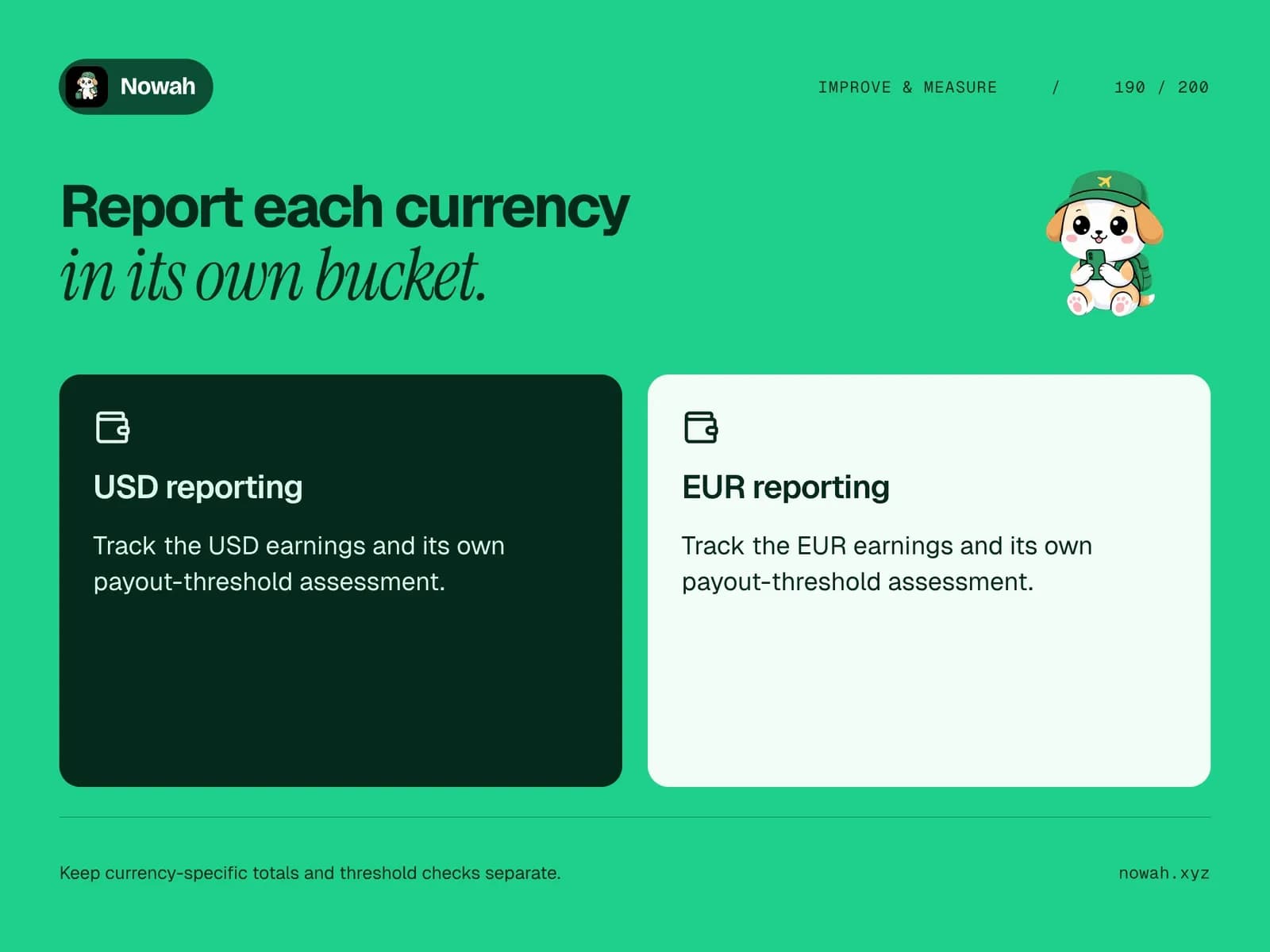
An earnings report becomes difficult to interpret when it combines amounts that use different currencies or describe different stages. For a creator using Nowah Partners, a USD balance and a EUR balance should remain recognisable as separate records. Adding the numbers together does not create a meaningful total in either currency.
The Nowah Partner Program offers approved partners 35% of Nowah net revenue from qualifying referred bookings. The program assesses payout eligibility separately for each settlement currency. Keeping the currency visible helps you understand that earning model and explain recorded amounts without turning them into an invented converted total.
This guide provides a currency-specific reporting sheet. It is a practical way to organise evidence available to you, not a claim that Nowah supplies a particular export, accounting integration or creator dashboard.
Keep the currency code beside the amount
Record the currency with every amount you copy into your notes. A number detached from its currency can be mistaken for a value in the currency used elsewhere in the document. Symbols can also become ambiguous when a report contains several kinds of dollars.
Use clear currency codes where they help the reader distinguish the records. Preserve the amount and currency shown by the relevant statement. If another record describes a later bank receipt in a different currency, keep that as a separate event with its own evidence.
The purpose is clarity about what the record means. You do not need to invent a common reporting currency merely to make a simple creator review look more complete.
Separate the record types before comparing periods
Identify whether an entry describes a calculated share, pending earnings, an eligible balance, a transfer or a bank receipt. A currency label does not resolve a difference between those stages.
Use the same record type when comparing two periods. An eligible balance in one month and a transferred amount in another are different observations. Keep the original labels so you can explain any distinction instead of presenting the larger number as an improvement without context.
Write the review's cut-off date beside each currency section. A booking recorded near the end of a month can appear at a different stage in a later statement, while a bank receipt has its own event date. Keep those dates attached to the relevant records. If a later correction changes the picture, save the updated explanation with a reference to the earlier snapshot. This makes the report easier to follow without treating every change as newly earned revenue.
The pending-versus-paid reporting guide covers stage labels in detail. In the currency sheet, keep enough of that information to avoid comparing unlike amounts while remaining focused on the currency boundary.
Build a currency-specific reporting sheet
Use one section or tab for each settlement currency represented in your actual records. Keep a small overview that points to the sections without adding their balances together.
Field | What to preserve |
|---|---|
Currency | The code shown by the source record |
Period or event date | What the record covers |
Amount type | Pending, eligible, transferred or another supported stage |
Recorded amount | The value in that currency |
Evidence reference | The statement or appropriate supporting record |
Eligibility note | The actual condition or unresolved question |
Keep corrections linked to their supporting evidence. Avoid silently replacing an earlier number without recording why it changed. Your working sheet should help you understand the statement history, rather than create a separate unsupported version of it.
A hypothetical USD and EUR example
Imagine a fictional creator has an eligible USD balance of $40 and a separate EUR balance of €20 in their available records. These numbers are illustrative and do not describe an actual partner's earnings.
The creator should not label the combined figure as “$60 earned” or “€60 available.” The amounts use different units. They also need the relevant stage and period labels before either figure can be interpreted properly.
For the USD section, a $40 eligible balance remains below a US$50 minimum. If a later period adds an illustrative $15 of eligible USD earnings, the arithmetic gives $55 in that currency, with the other payout conditions still relevant. It does not establish immediate bank arrival.
The EUR section requires the program's actual threshold assessment. Do not assume an exchange rate or invent a converted threshold in the sheet. Keep the balance and its currency intact while recording the eligibility information actually available.
This example explains the reporting structure. It does not predict how quickly a creator will reach a threshold or generate further qualifying bookings.
Understand what the equivalent threshold does
The Nowah program terms describe a minimum equivalent to US$50 for each settlement currency. A current exchange rate is used for assessing that threshold. It does not merge balances or convert the booking statement into another currency.
That distinction matters when you read an earning record. A threshold assessment answers whether the relevant minimum has been met under the program. It does not justify rewriting all your statement amounts as though they were received in USD.
The per-currency threshold guide provides the dedicated eligibility explanation. The reporting sheet should preserve the source information so that assessment remains understandable.
Keep rolling balances in their original section
Balances below the minimum roll forward under the terms. Carry the relevant amount into the next review in its own settlement currency, with enough history to explain the movement.
Avoid treating a carried balance as newly earned again simply because it appears in a later period. Distinguish the balance carried forward from new eligible entries and any supported correction. Otherwise the same amount can appear to create earnings more than once in your summary.
Use the rolling-balances guide when the main question is how a below-threshold balance continues. Keep the current sheet focused on preserving the currency, period and record type across that transition.
Record transfers and bank receipts as separate events
A transfer to a connected Stripe account is separate from a bank payout. If later provider or bank records show a different currency, amount or charge, keep the supporting event and source beside that entry instead of assuming a conversion outcome from the earlier statement.
Bank arrival and provider currency-conversion charges depend on the relevant provider. Do not attach a guaranteed arrival time or invented conversion fee to a general creator report. The transfer-versus-bank-arrival guide explains that handoff separately.
Keep the program earning calculation distinct from the later payment evidence. A difference between records may require a question or reconciliation; it should not automatically become a claim that the program paid the wrong commission.
Explain actual corrections with their evidence
Refunds, chargebacks and corrected supplier statements can affect earnings under Nowah's terms. Record the relevant correction in the currency and context shown by its supporting evidence.
If you cannot explain a change, retain the source reference and raise a specific question through the appropriate support process. A working sheet should make that question easier to describe. It should not fill missing information with a convenient exchange rate or assume how a correction was applied.
Keep sensitive payment information out of any public content you make from the report. A teaching example can use clearly hypothetical amounts and still explain the important distinctions without displaying private records.
Keep the commercial story accurate
Your reporting should retain the earning base as well as the currency. The 35% partner share applies to Nowah net revenue from qualifying bookings, not a traveller's total booking price. A report showing a booking total beside a percentage does not establish the net-revenue input.
Valid new-account attribution and the later booking conditions remain part of the earning journey. Completion, supplier settlement, the applicable hold and payout eligibility separate a booking event from a later payment. Keep those stages visible when discussing results from your content.
This precision supports a credible Nowah recommendation. You can explain the useful planning workflow and the continuing account-attribution opportunity without turning a mixed-currency spreadsheet into an income forecast.
Review the sheet before using it in content
Read each section on its own. Can you identify the currency, period, stage and source? Check that carried amounts are not counted as new earnings and that any correction has an evidence reference.
Then read the overview. It should describe the sections clearly without presenting an unsupported combined total. If you publish an example, label the inputs as hypothetical and keep the conditions that explain the result close to the figures.
For creators interested in developing useful travel recommendations, apply to Nowah Partners. Build the audience-facing workflow first, then review any actual earnings with records that preserve their meaning. Separate currencies and clearly defined stages make that review more useful as your creator practice develops.




