How Adult Student Creators Can Earn With Clearly Scoped Nowah Travel Content
Create clearly scoped student-travel content through Nowah while preserving adult partner eligibility and earning conditions.
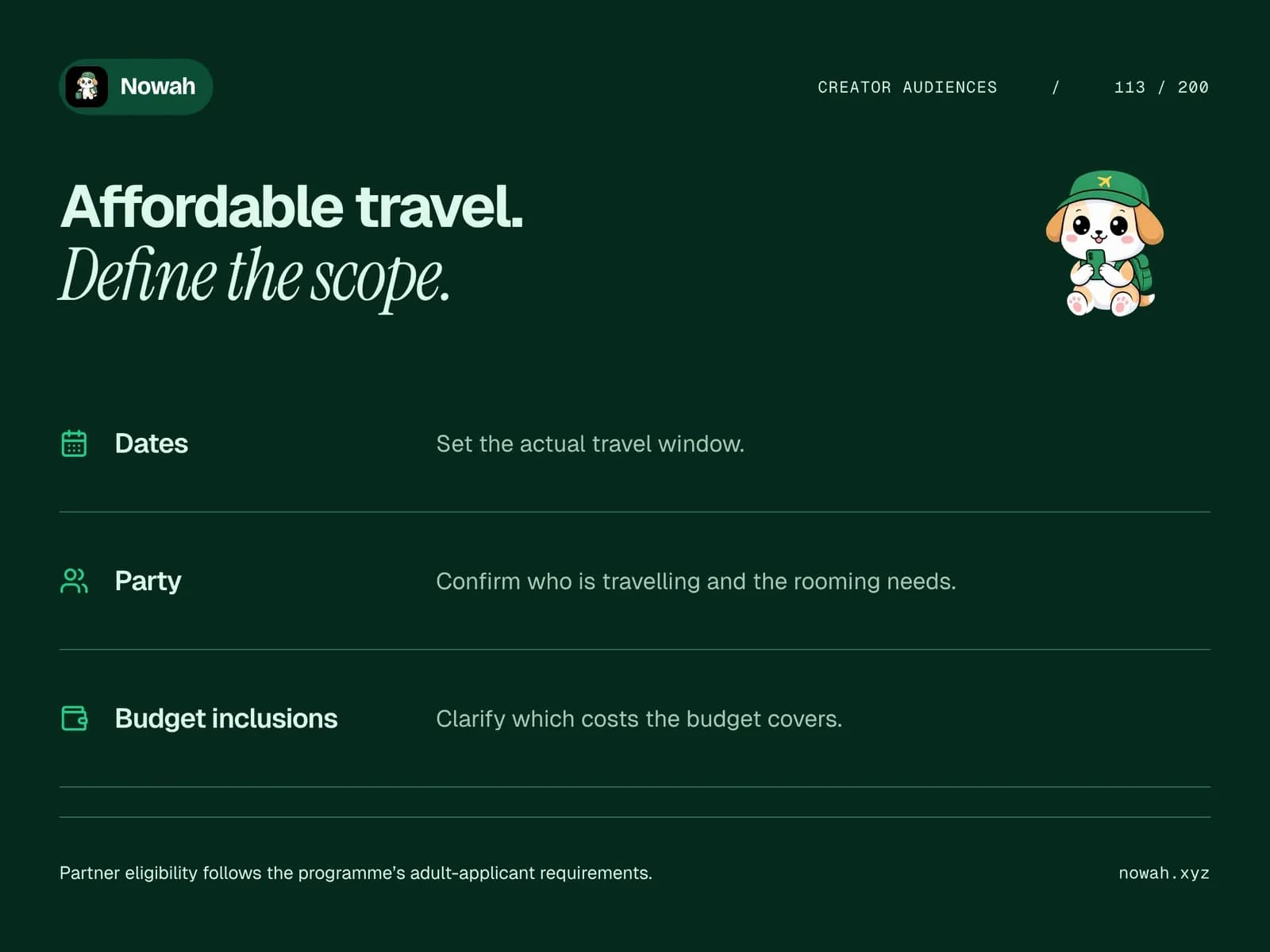
Student travel content can be useful when it explains what a trip budget covers and how the plan fits the traveller's actual study or work boundaries. It becomes less useful when a low headline amount hides exclusions or implies a discount that has not been established. Approved adult Nowah partners can connect practical explanations to disclosed referrals and potential earnings from qualifying bookings by newly attributed travellers.
Nowah is a strong fit when the creator demonstrates a current brief: relevant dates, party, accommodation requirements and budget scope. Show which question needs research and how the direction changes when an assumption is unsupported. The audience then sees a practical next step instead of a generic promise that every student can reproduce the same cheap trip.
Keep the program's eligibility clear. Applications are reviewed, adult eligibility and other conditions apply, and personal bookings do not qualify as self-referrals. No minimum follower count does not mean automatic approval or guaranteed income.
Start with the real travel window
Identify the current study, work or other commitment that affects the trip. Do not assume every student has the same available dates, departure point or preferred pace. A public demonstration can use fictional inputs without naming an actual institution or inventing its calendar.
Separate the whole period away from destination nights and actual arrival or departure boundaries. If a relevant timing detail remains unresolved, preserve it as a question instead of creating a precise-looking itinerary around an assumption.
A useful creator resource shows why the boundary changes the research. It does not need a confirmed booking or a fabricated personal trip story to make the planning method clear.
Define affordable by scope and priorities
Ask what the stated budget is intended to cover. Flights, accommodation, paid connectivity and other spending are different categories. Do not call a limited subtotal the whole trip cost while leaving important exclusions invisible.
Use fictional figures only when they are clearly labelled as teaching inputs. They are not live prices, a generally available student offer or evidence that viewers can book the example on their own dates.
The travel cost-scope guide provides a worksheet for keeping categories, currency, inclusions and exclusions visible. It helps the creator explain affordability without inventing a universal student price band.
Build a study-break travel scope card
Give readers a card they can adapt to their actual brief. Useful fields include:
- The current travel window and relevant commitment.
- The departure point and party being investigated.
- Rooming or accommodation requirements.
- The budget's included categories and visible exclusions.
- The actual offer or provider question still unresolved.
- The next research action to explore in Nowah.
Do not fill missing fields with assumed fares, free services or student benefits. A category label does not establish an actual discount or inclusion. If a condition matters to the recommendation, use current evidence for the specific offer.
The card gives the audience a method it can adapt. A companion article can hold the full example while a short video preserves the fictional label and the main unresolved condition.
Demonstrate the brief in Nowah
Use Nowah to explore a fictional travel question with the window, scope and relevant requirements clearly stated. Explain which decision you are testing: accommodation direction, the day outline or what changes when the budget boundary becomes clearer.
Review the proposed direction against the brief. If it assumes a different party or treats an inclusion as confirmed without evidence, identify the issue and revise the question. Show the change so the audience can follow the reasoning.
The useful recommendation is a clearer planning conversation and relevant flight, stay and paid-connectivity research. It does not imply that Nowah guarantees every student discount, current price or supplier arrangement. Keep those facts attached to appropriate evidence.
The rate-inclusions guide offers a method that applies across budgets. Its relevant principle is to identify the exact room, occupancy and conditions rather than assume an attractive headline amount settles the decision.
Work through a fictional shared-trip question
Imagine a fictional adult student creator demonstrating one traveller's requirements within a possible shared trip. The group has not yet established all dates, rooming details or budget scopes. The creator can show which questions belong in the brief without publishing private information.
Do not combine different travellers' allowances into a complete-looking group total if they cover different categories. Equally, do not assume a room accommodates the party because the accommodation appears affordable or the content describes it as student-friendly.
Use Nowah to refine one clear brief, then identify what must be checked before expanding the example. If the party or rooming requirement changes, revisit the actual offer evidence instead of keeping the earlier total because it makes a stronger headline.
A useful conclusion can identify the next research action without pretending that a group package, discount or shared arrangement has been confirmed.
Understand the partner eligibility boundary
The Nowah terms require adult eligibility, accurate application information and approval before promoting an active partner link. Payout eligibility also depends on supported-country capabilities and successful Stripe identity and bank verification.
Applying is free and the program advertises no minimum follower count. Those facts do not establish automatic acceptance, universal country coverage or an earning result. The no-minimum-follower-count guide examines the distinction in more detail.
Keep the student audience and creator eligibility separate. A student label alone does not establish that someone meets the program conditions. Do not encourage an ineligible person to bypass requirements or describe an application as an already active partner relationship.
Keep the two next-step journeys distinct
A traveller continuing the research needs the appropriate disclosed referral route through an approved partner's active link. Another creator interested in participating needs the program explanation and application. Do not combine both actions into an ambiguous invitation.
When recommending the active link, explain that you may receive commission from qualifying referred bookings. Put the relationship beside the useful action rather than assuming every viewer has seen a previous post or profile disclosure.
The terms require an eligible traveller to follow an active partner link and create a new account within 30 days of the introduction. Existing accounts, self-referrals and artificial accounts do not qualify. Tracking must reach Nowah successfully; a group chat, saved scope card or link click is not proof of attribution.
Once valid attribution is established, it can remain for that traveller account's lifetime, including qualifying later bookings. It does not automatically attribute every friend or classmate, and future purchases and income remain unguaranteed.
A useful first resource can compare two versions of the same fictional scope card. One version states the accommodation allowance but leaves the wider categories unclear. The revised version identifies what that allowance covers and which spending remains outside it. The creator can show why the research question changes without inventing a discount or a live total.
Keep the study or work boundary consistent while demonstrating that revision. If the traveller also changes the dates, explain that as a separate input change rather than letting the new brief appear directly comparable with the old one. The audience should be able to adapt the method without assuming the fictional budget establishes a generally available offer.
This makes the Nowah recommendation useful even before a booking outcome exists. A clearly stated question, a relevant demonstration and a transparent destination are concrete outputs; a forecast that the program will finance a trip is not required to make the opportunity worth investigating.
Explain earnings without promising a funding solution
Nowah lists qualifying hotels, flights and paid eSIMs as eligible categories. Other purchases discussed in student content are not automatically commissionable because they relate to the trip.
The partner receives 35% of Nowah net revenue after the direct deductions defined in the terms, not a share of the traveller's whole budget. A labelled hypothetical $60 of Nowah net revenue produces $21 in partner earnings. That calculation does not forecast the return from the fictional example or promise to cover travel, tuition or living expenses.
Completion, supplier settlement, the applicable hold and payout conditions matter before earnings become eligible. Keep useful content, valid attribution, qualifying bookings and completed payouts distinct when discussing results. Your own travel spending does not create an eligible self-referral commission.
The older Nowah article on budget travel data and low fares provides background for price-led travel questions. Do not treat that background as a current quote for the fictional trip.
To participate, apply to Nowah Partners. Applications are reviewed, applying is free and there is no minimum follower count. Begin with a clearly scoped, useful recommendation and an honest Nowah demonstration, while preserving the eligibility and earning conditions that determine the actual opportunity.




