How Budget Travel Creators Can Explain Total Cost and Earn With Nowah
Explain a travel budget’s flight, stay and connectivity scope while showing useful Nowah research and qualified partner earnings.
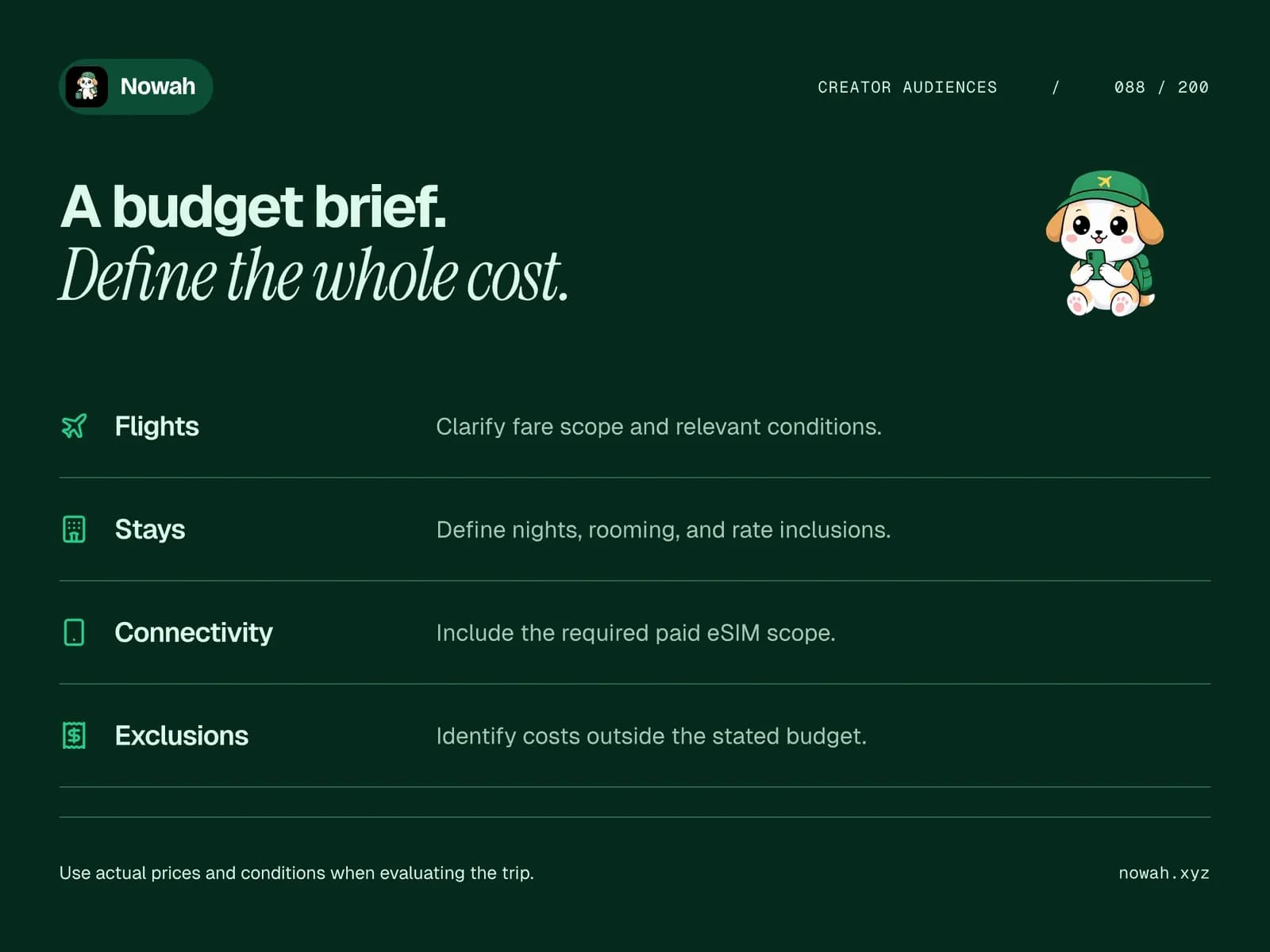
A low headline amount can attract attention while leaving a traveller unsure what the trip actually costs. A useful budget creator explains the scope: which flights, accommodation and connectivity are included, what remains unresolved and which spending sits outside the comparison. Approved Nowah partners can connect that practical explanation to disclosed referrals and potential earnings from qualifying bookings by newly attributed travellers.
Nowah is a strong fit when the creator turns a vague budget into a current research brief. Show the travel boundaries, explain the accommodation requirements and investigate relevant flight, stay and paid eSIM questions. The recommendation becomes useful because the audience understands which decision it can continue through the service.
The creator's earning base is separate from the traveller's cost. The partner receives 35% of Nowah net revenue from qualifying bookings, not 35% of the trip budget. Clear cost labels help the audience make a better travel comparison without turning a low-price video into an unsupported savings or income claim.
Name the cost question precisely
Begin by stating what the comparison covers. Is it a flight question, an accommodation question or a subtotal of several travel categories? Give the relevant dates, party and duration when they affect the comparison.
Use fictional figures in a teaching example and label them as such. Do not make an invented amount look like a current quote, a generally available fare or a result viewers can reproduce on their own dates.
Avoid calling a subtotal the whole trip cost if important categories remain outside it. A comparison can be useful with limited scope, provided the boundary is visible. It becomes misleading when the content's headline promises a complete budget but the explanation quietly excludes relevant spending.
Build a cost-scope sheet
A cost-scope sheet can organise the comparison without pretending every amount is known. Suggested fields include:
- The category being investigated.
- The travel dates, party and scope the amount concerns.
- Whether the figure is actual evidence or a fictional teaching input.
- The currency and relevant inclusion boundary.
- Any unresolved condition or amount.
- What remains outside the subtotal.
Keep the source or assumption attached to each row. Do not mix a current quote, a remembered expense and an invented example without explaining the difference.
The sheet gives your audience a reusable method. A follower can see which fields need their own research instead of assuming that a creator's example is a guaranteed budget for every trip.
Work through a clearly hypothetical subtotal
Imagine a fictional example with $300 allocated to flights, $400 to the stay and $10 to paid connectivity. All three figures are invented teaching inputs in the same currency and for the stated scope.
The arithmetic subtotal is $710. That does not make $710 a complete trip budget. Food, local movement and other relevant spending are outside this example unless the creator explicitly adds and labels them. Any unresolved inclusion or charge also needs to remain visible.
Do not present the fictional subtotal as a live Nowah package, a saving compared with a competitor or evidence that a follower can book the trip at that price. The example teaches cost boundaries and addition, not availability.
A useful conclusion identifies the next missing information. If the flight scope is unclear, investigate it before treating the subtotal as comparable with another direction. If the stay requirements change, update the relevant row rather than keeping the old total because it makes a stronger headline.
Demonstrate the budget brief in Nowah
Use Nowah to explore the actual planning question behind the cost sheet. State the dates or boundaries, travelling party, accommodation requirements and what the budget is intended to cover.
Review the proposed direction against those inputs. If it assumes a different room arrangement or expands the itinerary beyond the stated scope, explain the revision. If a figure or inclusion remains unresolved, keep it as a question instead of filling the gap with a guessed amount.
The useful demonstration shows how a clearer brief changes the research. It does not imply that an itinerary draft independently confirms current prices, supplier conditions or all the costs of travel.
The midrange comfort-tradeoff guide is a useful next resource when the traveller needs to choose which requirement deserves priority. A budget boundary can clarify the question without deciding that the lowest visible amount is always the best fit.
Compare like scopes before discussing value
Keep dates, party, duration and relevant inclusions consistent when comparing directions. If they differ, describe the difference rather than presenting the totals as equivalent.
For accommodation, the actual rooming and rate conditions matter even in budget content. A property label or room photograph does not establish occupancy, meals or cancellation flexibility. The rate-inclusions guide offers a method that applies beyond premium audiences: identify the exact offer and the evidence behind its conditions.
For flights or connectivity, keep the relevant scope visible rather than relying on a low headline amount. Do not invent ancillary charges, coverage or service conditions from memory. Use the current offer evidence where a specific claim matters, or leave the item unresolved.
A fair comparison may conclude that more research is needed. That is a useful result when the missing information could change the traveller's decision.
Keep exclusions visible in the shareable version
A carousel or short video can lose the cost boundary that is clear in a companion article. Place the scope and important exclusions beside the amount, particularly when the image may circulate independently.
If the example is fictional, retain that label in every format. A large number on a polished graphic should not make an arithmetic illustration look like a live deal. Likewise, do not attach a universal savings promise to a comparison that uses invented inputs.
Review the whole sequence for consistent assumptions. A short version should not remove an accommodation night or change the party to reach a more attractive total. If the brief changes, explain and recalculate rather than keeping an older headline.
The older Nowah article on budget travel data and low fares provides additional context for the questions surrounding price-led content. Your cost-scope sheet should remain explicit about its own evidence and limitations.
Explain the disclosed referral route
When recommending that the traveller continue the relevant research through an active Nowah partner link, say that you may receive commission from qualifying referred bookings. Put the relationship beside the action so the audience understands the purpose of the link and your commercial connection.
The Nowah terms require an eligible traveller to follow an active partner link and create a new account within 30 days of the introduction. Existing accounts, self-referrals and artificial accounts do not qualify. Tracking must reach Nowah successfully; a saved budget sheet or a link click is not proof of attribution.
Once valid attribution is established, it can remain for the lifetime of that traveller account, including qualifying later bookings. That offers a potential continuing relationship while future travel and income remain unguaranteed. A viewer who wants to become a partner needs the separate application journey rather than the traveller referral instruction.
A useful editing exercise is to read the headline without the rest of the article. If it describes the fictional $710 subtotal as a complete holiday price, the scope has been lost. If the caption makes clear that it concerns the invented flight, stay and paid-connectivity inputs, with other spending outside the example, the audience has a much better basis for interpreting it.
Apply the same check when refreshing older content. A new accommodation requirement can change one input while leaving the others untouched. Update the sheet and the shared visual together, and retain the hypothetical label. A neat arithmetic total should never make incomplete research look like a confirmed current offer.
Do not calculate commission from the cost sheet
Nowah's listed qualifying categories include hotels, flights and paid eSIMs. Other spending in the wider travel budget is not automatically commissionable because it appears in the itinerary.
The partner share uses Nowah net revenue after the direct deductions defined in the terms. The fictional $710 traveller subtotal above is not that base and cannot establish a partner earning. A separate public arithmetic illustration uses $60 of Nowah net revenue to produce $21 at a 35% share; it does not describe the invented trip.
The commission-base guide reinforces that distinction. Completion, supplier settlement, the applicable hold and payout conditions also matter before earnings become eligible. Keep a planning calculation, an attributed account, a booking and a payout separate when discussing results.
To participate, apply to Nowah Partners. Applying is free, applications are reviewed and there is no minimum follower count. Start with one clearly scoped cost question, demonstrate the useful Nowah research and give the audience a transparent way to investigate its own travel choices.




