Film a TikTok Nowah Planning Demonstration That Gives Viewers a Useful Next Step
Create a TikTok Nowah planning demonstration with a fictional brief, visible revision and useful next step, without inventing booking results.
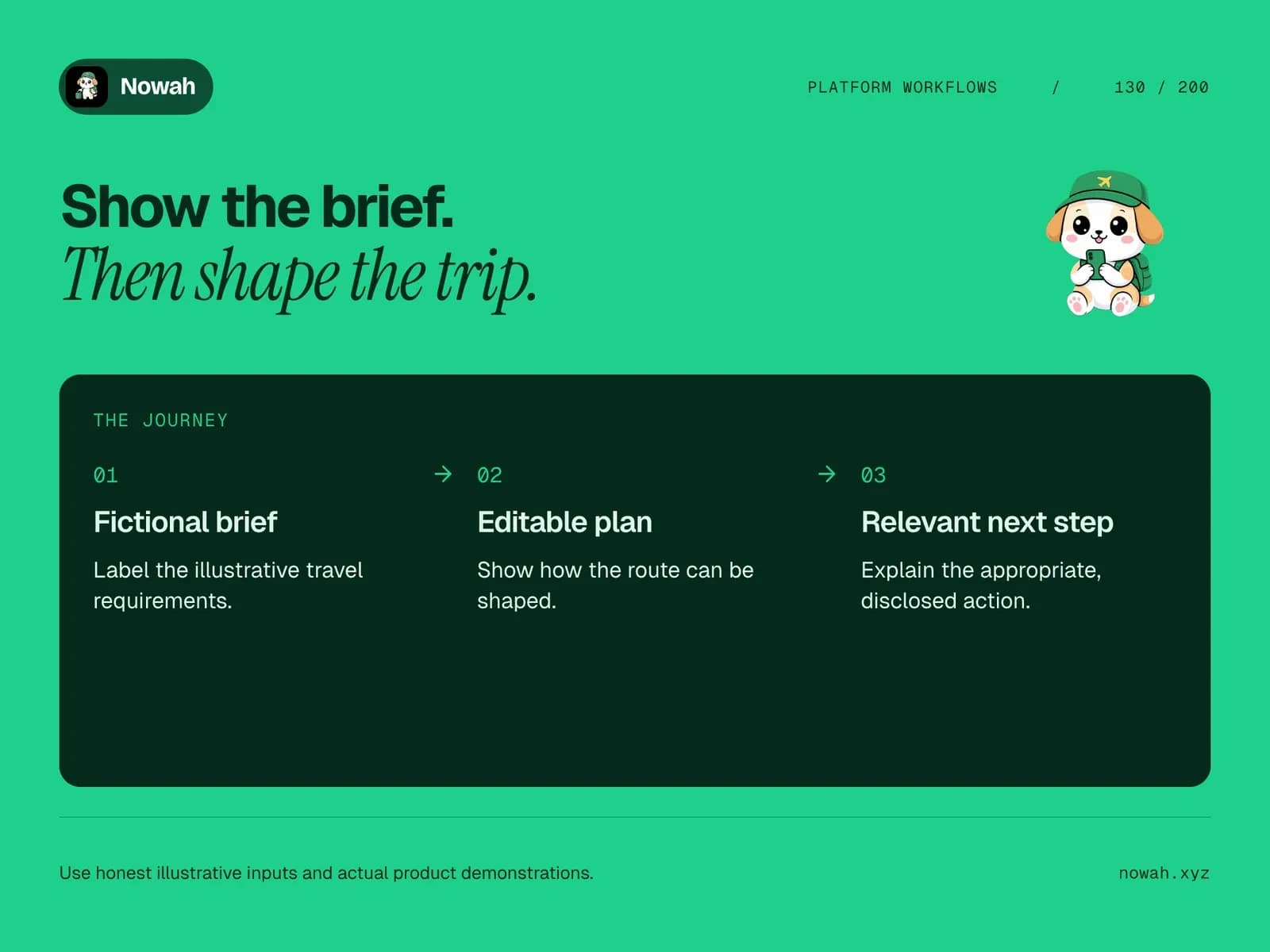
Showing a travel-planning screen is not the same as explaining a travel decision. A good TikTok demonstration helps the viewer understand why a particular input changes the plan and what they should investigate next.
That is a practical way to introduce Nowah. You can start with a fictional travel brief, show a relevant planning task and explain a revision when a constraint changes. For an approved creator, the demonstration can lead into a disclosed partner recommendation. Nowah Partners offers 35% of Nowah net revenue from qualifying bookings by eligible newly attributed accounts.
Build the video around a useful finding, rather than a promised result. You do not need an invented booking, testimonial or commission notification to show why Nowah belongs in a traveller's research process.
Choose a constraint worth demonstrating
A demonstration needs a change the audience can recognise. A late arrival, an early departure or a fixed event can alter the shape of a short trip in a way that is easy to explain.
Avoid starting with an extremely broad brief and then showing a dense plan without commentary. The viewer cannot tell which information mattered or whether the result answers their own question.
Write the constraint in one sentence. For example: “This fictional party has three nights, one evening event and an early departure.” Then identify the decision the video will investigate, such as which day should remain lighter.
Keep the scenario within the scope of the evidence and product behaviour you can verify. If the lesson depends on an unconfirmed hotel service or an exact transfer duration you have not checked, change the demonstration or clearly identify the missing information.
The fixed-date festival planning guide offers a related way to think about trips organised around an immovable anchor.
Create a fictional brief with enough detail
Label the scenario as an example and use only the inputs needed for the lesson. The party, available time, fixed commitment and current priorities should usually be enough to explain a bounded planning question.
Do not use a follower's private message or booking details simply to make the demonstration feel real. A fictional scenario can teach the same reasoning while keeping the evidence role clear.
Make the priorities concrete. “Relaxed” could mean fewer activities, less movement or more space between fixed commitments. Decide which meaning the example will explore.
Record what the brief does not establish. It might not specify a final hotel, confirmed event transport or available fare. Those gaps should remain research questions, rather than being silently filled with confident statements.
The brief is a teaching device. It should not be presented as evidence that a real traveller used Nowah, completed a booking or generated partner earnings.
Verify the product sequence before recording
Open the current product and check that the intended actions work as described. The script should follow verified behaviour, not a workflow imagined from a marketing phrase.
Decide which moments deserve explanation. You might show the initial planning request, the relevant part of the output and a revision after adding the constraint. There is no need to display every screen or make the viewer read a full itinerary in a brief video.
Remove unnecessary personal information from anything you record. A public demonstration should not expose identity documents, payment data or another person's travel references.
If the actual product behaves differently from the planned script, adapt the script. Do not fabricate a missing screen, a booking confirmation or a special creator feature to make the sequence look smoother.
The point of the recording is to explain the planning task accurately. A concise, honest demonstration is more useful than an apparently complete journey built from unsupported claims.
Use a shot ledger and a voiceover test
A shot ledger pairs each visual with the idea it supports. Write down the screen or illustration, the spoken explanation and the evidence behind any factual statement.
For a constraint-change demonstration, the ledger can contain:
- The fictional brief and the decision being investigated.
- The initial planning task in Nowah.
- The constraint that requires a revision.
- The relevant change in the plan.
- The remaining supplier or source checks.
- The disclosed next action.
Read the voiceover without the visuals. If it does not explain why the revision matters, more screen footage will not solve the problem. Rewrite the reasoning first.
Then watch the visuals without assuming the audience can read small text. Use a clear explanation of the relevant change rather than expecting the viewer to inspect a dense output.
This ledger is your production tool. It does not imply that Nowah automatically generates a creator script or a TikTok editing sequence.
A fictional event-trip demonstration
Imagine a creator explaining a short city trip around an evening event. The following is a hypothetical production example, not a real traveller story or campaign result.
The opening introduces the fictional party and asks whether the arrival day should include a full sightseeing schedule. The creator shows the relevant Nowah planning task, then adds a late-arrival constraint that changes the day structure.
The voiceover explains the decision: a lighter arrival evening may be worth investigating because the event is fixed and the travellers prefer to avoid rushing. The creator does not invent a transport duration or claim that a particular hotel's check-in arrangement is confirmed.
A simple illustration highlights the revised day rather than presenting every itinerary detail. The conclusion identifies the practical research tasks: current arrival logistics, actual accommodation conditions and the party's own priorities.
The final invitation directs interested travellers toward a suitable route to explore their own brief, with a clear partner relationship statement. The video ends with a more understandable planning decision, rather than an artificial “booking complete” moment.
Show why the recommendation is relevant
Explain the connection between the demonstration and the destination. A viewer should know what they could investigate next and why Nowah is being recommended for that task.
Use the actual linking surface available on your TikTok account. Do not promise a universal profile-link setup or send travellers to an unexplained creator application. The TikTok click-route guide provides a separate audit for that step.
Tell viewers that you are a Nowah partner and may receive commission from qualifying referrals. TikTok's commercial-content guidance requires its relevant disclosure setting for brand promotions. Check the current controls used by the publishing account and make the relationship understandable in the content as well.
A useful demonstration should remain informative even for someone who decides not to follow the recommendation. That is a helpful test of whether the product explanation is serving the traveller's decision.
Keep the economics illustrative
The demonstration may prompt other creators to ask how the earning model works. Explain it using the correct base.
For a deliberately hypothetical calculation, suppose one qualifying booking produces $40 in Nowah net revenue. At a 35% partner share, the illustrative amount is $14. This is arithmetic based on an assumed net-revenue input, not a forecast, a real creator result or a percentage of the traveller's booking total.
The Nowah terms also require valid new-account attribution. The traveller must follow an active partner link and create an eligible new account within 30 days of introduction, with successful tracking. Existing accounts and self-referrals are excluded.
Later qualifying bookings can produce earnings for an attributed account's lifetime, but future travel is not guaranteed. Completion, supplier settlement, the hold and payout conditions remain necessary. A TikTok view or a planning demonstration does not establish that those stages have happened.
Give the viewer a reusable planning question
End the lesson with a question that transfers beyond the fictional example. “Which fixed commitment should shape your arrival day?” helps the audience apply the reasoning to their own trip.
A short checklist can reinforce that lesson: identify the anchor, state the timing constraint, explain the priority and list what requires confirmation. Avoid turning the checklist into a universal travel rule that ignores individual circumstances.
Nowah's discussion of multi-city trip intelligence provides background for creators moving into more complex trip structures. A short TikTok should still stay within the single question it can explain clearly.
The multi-channel brief guide can help if you later expand the same scenario into a longer video or article. Preserve the facts and qualifications while adapting the explanation to the format.
Review the demonstration before building a series
Check the recording against the shot ledger. Confirm that fictional inputs are labelled, product behaviour is accurately shown and supplier questions have not become unverified promises.
Review the commercial explanation and the actual destination. If the next action has changed since filming, revise the instruction before reusing the content. Keep a record of the source checks behind changeable statements.
Choose a different decision for the next demonstration rather than repeating the same script with another destination name. A rooming question, a hotel-move tradeoff and an event anchor require different reasoning.
If you want to monetise useful demonstrations this way, apply to Nowah Partners. Describe the audience you help and the concrete travel questions your content can answer. A verified, specific demonstration gives that application and your eventual recommendations a clear practical foundation.




