Check Your TikTok Link Route Before Promoting Nowah
Check the actual TikTok click route before promoting Nowah, with an account-specific destination audit and a truthful traveller next step.
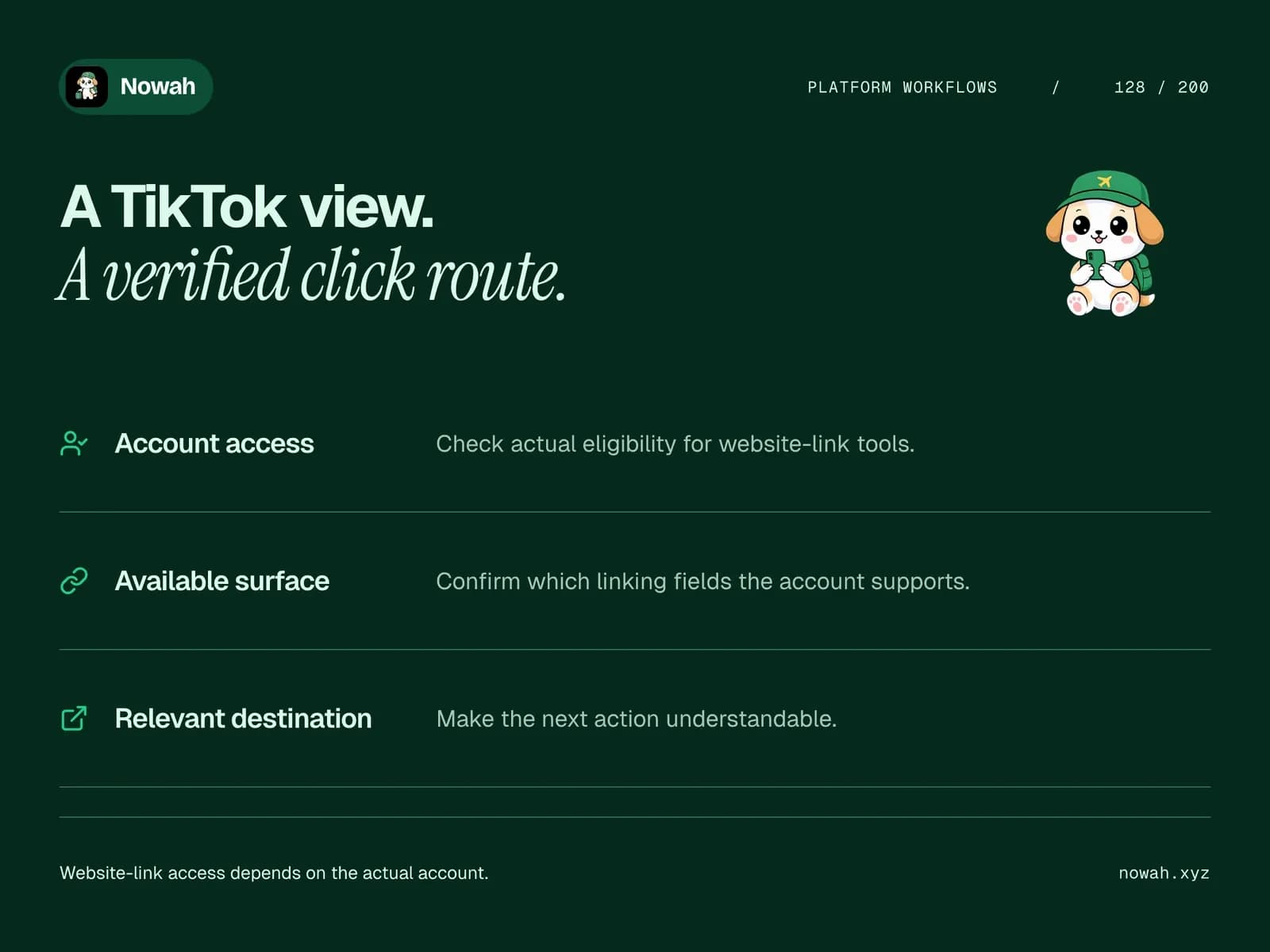
A useful travel video can lose its purpose when the final instruction leads nowhere. Before telling TikTok viewers to investigate a trip through Nowah, check the exact route your own account can provide. A destination that exists on another creator's profile is not proof that the same setup is available to you.
Nowah gives a travel recommendation a practical task to lead into: exploring a brief, examining a trip structure or researching relevant travel. Approved Nowah partners can earn 35% of Nowah net revenue from qualifying bookings by eligible new accounts they introduce. That makes a clear, truthful introduction commercially relevant without turning a video view into an earnings claim.
This guide focuses on the route between the video and its destination. The first question is simple: can a viewer follow the instruction you are about to give?
Start with the tools on the publishing account
Inspect the current account and the tools actually available there. TikTok's account options and website-link eligibility are account-specific, so avoid building a campaign around a universal assumption.
Use TikTok's official account guidance and the current information shown to you when deciding how to configure your presence. Do not change account type merely because an old tutorial promises a guaranteed shortcut.
Record what you can verify. If a particular website destination is available, note where the viewer can find it and what it opens. If it is not available, the script needs an honest alternative or a different content objective.
A route audit is different from an account-growth plan. This process does not predict when a feature will become available, promise that a follower threshold applies everywhere or claim that one account setup produces better earnings.
For creators with a small audience, the TikTok small-creator strategy develops the content and application questions separately from account tools.
Define what the viewer is trying to do
The destination should follow the video's actual promise. A traveller investigating a hotel-area question needs a relevant planning explanation. Another creator asking how to join Nowah Partners needs program and application information.
Choose one primary audience for the piece. A call to “get started” can mean different things to these two groups, so explain the action rather than relying on a vague phrase.
For a traveller recommendation, an approved partner should use the active route supplied through approval and onboarding. Do not invent a referral address or assume that the ordinary partner application page establishes traveller attribution.
For prospective creators, the program overview and official partner portal are relevant destinations. The explanation should cover why the program fits their content and what the reviewed application involves.
This audience distinction prevents a technically working link from sending someone to the wrong task.
Map the complete route in a worksheet
Write the journey down before filming. Your route worksheet should contain:
- The video question and intended audience.
- The instruction you plan to speak or display.
- The account surface the instruction refers to.
- The actual destination reached.
- The task the destination helps the visitor perform.
- The partner disclosure accompanying the recommendation.
- Any step you could not verify.
- The date and context of your check.
Use specific language. “Profile destination opens the program overview for creators” describes something you can inspect. “Link works and earns commission” combines several events you have not established.
Keep the worksheet in your own campaign notes. This guide does not imply that Nowah provides a TikTok route-audit dashboard or automatically checks your account configuration.
If the route contains an intermediate page you control, include that page in the audit. An extra step can create another mismatch between what the video promises and what the visitor finds.
Make the Nowah demonstration earn the click
A working route is necessary for the instruction, but it does not give viewers a reason to use it. The video should explain a useful travel decision first.
Choose a narrow problem, such as organising a short break around a fixed event. Introduce a labelled fictional brief and show a Nowah planning task that relates to the constraint. Explain why you would investigate one day structure or hotel-area question before another.
Only show product behaviour you have verified. Do not invent a booking confirmation, commission notification or creator reporting screen to make the video feel complete.
A planning demonstration can end with a useful research conclusion. It need not promise that a particular room is available or that the traveller will save money. The viewer should understand what they could investigate for their own trip.
The TikTok planning-demonstration guide goes deeper into choosing the brief and explaining a revision.
A fictional route audit for an event-trip video
Imagine a creator preparing a video about arriving for a fixed evening event. The example is hypothetical and includes no real follower, booking or campaign result.
The video explains why arrival timing changes the first day's plan. A Nowah demonstration uses a fictional party and shows how the creator would investigate a lighter arrival day. Current transport and accommodation arrangements remain separate research questions.
Before filming the closing instruction, the creator inspects the publishing account. They identify the destination surface actually available and open the page it reaches. They compare that page with the traveller task described in the video.
The creator then writes an accurate instruction using the verified route. The commercial relationship is explained with the recommendation. If the intended route cannot be provided, they revise the content plan rather than telling viewers to use a tool the account does not offer.
The audit's result is a truthful viewer journey. It is not proof that a visitor will become an eligible account or that the content has generated earnings.
Test the instruction as a viewer
Read the spoken words, on-screen text and caption together. They should describe the same destination and action.
Check whether someone can understand the instruction without having seen earlier posts. If the route depends on a profile destination, the content should describe that route clearly instead of implying that an unverified location is clickable.
Inspect the destination's explanation. Does it continue the planning question, or does it abruptly ask the visitor to apply as a creator? Does it make the partner relationship understandable? Has an old content series left instructions pointing to a destination with a different purpose?
Record the limits of your test. Opening a page establishes the destination behaviour you observed. It does not establish a recorded introduction, eligible signup, qualifying booking or eventual payout.
Nowah's explanation of the trust equation in travel booking offers useful background for thinking about why each step needs a clear purpose.
Include the commercial context
Tell viewers that you are a Nowah partner and may earn commission from qualifying referrals. Apply the current platform disclosure tools relevant to your content and account, and make the relationship understandable in the recommendation itself.
A disclosure should not be contradicted by the hook. Promising guaranteed bookings, savings or earnings would remain misleading even if another part of the post says that a commission relationship exists.
The TikTok commercial-content guide deals with the disclosure task in more detail. Keep that task connected to the route audit: the viewer should understand both where they are going and why you are recommending it.
Do not present an illustration as evidence of an actual traveller outcome. A fictional example can explain a useful process without a fabricated testimonial.
Know what must happen after the click
The Nowah program terms require the traveller to follow an active partner link and create an eligible new account within 30 days of introduction. Tracking must successfully reach Nowah. Existing accounts and self-referrals are excluded.
Once valid account attribution exists, later qualifying bookings can produce earnings throughout that account's lifetime. This does not guarantee repeat travel or a fixed income. Hotels, flights and paid eSIMs are the qualifying categories described by the program.
The 35% share applies to Nowah net revenue, rather than the traveller's full booking total. Earnings also depend on completion, supplier settlement, the applicable hold and payout conditions.
These rules explain why the click route matters while also showing its limits. A technically valid route is one part of a larger journey, not a substitute for the remaining conditions.
Maintain the route when the campaign changes
Repeat the audit when you change the destination, start a different content series or notice that your account tools have changed. An instruction can become inaccurate while the original video remains available.
Keep the checked date and the reason for each change. If you reuse a video, review its instruction and commercial explanation before assuming that the old route still fits.
Use genuine questions from viewers to identify confusion, but do not interpret every question as a tracking failure or a lost commission. Sometimes the destination is technically correct while the explanation of the next task is unclear.
If useful travel demonstrations suit your audience, apply to Nowah Partners. After approval, build your first recommendation around a task you can explain well and a route you can actually verify. A clear path gives viewers a fair next step and gives your Nowah recommendation a stronger foundation.




