Travel commissions vs UGC licensing: understand Nowah's role in creator earnings
Compare Nowah referral commissions with separately agreed UGC licensing, including work briefs, permissions, evidence and earning conditions.
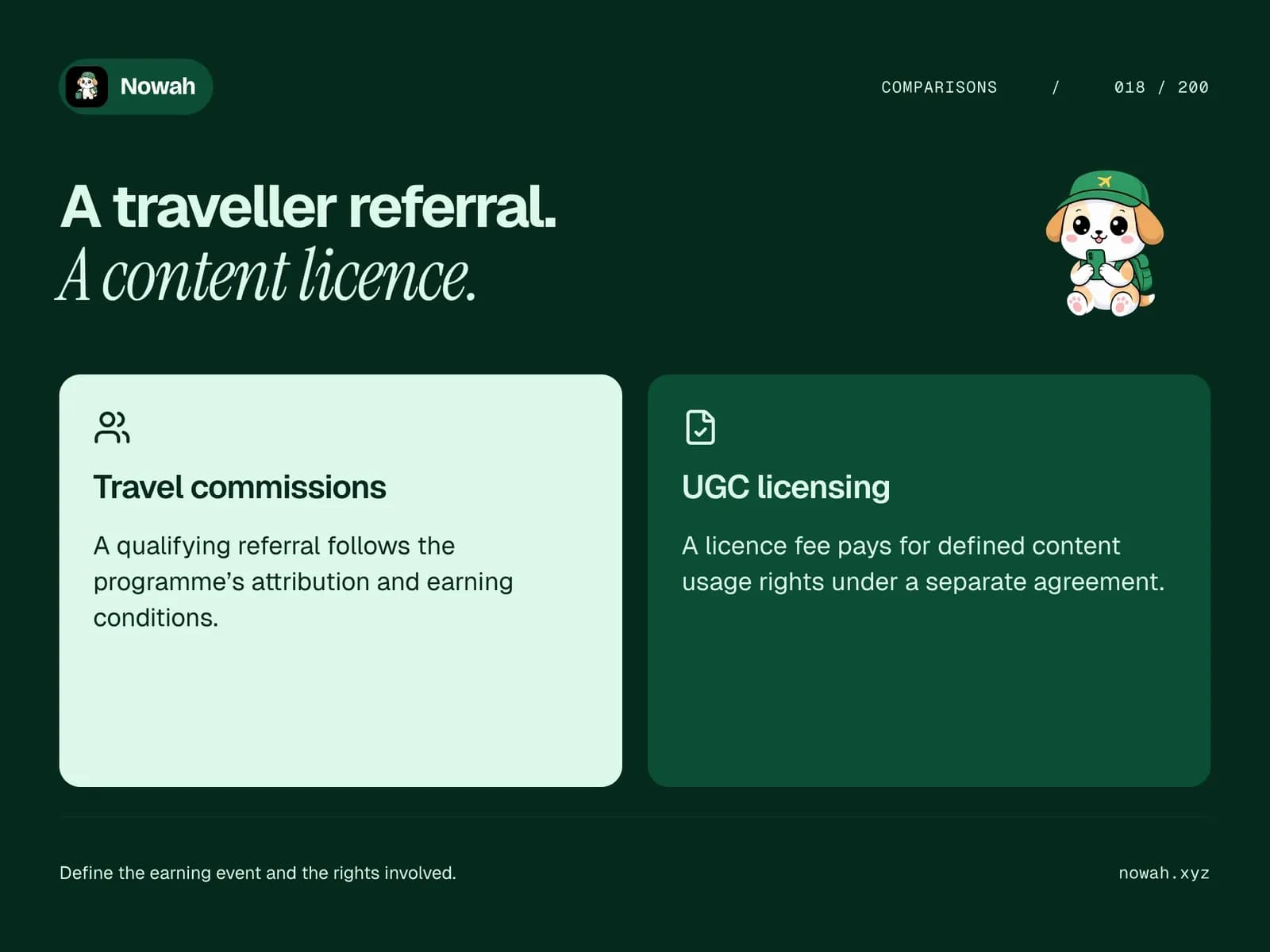
A creator can produce useful travel content for a brand without making a public recommendation to their own audience. They can also recommend a travel workflow to followers and earn through qualifying referred bookings. These are different commercial activities. Comparing UGC licensing with Nowah commissions starts by identifying which activity you are actually doing.
The Nowah Partner Program offers approved partners 35% of Nowah net revenue from qualifying bookings by eligible attributed accounts. It is a referral commission model, not a promise that Nowah will buy your videos or provide a UGC licensing marketplace.
That distinction does not make the opportunity less interesting. Nowah's continuing account attribution can suit creators who publish useful travel explanations and introduce new travellers through those recommendations. This guide helps you keep content-rights work and partner activity separate, so each earning claim has a clear basis.
Describe the UGC arrangement in concrete terms
“UGC” can be used loosely in creator conversations. Before discussing earnings, identify the actual content work and the agreement under which someone will use it. The deliverables, permissions, duration, channels, revisions and payment conditions depend on that arrangement.
Do not assume a content-production fee automatically includes every possible use of an asset. Nor should you assume that uploading a clip somewhere proves a buyer has accepted it or that payment is due. Use the actual agreement and relevant professional advice for contractual questions.
The practical distinction for this comparison is straightforward: a separately agreed content-rights arrangement concerns the work or permission being supplied. A Nowah earning event concerns qualifying bookings by eligible travellers attributed to you under the partner terms.
Keep the terminology specific in your public content. Calling both activities “affiliate income” makes it harder for another creator to understand what they would need to do.
Identify the audience relationship behind a commission
A Nowah recommendation should give a traveller a useful reason to continue planning. That might be a clear explanation of a hotel-area tradeoff, a fictional itinerary demonstration or a preparation guide linked to a relevant travel question.
Your public audience does not need to be huge for the program to consider an application: Nowah advertises no minimum follower count. Applications are still reviewed, and eligibility and verification requirements apply. The absence of a follower minimum is not automatic approval or guaranteed earnings.
Focus on the usefulness and honesty of the recommendation. A creator who teaches one well-defined task can explain why Nowah belongs in the workflow more convincingly than someone adding an unexplained partner link to unrelated content.
The no-minimum-follower-count guide is a useful next read for creators deciding whether a focused audience could fit the program.
Build two separate work briefs
For a UGC or content-rights brief, record the actual asset requested, production requirements, evidence needed for claims, permitted uses, relevant approvals and payment terms. Treat any gap as a question for the contracting party rather than filling it with an assumed industry standard.
For a Nowah partner brief, record the traveller question, the useful demonstration, appropriate active partner destination, disclosure and relevant earning conditions. Your objective is to help an eligible new traveller understand a task and continue through a clear recommendation.
These briefs should remain separate even if they involve similar footage. Producing a video for a brand does not automatically make its viewers your eligible Nowah referrals. Publishing a Nowah recommendation does not automatically establish a content licence or production payment from Nowah.
The commissions versus sponsored-post fees comparison covers another content-work arrangement. Use it when the work concerns a separately contracted post rather than a licence or usage permission.
Work through a fictional creator example
Imagine a travel creator preparing two distinct projects. One is a separately agreed hotel-content package for a contracting brand. The other is an independent guide teaching followers how to organize a short city trip using a labelled Nowah example.
For the first project, the creator checks what content is requested and how it may be used. This guide does not invent a fee, assume a licensing term or claim the brand is Nowah. The actual agreement determines that arrangement.
For the second, the creator uses a fictional two-adult, three-night brief, explains a location tradeoff and shows what they would investigate next. Current supplier availability and room conditions remain subject to verification. If approved, the creator can make an appropriately disclosed recommendation through their active Nowah partner route.
The two projects may both involve useful travel knowledge, but their earning events remain different. That is the lesson to preserve in a media kit, educational article or internal work record.
Understand the Nowah earning calculation
Approved partners receive 35% of Nowah net revenue from qualifying bookings by eligible attributed accounts. The current partner terms define net revenue as revenue actually received for the booking, less the permitted direct deductions. General overhead, salaries and general marketing are excluded from that deduction list.
For hypothetical arithmetic, a qualifying booking producing $60 of Nowah net revenue would create a $21 partner share. This does not value a video asset, establish a licensing fee or predict earnings from the fictional trip demonstration.
The traveller's full booking price is not the commission base. Likewise, a quoted content fee under another arrangement does not tell you what Nowah net revenue would be for a booking. Different quantities should not be presented as if they measure the same earning activity.
The net-revenue versus booking-price guide is useful when you need to review a numeric explanation in your creator materials.
Explain the continuing account relationship
An eligible new traveller must follow your active Nowah partner link and create a new account within 30 days of the valid introduction. Tracking must successfully reach Nowah. Existing accounts, self-referrals and artificial accounts do not qualify.
Once established, attribution remains for the traveller account's lifetime and can apply to later qualifying hotel, flight and paid eSIM bookings. That continuity gives creators a meaningful reason to build a useful body of travel recommendations instead of viewing every piece as an isolated sale.
It remains a possible earning relationship, not guaranteed repeat income. A person may watch without signing up, create no eligible attribution or never complete a qualifying booking. Content quality does not remove those conditions.
Do not describe a UGC buyer's audience as automatically attributed to your Nowah account. The actual traveller introduction must satisfy the program rules. A distribution arrangement and a recorded eligible account relationship are different forms of evidence.
Keep permissions and disclosures understandable
Use only content you are entitled to publish in the relevant context. If an asset was made under a separate agreement, check that agreement before reusing it in your own partner recommendation. This guide does not establish the usage rights in an individual contract.
Nowah's promotion terms also prohibit unauthorized use of another person's content or identity and require clear partner disclosure. Explain the relevant commercial relationship beside the recommendation rather than relying on an unexplained badge or a distant profile statement.
For endorsements affecting US consumers, the FTC's influencer guidance provides an official reference about clear disclosure with the message. Check the other requirements and platform rules applicable to your content as well.
The honest imagery guide helps distinguish a generated planning diagram from evidence of an actual stay. Neither should be mislabelled to make the commercial story more impressive.
Maintain separate evidence for payment
For content-rights work, retain the actual deliverable, acceptance and payment evidence relevant to the agreement. Do not assume Nowah provides a licensing-contract or invoicing tool simply because you use its partner program for another part of your business.
For Nowah, actual earnings require booking completion and verified supplier settlement. A 30-day hold starts after the later event, and monthly eligibility depends on the separate currency threshold, verification and other conditions. A pending calculation is not a bank receipt.
The existing trust and AI booking article is useful background for clear commercial explanations. Your own records should make it possible to explain what actually happened without inventing a combined income story.
Choose the next useful piece of work
Nowah gives creators a strong referral model when their content helps eligible new travellers begin planning and later make qualifying bookings. UGC licensing concerns a separate agreement for content and its use. Both need clear descriptions; neither should be presented as a feature of the other.
Prepare the two briefs, resolve relevant permissions and choose one audience question for a labelled Nowah demonstration. If that model fits your work, apply to Nowah Partners. Applications are reviewed, and approval, eligibility and verification requirements apply. Build a recommendation around a practical travel decision and let the earning explanation accurately reflect the relationship it creates.




