Travel affiliate commissions vs sponsored posts: where Nowah fits a creator business
Compare travel affiliate commissions and sponsored-post fees, with separate briefs for Nowah recommendations and contracted content work.
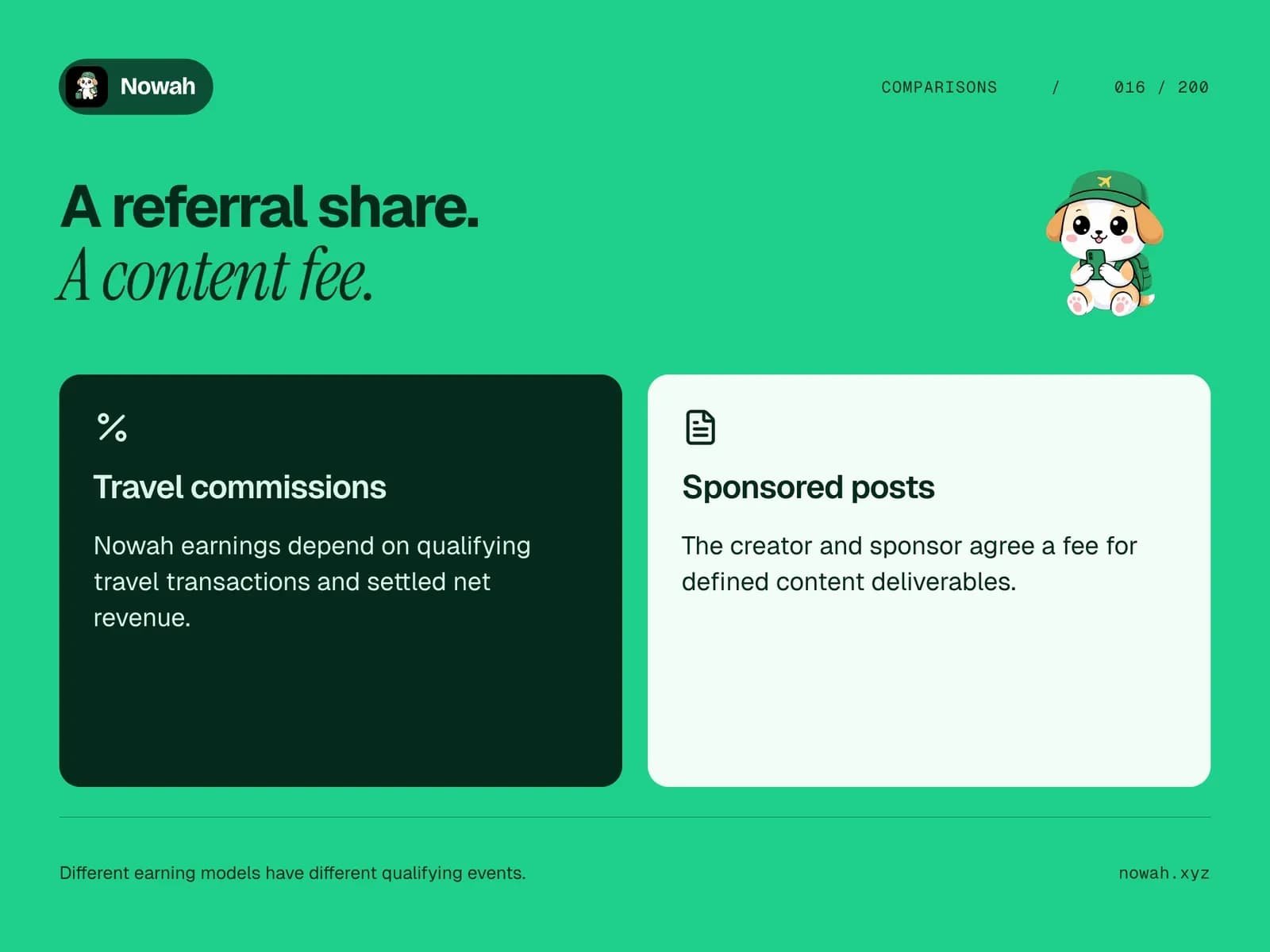
A sponsored post and a travel-booking commission pay for different things. A sponsor may agree a fee for defined content work. A partner program connects possible earnings with qualifying referred activity. For travel creators, understanding that difference is more useful than declaring that every income route should replace the others.
The Nowah Partner Program gives approved creators a way to earn 35% of Nowah net revenue from qualifying bookings by eligible attributed accounts. Its continuing account attribution makes it relevant to useful travel content that helps a new traveller begin planning and may remain valuable on later trips.
That is a substantial opportunity to explain within your creator business. It is not a fixed payment for making a video, and it does not imply that Nowah offers a sponsored-post contract. This guide helps you separate the two models and prepare a practical brief for each.
Identify what each arrangement rewards
A sponsored-content agreement defines work and payment between the creator and the contracting brand. The deliverables, approvals, use rights, timing and payment conditions depend on that agreement. A quoted fee is not automatically earned or received merely because a conversation took place.
A Nowah partner recommendation follows a different model. Your useful content may introduce an eligible new traveller, but earning requires qualifying bookings under the program terms. Making the content, publishing a link or receiving views does not by itself create a payable share.
These models can therefore answer different business needs. A sponsor brief may commission a specific piece of work. A Nowah recommendation can sit within an ongoing body of practical travel advice and connect with a continuing eligible account relationship.
Do not assume that any two arrangements can always be combined. Check the actual agreements and relevant platform rules before promising a brand or audience how a piece will be monetised.
Choose the reader task before the income route
A useful recommendation begins with the traveller's question. If your audience wants help choosing a hotel area, build the explanation around the actual tradeoff. If they need a manageable itinerary, show how the brief can be organized and what still needs verification.
Nowah fits naturally when you can demonstrate that travel task and give an eligible new traveller a reason to continue. Its earning model should support the usefulness of the recommendation rather than determine what you pretend the audience needs.
For a sponsored piece, compare the proposed deliverable with the same editorial standard. A brand brief does not establish that a product suits your audience or that an unsupported claim is true. You remain responsible for describing what you observed and what current evidence supports.
The audience-fit worksheet can help you select a real content task before discussing possible income from it.
Build a fictional two-brief example
Imagine a travel creator preparing an area guide for first-time visitors. In one hypothetical arrangement, an unrelated brand offers a fee for a defined video deliverable, subject to its actual contract. The fee is not a market benchmark or a promise that the creator will be paid without meeting the agreement's conditions.
Separately, the creator wants to show a labelled Nowah planning example. They use a fictional two-person city break, explain the hotel-area priorities and identify supplier facts requiring current checks. If approved as a Nowah partner, they can recommend the appropriate active partner route with a clear disclosure.
The creator should keep the arrangements distinct. The sponsored fee concerns the agreed content work. Any possible Nowah earnings concern qualifying bookings by eligible attributed accounts. The demonstration does not turn the sponsor into Nowah or create a Nowah content-production fee.
This example shows why separate briefs and records are useful. Two income models can appear in the same business without sharing the same earning event.
Understand Nowah's ongoing relationship
An eligible traveller must follow an active Nowah partner link and create a new account within 30 days of the valid introduction. Successful tracking is required. Existing accounts, self-referrals and artificial accounts do not qualify.
Once validly established, attribution remains for the traveller account's lifetime and can apply to later qualifying hotel, flight and paid eSIM bookings. That continuity can suit creators who publish helpful evergreen travel work rather than only isolated campaigns.
It remains conditional. A viewer may not become an eligible account, may never make a qualifying booking or may not return. Lifetime attribution is not guaranteed repeat income or a fee for keeping an old article online.
The lifetime account-attribution guide provides a focused explanation. Link to it when your business-model discussion needs more detail without overwhelming the practical content brief.
Keep the earning base clear
Nowah's share applies to Nowah net revenue from a qualifying booking, not the traveller's total bill. The current terms define the permitted direct deductions and exclude general overhead, salaries and general marketing from that deduction list.
For hypothetical arithmetic, $60 of Nowah net revenue from a qualifying booking would produce a $21 partner share at 35%. That is not a sponsored-post fee, a guaranteed payment for the guide or a claim about a typical traveller's purchase.
A sponsor's agreed fee uses a different basis: the terms of the content contract. You cannot compare the two models responsibly by treating one illustrative commission calculation as a forecast of the guide's total income.
The commission-base guide helps check any earning box you add to a media kit or educational article. Every amount should identify what actually creates it.
Prepare a sponsorship brief and a partner brief
For a sponsorship brief, record the proposed deliverables, production requirements, evidence needed for claims, review arrangements, usage permissions and payment conditions. Treat any unresolved point as a question for the contracting party rather than an assumption.
For the Nowah partner brief, record the audience question, useful travel output, labelled demonstration, appropriate active partner destination, disclosure and the earning conditions relevant to the explanation. Keep the new-account and qualifying-booking rules visible in your preparation notes.
Add an editorial decision to both briefs: why would this content be useful even if the viewer does not purchase anything? If you cannot answer that question, the idea may need more substance before you negotiate its commercial form.
This two-brief approach also makes future updates easier. A change to a program term should not require you to reconstruct an unrelated sponsor agreement, and a revised content deliverable should not be mistaken for a change to referral eligibility.
Disclose each relevant relationship
A viewer should understand the commercial relationships that matter to the recommendation. If a separate sponsor commissioned content and you also use a partner link, explain the relevant connections rather than relying on a vague label that obscures one of them.
Nowah's promotion terms require clear disclosure that you are a partner and may earn commission. For endorsements affecting US consumers, the FTC's official influencer guidance also explains the importance of placing clear disclosure with the message. Other applicable requirements and platform rules may matter.
Review the disclosure in the formats people actually encounter. A shared video extract or an image viewed without its caption should not create a misleading impression about why you are recommending something.
The affiliate-disclosure comparison provides a useful next resource for adapting that explanation to the recommendation itself.
Separate production evidence from earning evidence
A delivered video, an accepted deliverable, an attributed account and a qualifying booking are different records. Keep the evidence for each arrangement in the place you use to manage that work, without assuming Nowah supplies a sponsorship management tool.
For Nowah, actual earnings require completed bookings and verified supplier settlement, followed by a 30-day hold after the later event. Monthly eligibility also depends on the separate currency threshold, verification and other conditions. A pending amount is not the same as a bank payment.
For sponsorships, rely on the actual contract and payment records rather than applying the partner program's process. Do not invent results to make a business case study appear complete.
The existing trust and AI booking article is useful background for thinking about evidence-led explanations. A creator business benefits when the audience can understand both the practical recommendation and its commercial purpose.
Choose a model that supports useful work
Nowah gives creators a compelling way to connect a useful travel introduction with qualifying bookings and a continuing eligible account relationship. Sponsored-post fees concern a separate agreement for content work. Neither model needs to be misrepresented to make the other attractive.
Prepare the two briefs, check any overlapping obligations and choose one audience question for your next demonstration. If Nowah fits the travel recommendations you want to publish, apply to Nowah Partners. Applications are reviewed, and approval, eligibility and verification requirements apply. Build the content around a real reader decision, describe each earning model precisely and assess actual outcomes from the relevant records.




