How Wellness Creators Can Earn With Slower-Travel Planning in Nowah
Help wellness audiences express slower-travel preferences through a useful Nowah pace-and-movement audit.
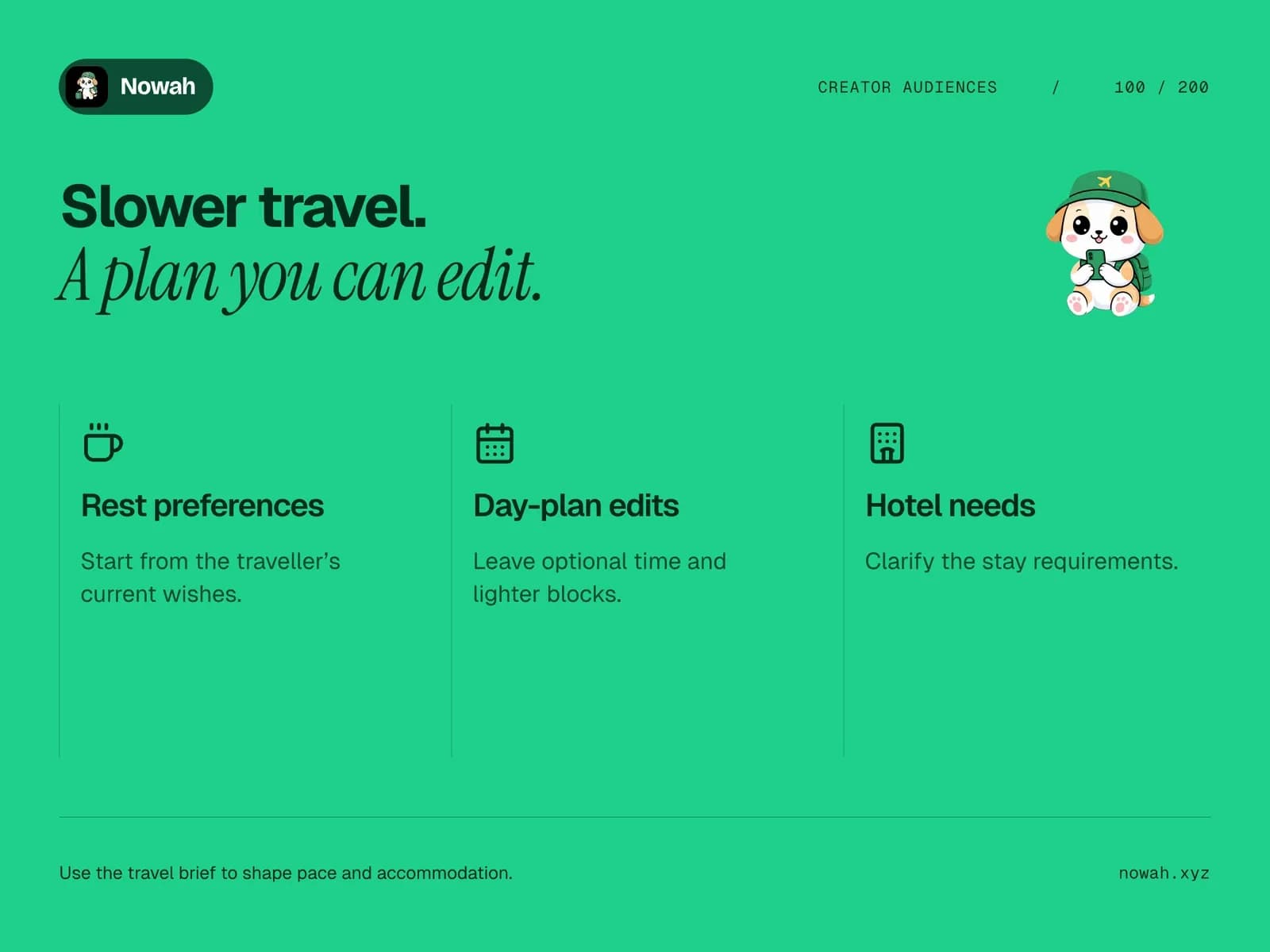
Slower-travel content becomes useful when it explains what the traveller wants to change about the trip's rhythm. Fewer movements, more open periods or time at one accommodation base are concrete planning preferences. Approved Nowah partners can connect that explanation to a useful demonstration, a disclosed referral and potential earnings from qualifying bookings by newly attributed travellers.
Nowah is a strong fit when the creator turns a broad wish for a slower trip into a current brief. Show the priority, explore an outline and explain the revision when the proposed plan becomes busier than the traveller wanted. The audience sees why continuing the research through the service is relevant to its own decision.
Keep the claim within travel planning. A slower-looking itinerary does not establish a medical outcome, a guaranteed feeling or a particular creator earning. The partner receives 35% of Nowah net revenue from qualifying bookings under the program terms, not a share of every service or activity associated with a wellness-themed trip.
Define what slower means in this brief
Ask which part of the rhythm the traveller wants to protect. They may want fewer accommodation moves, more unplanned time, a lighter arrival period or fewer fixed commitments. Those are different inputs and should not be treated as one universal style.
Do not assume that wellness interests identify a person's health, ability, age or budget. A public demonstration can use fictional details without collecting private medical information or making claims about what a particular person needs for their wellbeing.
State the preference in practical language. For example, a fictional traveller might want to preserve open periods during a four-night stay while investigating one main interest. Label that as a teaching brief, not an actual customer's schedule or a prescription for how everyone should travel.
Audit movements as well as activities
An itinerary can contain relatively few named activities while still introducing repeated movements, accommodation changes or fixed timing dependencies. Explain those relationships instead of measuring pace only by the number of attractions on the page.
Keep actual timing evidence separate from assumptions. Do not invent transfer durations, opening arrangements or arrival allowances to make a direction look unhurried. An unresolved movement question belongs in the audit because it can change the conclusion.
A useful creator explanation shows which part of the brief is affected. If another hotel move consumes a period the traveller wanted open, identify that tradeoff. If an activity is optional, show whether removing it actually changes the surrounding movements.
Build a pace-and-movement audit sheet
Give each meaningful day or block a row. Suggested fields include:
- The preference the traveller wants the plan to respect.
- Fixed anchors that genuinely constrain the block.
- Accommodation moves or other movements being investigated.
- Optional interests and deliberately open time.
- The evidence needed for timing or provider assumptions.
- The revision that would better reflect the current brief.
Do not use a score that implies a scientifically established pace or universal wellness benefit. The sheet is a planning tool for the stated preferences, not an assessment of health or suitability.
A companion article can show the completed fictional sheet while a short video explains one revision. Preserve the relevant open question in the shorter version rather than letting the visual communicate a certainty the evidence does not support.
Demonstrate the slower brief in Nowah
Use Nowah to explore the fictional four-night window with the desired open periods and main interest visible. Explain which question you are asking and how you will assess the proposed direction.
Review the outline. If it fills every open period or introduces another accommodation move without serving the brief, identify the assumption and revise the question. Show the change so viewers can follow the reasoning instead of treating the initial output as a complete answer.
Nowah's useful role is the clearer planning conversation and relevant travel research. Actual availability, room conditions, routes and supplier arrangements still need appropriate current evidence. Do not imply that a planning demonstration independently certifies those details.
The wellness-stay guide addresses a different task: investigating the accommodation requirements behind a stay. Link when the pace audit reveals that an actual property or room question needs more evidence.
Compare two versions of the same fictional outline
Imagine the first version of the four-night outline adds several optional interests but also introduces movements that affect the periods the traveller wanted open. The second version keeps the main interest while reconsidering one of those dependencies.
Keep the travel window, party and requirements consistent. Do not make the quieter-looking version appear better by quietly adding a night or assuming a special accommodation arrangement. Explain the specific preference that caused the revision.
Use Nowah to refine the chosen direction, then return to the audit sheet. Which movement question remains unresolved? Which block is genuinely optional? What fact could change the recommendation? Those questions make the conclusion adaptable rather than a claim that one itinerary is universally restorative.
A useful result can be a clearer research direction without a guaranteed outcome. The traveller still decides whether the rhythm reflects their present priorities.
Keep accommodation claims tied to actual offers
A plan that leaves more time at the accommodation may create specific room or property questions. Do not infer quiet, privacy, included facilities or a particular service from a premium label or an appealing photograph.
The rate-inclusions guide helps followers identify the actual rooming, inclusions and conditions of an offer. A slower-travel preference does not establish those facts automatically.
If you discuss your own stay, describe it honestly and distinguish it from supplier information and fictional planning. A generated illustration can explain the audit, but it should not be presented as actual footage or proof of a future traveller's experience.
The independent-judgement guide supports recommendations whose reasoning follows priorities and evidence rather than a possible commission or an aesthetic that the creator wants to promote.
Put the partner relationship beside the useful action
When recommending that viewers continue the relevant research through an active Nowah partner link, explain that you may receive commission from qualifying referred bookings. The audience should understand the travel task and the commercial connection before choosing to follow it.
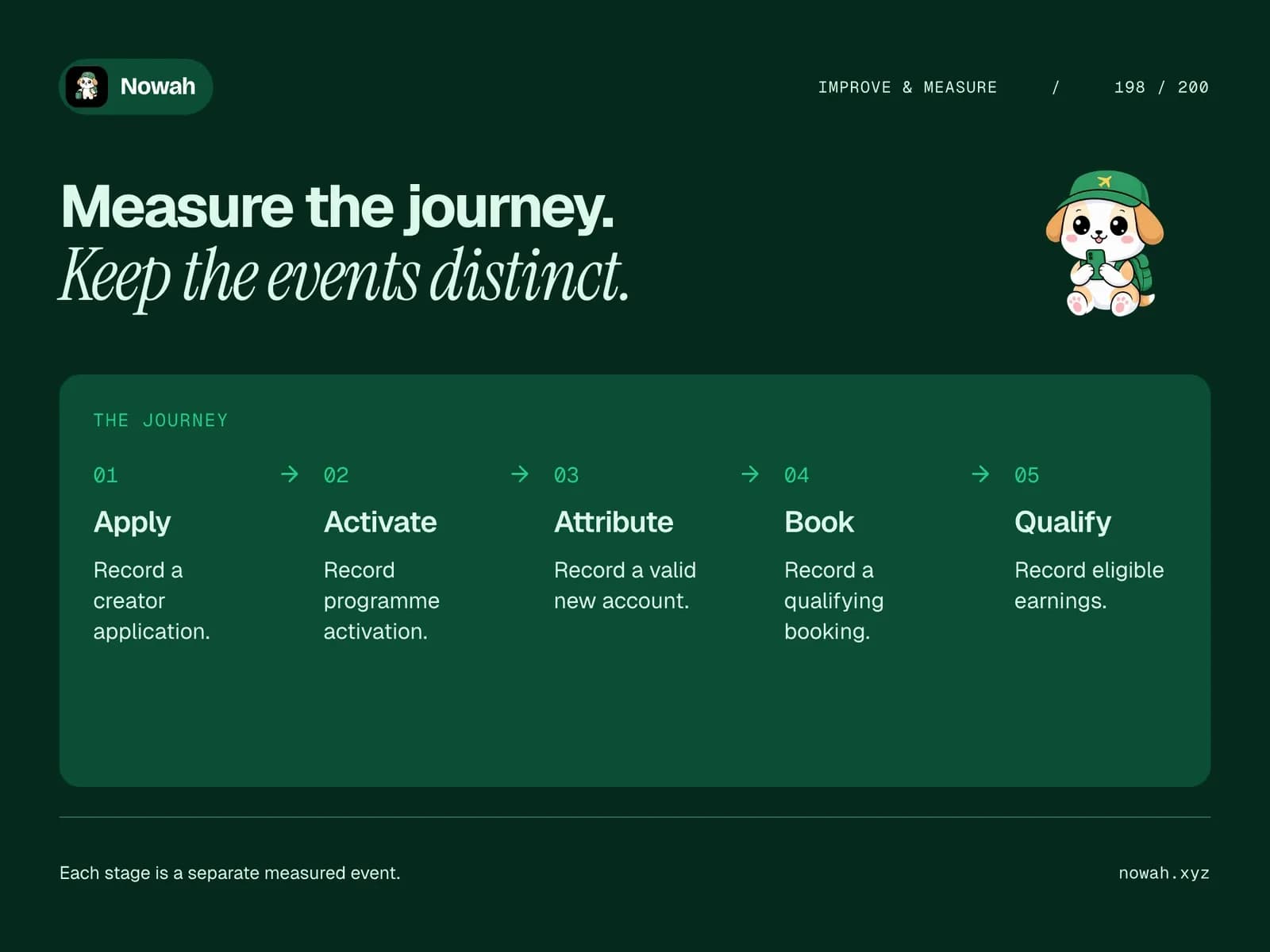
Under the Nowah terms, an eligible traveller must follow an active partner link and create a new account within 30 days of the introduction. Existing accounts, self-referrals and artificial accounts do not qualify. Tracking must reach Nowah successfully; a saved pace audit or a link click is not proof of attribution.
Once valid attribution is established, it can remain for that traveller account's lifetime, including qualifying later bookings. That offers a potential continuing relationship while future travel and income remain unguaranteed. A creator wanting to join the program needs the separate explanation and application journey.
Let the audit record a changed preference as clearly as a changed fact. If the fictional traveller decides that one optional interest matters more than preserving an open block, show the new brief and reassess its dependencies. The planning method should respond to that choice rather than defend a slower-looking aesthetic as automatically superior.
Keep the same distinction in the companion visual: a preference-led revision explains what the traveller chose, while provider evidence establishes actual services and arrangements. Neither one should be presented as proof of a medical or emotional outcome from the trip.
Explain earnings without rewarding a busier trip
Nowah lists qualifying hotels, flights and paid eSIMs as eligible categories. A wellness activity, class, treatment or other service in the story is not automatically commissionable. Adding more itinerary items does not establish more partner revenue.
The partner share uses Nowah net revenue after the direct deductions defined in the terms, rather than the traveller's booking total. A labelled hypothetical $60 of Nowah net revenue produces $21 in partner earnings. That calculation does not forecast a return from the fictional slower-travel example or prove that one rhythm generates more income.
Completion, supplier settlement, the applicable hold and payout conditions matter before earnings become eligible. Keep a planning preference, useful audience feedback, valid attribution, a booking and a completed payout separate when discussing results.
The older Nowah article on the anatomy of a hotel recommendation provides context for putting requirements before the conclusion. Your pace-and-movement audit gives a wellness audience a concrete way to express and investigate its travel preferences.
To participate commercially, apply to Nowah Partners. Applying is free, applications are reviewed and there is no minimum follower count. Start with one honest preference, demonstrate a useful Nowah revision and give followers a transparent way to continue researching a trip at a rhythm they choose.