Connect YouTube Shorts to a Useful Nowah Long-Form Explanation
Connect a useful YouTube Short to a relevant longer Nowah explanation, with a consistent brief, clear disclosure and checked external next step.
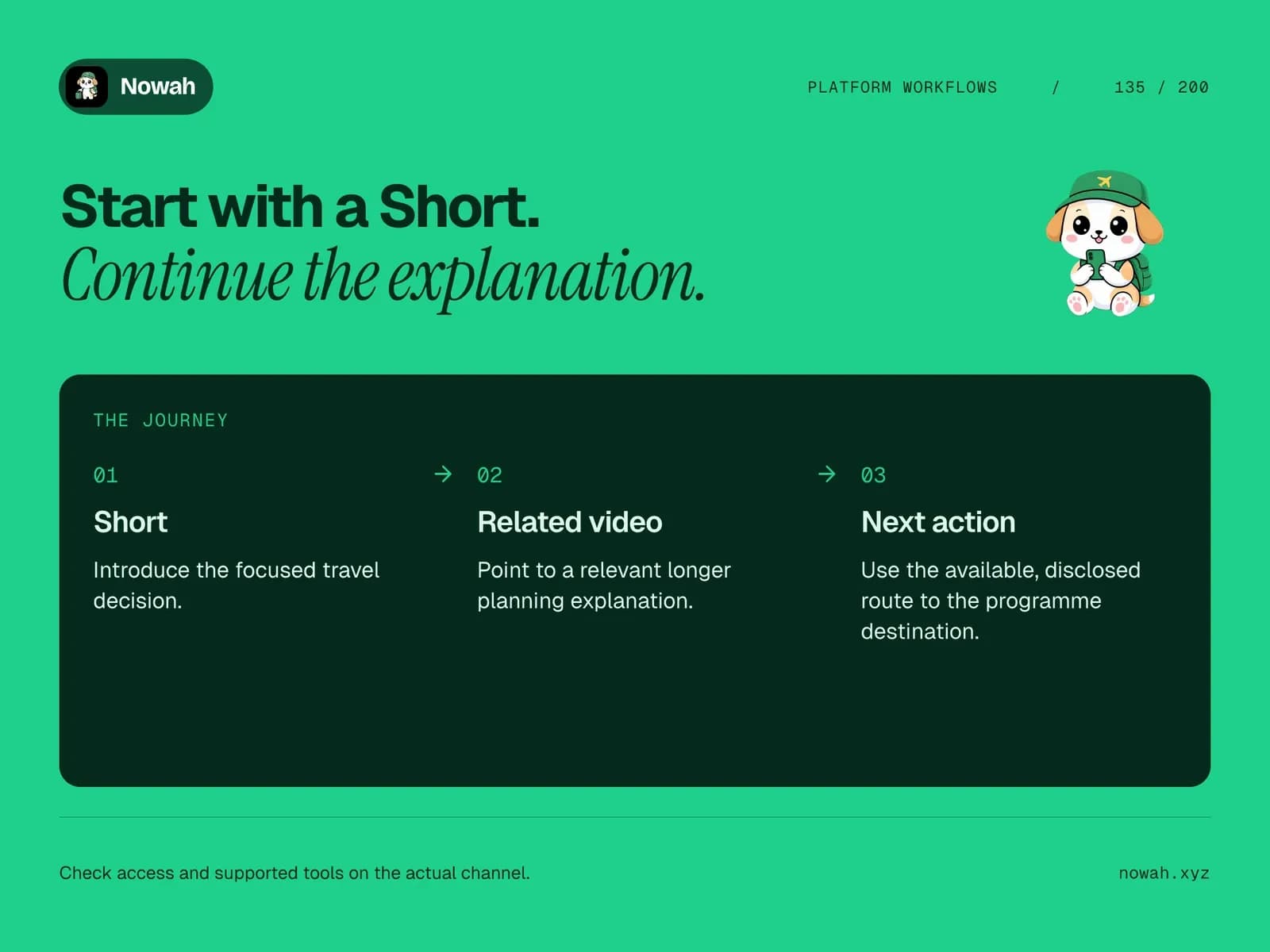
A YouTube Short can make one travel decision understandable. A longer video can show the assumptions, evidence and planning revisions behind that decision. Connecting the two works best when the longer explanation genuinely continues the question the Short introduced.
For a creator recommending Nowah, that gives the product demonstration room to be useful. You can show how a brief develops, explain which supplier facts remain unconfirmed and offer an appropriate partner next step. Approved Nowah partners can earn 35% of Nowah net revenue from qualifying bookings by eligible new accounts they introduce.
The route is not an automatic conversion system. A viewer watching another video has not necessarily followed an active partner link, created an eligible account or made a qualifying booking. Design the handoff around a helpful explanation first.
Give the two videos different jobs
The Short should answer a narrow question well enough to be useful by itself. The longer video should explain the reasoning that needs more time.
For example, the Short might explain why a second hotel base adds another move to a brief trip. The longer video could compare the two structures against a fictional brief, demonstrate the relevant Nowah planning task and examine what would change the recommendation.
Avoid making the Short nothing more than an unexplained product slogan. A viewer should learn something even if they choose not to watch another video.
Likewise, the longer piece should not simply repeat the Short with more introductory material. It needs a distinct output: a fuller comparison, a worksheet, an annotated revision or an evidence-led research process.
The one-base-versus-two-bases guide provides a useful subject for this kind of division.
Check whether the related-video route is available
YouTube's related-video guidance explains that this feature requires advanced-feature access. The selected video must come from your channel, be public or unlisted and comply with the platform's requirements.
Inspect the current channel tools before writing the instruction. Do not imply that every channel can use the same route without checking eligibility.
A related-video link is an internal YouTube handoff. It gives the viewer another piece of content to watch; it is not itself the external Nowah partner link. Keep those stages distinct in your script and production notes.
YouTube's link-location guide also distinguishes the linking behaviour of Shorts and long-form surfaces. Do not assume that an external URL behaves identically wherever you place it.
The Shorts link-route audit covers the initial choice of a truthful next-click route in more detail.
Write a two-video promise contract
Create a short document that states what each video promises. This is an editorial tool you maintain, not a product feature.
For the Short, record the question, the useful answer and the deeper issue left for the longer explanation. For the long-form video, record the shared brief, the demonstration, the evidence boundaries and the next action.
Then add a handoff sentence describing what the viewer will learn next. It should be specific enough that the audience can decide whether the extra explanation is relevant.
A statement such as “the longer example compares the hotel-move tradeoff against the same three-night brief” is clearer than “watch to unlock the answer.” The Short should already have delivered an answer at its own level.
Use the contract to reject irrelevant additions. If a segment in the long-form video does not deepen the promised decision, it may belong in another piece of content.
Preserve the same brief and qualifications
The two videos should not quietly change the facts. Keep the fictional party, timing constraints and current priorities consistent unless the longer video explicitly explores a variation.
If the Short says the example is hypothetical, the long-form video must not introduce it as a real follower result. If the first video leaves a supplier question unresolved, the second needs evidence before presenting it as confirmed.
This continuity matters when the product appears in only part of the content. A viewer should understand how the Nowah demonstration relates to the same travel problem, rather than feeling that the subject changed after the click.
Keep your own commentary separate from supplier facts. You may reasonably explain why you would investigate fewer hotel moves while still needing current evidence for transport arrangements or room conditions.
The multi-channel brief guide applies the same consistency principle when a scenario moves beyond YouTube into other formats.
A fictional hotel-base video pair
Imagine a creator making a pair of videos about a short break with one fixed event. This is a hypothetical editorial example, not a report of a traveller's holiday or a campaign's results.
The Short uses a diagram to explain that adding another hotel base changes the trip's movement and check-in tasks. It identifies the relevant priority: whether the traveller values reducing hotel moves more than beginning each day in a different place.
The longer video repeats the fictional brief clearly, then develops the comparison. A Nowah demonstration investigates a day structure around the fixed event. The creator explains which revision they would explore and why.
The longer explanation produces a worksheet: shared assumptions, consequences of each structure, questions requiring current provider evidence and the traveller priority that would change the recommendation.
The partner relationship is made clear with the recommendation. The external destination is checked separately and matches the task of investigating the viewer's own brief.
Both videos have a useful role. The Short explains the tradeoff, while the longer piece supplies the detailed reasoning and practical worksheet.
Make the long-form demonstration substantive
Use the extra time to explain decisions, rather than displaying more screens without commentary. Introduce the brief, show the relevant planning task and discuss a meaningful revision.
Only record product behaviour you can verify. Do not create a pretend commission notification, creator dashboard or booking confirmation to provide a dramatic ending.
A planning output is not proof of availability or suitability. If the example depends on a rooming condition, an arrival arrangement or another supplier fact, identify the evidence required.
Show how a changed priority would affect the investigation. This gives the audience a method they can use, rather than a single plan presented as universally best.
Nowah's article about multi-city trip intelligence offers background for more complex planning decisions. The video pair should still stay within the specific question promised at the start.
Check the external destination as a separate stage
Once viewers reach the longer explanation, they may need a relevant external next step. Check the actual channel tools and destination behaviour before publishing instructions.
An approved creator recommending Nowah to travellers should use the active partner route supplied through approval and onboarding. Do not invent a referral address or assume that a general program page establishes attribution.
A creator application serves a different audience. If the video teaches other creators about the program, the official partner portal is a relevant application destination, accompanied by a clear explanation of the reviewed offer.
Tell viewers that you are a Nowah partner and may earn commission from qualifying referrals. Use applicable current platform disclosure tools, and keep the commercial relationship understandable where the recommendation occurs.
Record the observed navigation behaviour in your production notes. Opening the intended destination is useful evidence about the route, but it does not prove a qualifying signup or booking.
Keep the earning journey precise
The Nowah program terms require an eligible traveller to follow an active partner link and create a new account within 30 days of introduction. Tracking must reach Nowah successfully. Existing accounts and self-referrals are excluded.
Once valid attribution is established, later qualifying hotel, flight and paid eSIM bookings may generate earnings for the account's lifetime. That rule does not guarantee future travel.
The 35% share is calculated from Nowah net revenue, not the traveller's full booking spend. Completed travel, supplier settlement and the applicable hold and payout conditions are also part of the process.
A Short view, a related-video interaction and a long-form watch are different events from those program conditions. Explain the commercial opportunity through the value of a relevant introduction, not a promise that watching the pair will produce income.
Review the pair before starting another
Watch the Short and longer explanation together. Check whether the handoff sentence accurately describes the next video and whether the shared brief remains consistent.
Then review each video independently. The Short should deliver its limited lesson, and the longer piece should introduce enough context for someone arriving without it.
Check changeable product and supplier statements when reusing the pair. Maintain the external destination and revise outdated instructions where possible.
If this style of useful travel explanation fits your channel, apply to Nowah Partners. Build the first pair around a question you can investigate honestly. A clear promise, a substantive Nowah demonstration and a verified next step give viewers a sound reason to continue.




