How to Share Nowah Links from YouTube Shorts
Share Nowah from YouTube Shorts using a truthful next-click route, with profile or related-video options instead of unclickable description URLs.
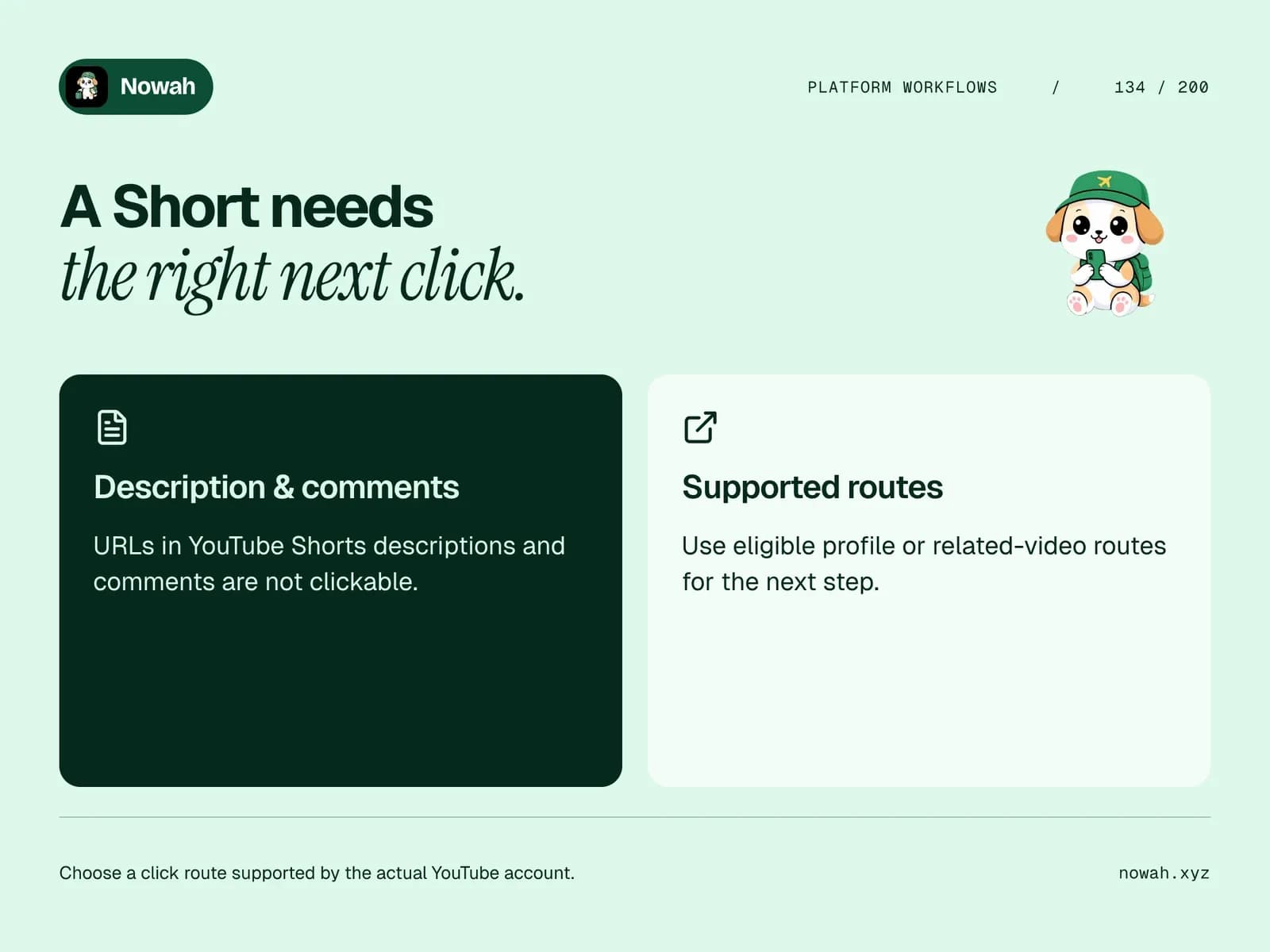
A YouTube Short can explain a travel decision quickly, but the usual instruction to “click the link in the description” can be wrong for this format. Before recommending Nowah, check where the audience can actually take the next step.
YouTube's official link guidance says that URLs in Shorts descriptions and Shorts comments are not clickable. It identifies channel profile links and related-video links as different linking surfaces. Build your instruction around a route available on your channel, rather than treating every video format the same.
For an approved Nowah creator, this matters commercially as well as editorially. Nowah Partners offers 35% of Nowah net revenue from qualifying bookings by eligible new accounts you introduce. A clear route helps a useful recommendation reach the appropriate destination; it does not guarantee attribution or earnings.
Decide what the Short should accomplish
Start with the viewer's next task. A traveller may want to investigate their own trip after watching a practical example. Another creator may want to understand the program and apply.
These audiences need different explanations. A traveller recommendation should lead into a relevant planning task through the approved partner route. A creator-focused explanation should lead toward the program overview and application information.
Do not use a vague instruction such as “start here” to cover both purposes. Explain what the visitor can do after following the route.
The Short itself should still answer a bounded question. A hotel-move tradeoff, arrival-day constraint or rooming question can give the recommendation context. An unexplained product mention followed by a complicated navigation instruction offers little value.
Keep the objective small enough to express clearly. You are designing a useful introduction, not promising to complete every planning and booking step inside a short video.
Separate the content route from the partner link
A related video or profile destination can help viewers reach further explanation. It is not automatically the same thing as your active Nowah partner link.
Map each step explicitly. What does the Short tell someone to open? What does that destination explain? Where does the relevant approved partner route appear, and how is the commercial relationship described?
For a creator application, the official partner portal is the relevant place to apply or sign in. Do not suggest that an ordinary application address attributes travellers to you.
For traveller recommendations, use the active partner route supplied through approval and onboarding. Avoid inventing a URL or assuming that a general Nowah page performs the same attribution role.
The creator-versus-traveller journey guide is useful when your channel covers both travel advice and the business of creating it.
Choose a route the channel can support
Inspect the current channel tools and use the relevant official guidance before writing a step-by-step instruction. The route should reflect the channel's actual setup.
A profile destination can offer a clear place for relevant next steps. A related video can provide a fuller explanation of the planning task before the viewer encounters an external destination. Choose the approach that fits the content and can be verified.
Do not claim that one route converts better without evidence. Do not describe a feature as available merely because another channel uses it. The practical question is whether your own instruction accurately describes what the viewer can find.
If the channel setup changes, update the instruction wherever possible. A route that was accurate for an earlier series may no longer fit the current destination or content purpose.
The Shorts-to-related-video guide develops the longer-explanation route in more detail. It serves a different job from this initial audit of link locations.
Build a route audit card
Use a simple production card with these fields:
- The Short's travel question.
- The audience it addresses.
- The spoken and on-screen next-action wording.
- The channel surface that wording refers to.
- The explanation reached at the next step.
- The actual external destination, if relevant.
- The partner disclosure accompanying the recommendation.
- The date and context of the viewer-journey check.
Write the instruction only after completing the route fields. This prevents you from designing a polished closing screen around a location that does not work as expected.
Keep the card in your own editorial notes. It is a workflow for checking content, rather than a feature claimed to exist inside Nowah or YouTube.
Record the limits of the check. Opening the intended page establishes the navigation behaviour you observed. It does not demonstrate a recorded introduction, eligible account or qualifying booking.
A fictional Short about changing hotels
Imagine a creator explaining whether a short break should use one accommodation base or two. This is a hypothetical production example, not a real traveller story or earnings result.
The Short introduces a fictional brief with limited nights and a fixed event. A simple illustration shows that a second base adds another hotel move, while keeping one base may create different daily journeys.
The creator explains one practical question: which consequence matters more to this traveller's priorities? They then show a verified Nowah planning task or direct the viewer to a fuller explanation that demonstrates it.
Before recording the closing instruction, the creator checks the actual channel route. The instruction refers to that verified destination instead of promising a clickable Shorts-description URL.
The next explanation preserves the same brief and qualifications. It identifies the partner relationship, makes the travel task understandable and offers the appropriate active partner route for interested travellers.
The useful outcome is a clearer decision framework. Nothing in the example claims that viewers clicked, signed up or booked.
Make the handoff understandable on its own
Read the next destination without the Short. Can someone understand the question, the fictional brief and the intended action?
A viewer may arrive without remembering every sentence of the video. The destination should supply enough context to make the recommendation coherent without simply repeating an unexplained promotional slogan.
Keep the promise consistent. A Short about hotel moves should not lead to a page that unexpectedly asks the visitor to become a creator without explaining the change of audience.
Check that the commercial relationship remains clear at the recommendation. A disclosure on a distant channel page should not be the only explanation available to someone evaluating the next action.
For longer videos, the YouTube description-link guide covers that separate publishing surface. Do not copy instructions between formats without checking the applicable tools and behaviour.
Give Nowah a practical role
The strongest Short demonstrates why Nowah is relevant to the traveller's problem. Show how a brief becomes a planning question and how a constraint changes the reasoning.
Use a labelled fictional scenario when teaching. Do not expose another person's identity details or booking information to make the example feel authentic.
Verify the product actions before recording. A planning demonstration should not invent a creator dashboard, earnings notification or confirmed booking status.
Keep supplier facts separate from the illustrative plan. A route diagram does not confirm room availability, actual rate conditions or transport arrangements. Identify the checks that remain when they matter to the decision.
Nowah's article about the twenty-tab planning problem provides useful background for explaining why a coherent brief helps. Your Short should still resolve its own specific question.
Explain what can generate partner earnings
Under the Nowah Partner Program terms, an eligible traveller must follow an active partner link and create a new account within 30 days of introduction. Tracking must successfully reach Nowah. Existing accounts and self-referrals do not qualify.
Valid account attribution can support earnings from later qualifying hotel, flight and paid eSIM bookings throughout that account's lifetime. It is not a guarantee that someone will travel again.
The share is 35% of Nowah net revenue, rather than 35% of the traveller's booking total. Earnings depend on completion, supplier settlement, the applicable hold and payout conditions. A video view, profile visit or external click does not establish that those events have occurred.
This is why the navigation route needs to be accurate while the earning explanation remains measured. Both help the audience understand the recommendation, but they describe different stages.
Review before reusing the Short
Keep the audit card and check it when you change a destination, revise a channel resource or reuse the content in a new series.
Listen to the final instruction again. Does it still name the right surface and task? Does the destination continue to explain the same brief? Have any product or supplier statements become outdated?
Choose a different useful question for the next Short rather than repeating the same broad Nowah pitch. A series of distinct decisions can give the audience a reason to explore more of your content.
If that approach fits your channel, apply to Nowah Partners. Build your first recommendation around a useful travel lesson and a next-click route you can actually verify. That is a stronger starting point than a description URL the format does not make clickable.




