Currency and Pricing Across Markets
Exchange rates, regional pricing strategies, and point-of-sale location all change the fare you see. The AI normalizes prices for fair global comparison.

The same flight costs $800 when searched from New York and $720 when searched from London. Same airline. Same aircraft. Same departure time. Same seat. The only difference is where the search originated. This is not a glitch. It is the product of a multi-layered pricing system that accounts for point-of-sale location, local currency dynamics, and regional market strategies.
For travelers, the implications are significant. The price you see is not the price. It is a price — one of potentially dozens of prices for the same product, filtered through your geographic context. Understanding why these differences exist, and how the AI normalizes them, is the key to making fair comparisons in a global travel market worth approximately $800 billion.
Point-of-sale pricing
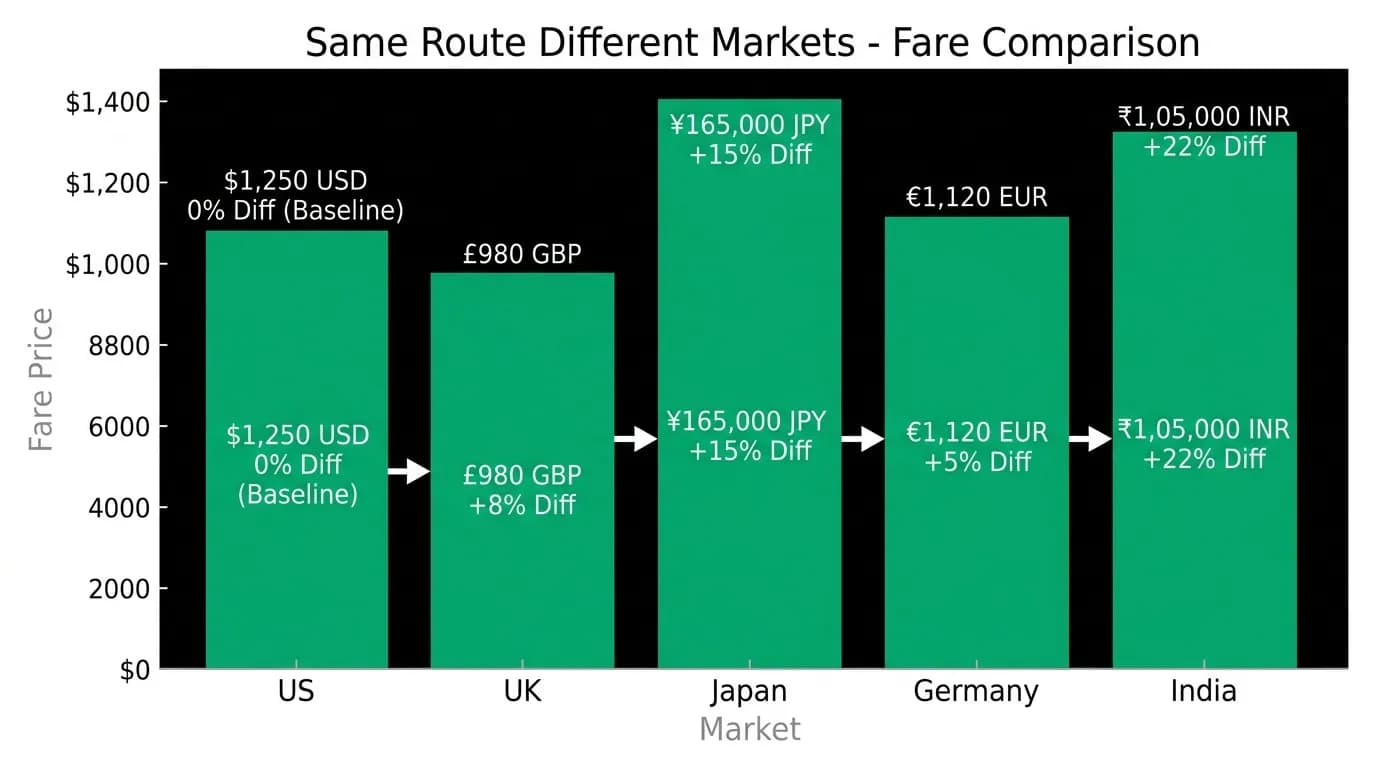
When you search for a flight, your request carries metadata about where you are searching from. This point-of-sale information tells the airline's pricing system which market to pull fares from. Airlines maintain different fare filings for different markets, and these filings can vary by 5 to 15% for the same route.
The reasons are partly competitive and partly strategic. In a market where a low-cost competitor is aggressive, the legacy carrier might file lower fares to compete. In a market where it faces little competition, the same carrier files higher fares because it can. The fares are also influenced by local purchasing power, tax structures, and regulatory requirements that differ by country.
The practical effect is that two travelers searching for the same flight at the same time can see different prices based solely on where they are located. This is not deceptive — airlines have always priced this way — but it is opaque, and most travelers have no idea it is happening.
Currency exchange rate effects
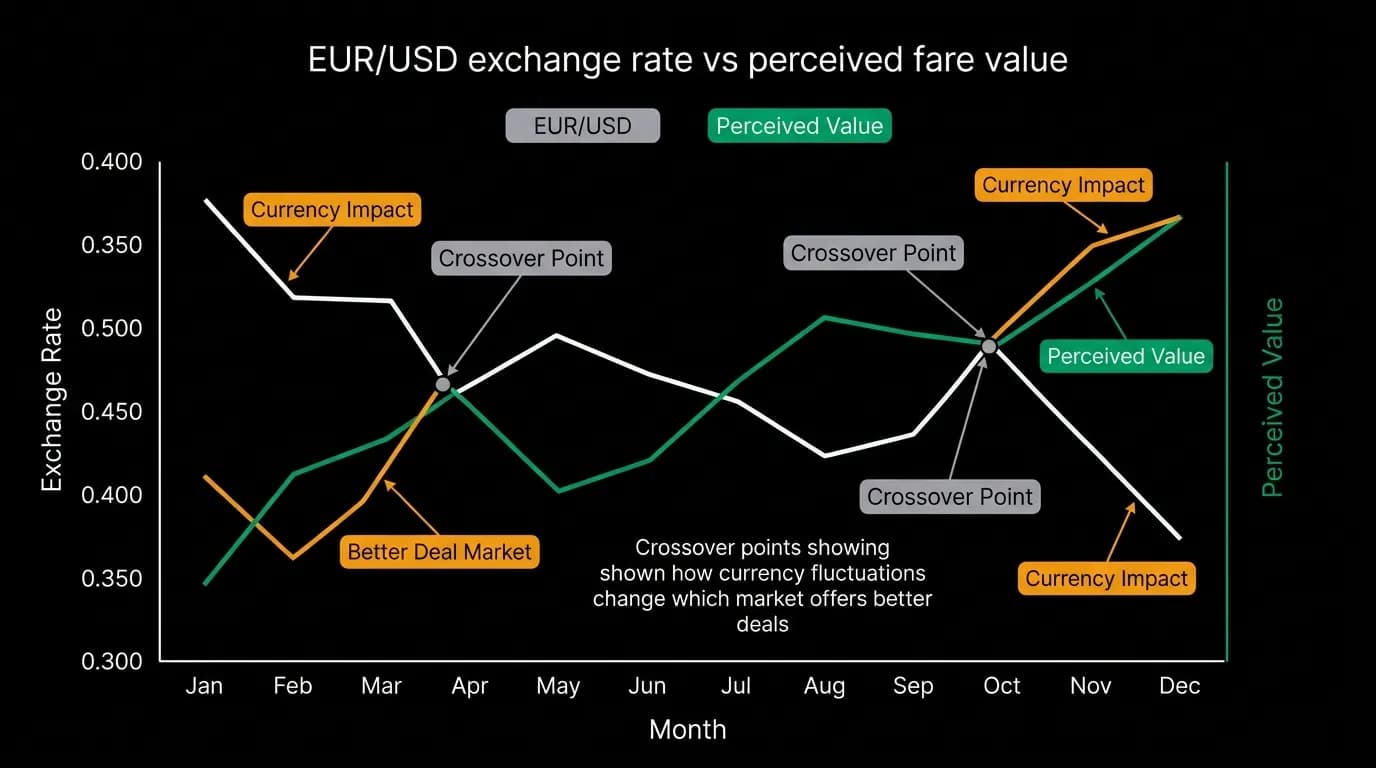
Even when fares are nominally the same across markets, exchange rate fluctuations can change the perceived cost significantly over time. A transatlantic flight priced at 700 euros looked like $770 when the euro was at 1.10. Six months later, with the euro at 1.20, the same nominal price translates to $840. The airline did not change the fare. The currency moved.
Exchange rate effects are particularly pronounced for travelers booking international trips from countries with volatile currencies. A 10 to 20% currency shift over a few months can make a destination that was affordable suddenly feel expensive, or vice versa. This dynamic affects perception of value even when the underlying fare in the airline's base currency has not moved.
For travelers, the timing of a booking relative to exchange rate movements can matter almost as much as the timing relative to fare movements. A strong home currency stretches your travel budget further on international trips. A weak one compresses it.
Regional pricing strategies
Airlines do not just file different fares for different markets — they pursue fundamentally different pricing strategies. In markets with high price sensitivity, like much of South and Southeast Asia, airlines often price aggressively on base fares while unbundling ancillaries (bags, seats, meals) to capture revenue from travelers willing to pay for extras. In premium markets like the US and Northern Europe, fares tend to be higher but include more features in the base price.
This regional strategy means that direct fare comparisons across markets can be misleading. A $400 fare in one market might include luggage and meals. A $350 fare in another market might charge $80 for the same luggage and $15 for a meal, making the true cost $445. Comparing only base fares would suggest the cheaper market has the better deal, when the opposite is true.
The AI handles this by normalizing fares to a total-cost basis that accounts for the ancillaries each traveler actually needs. If you check bags, the bag fee is included in the comparison. If you do not, it is not. This produces an apples-to-apples comparison regardless of how the airline structures its pricing in each market.
The data challenges of normalization
Normalizing prices across currencies and markets is a harder technical problem than it appears. It requires real-time exchange rate data, because rates move throughout the day and a stale rate can introduce meaningful error on a large transaction. It requires understanding which ancillaries are included in each market's base fare, because the same airline bundles differently in different regions. And it requires accounting for local taxes and fees, which vary by departure country and can add 10 to 30% to the base fare.
The AI processes all of these variables to produce a fair comparison. When it shows you three flight options, the prices reflect what you will actually pay in your home currency, including all applicable fees and the ancillaries you need. This is the kind of normalization that would take a human traveler an hour of research and a spreadsheet to replicate.
Searching fairly regardless of origin market
The fundamental promise is that your recommendations reflect genuine value, not geographic pricing artifacts. If a fare is cheaper through a different market, the AI does not hide that information — it presents the best available price for each option, contextualized with the total cost you will actually pay.
This matters most for international travelers, dual-nationality holders, and anyone with connections in multiple countries. The ability to see past point-of-sale pricing and currency effects to the underlying value of each option is a practical advantage that AI-powered travel booking brings to every search.
Search from anywhere. Nowah normalizes pricing for honest comparison, so the fare you see reflects the value you get, not the market you happen to be searching from.
Nowah is an AI travel agent that searches and books real flights and hotels through conversation — no filters, no thirty open tabs. Plan your next trip.