The AI Travel Agent vs. the Human Travel Agent: An Honest Comparison
AI wins on speed, availability, and data processing. Humans still lead on relationship depth and crisis empathy. Here is where each excels — for now.
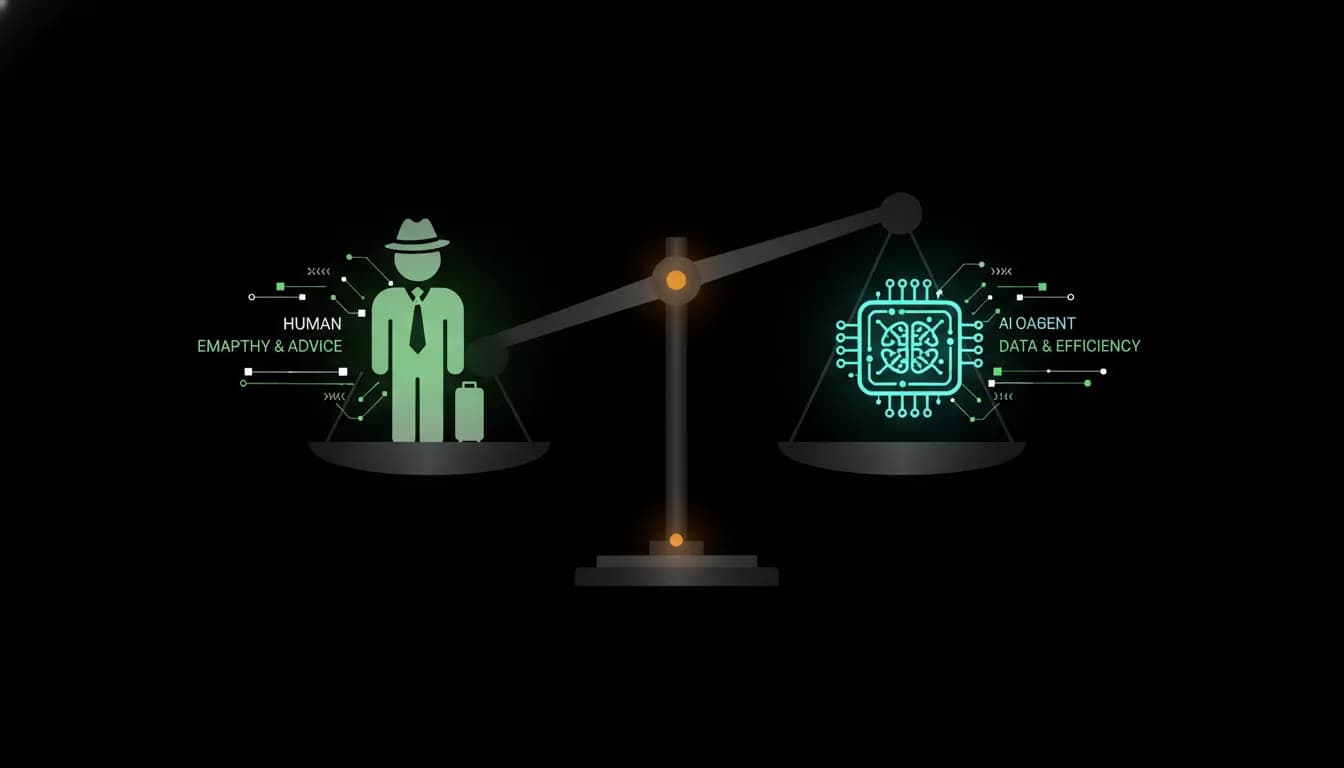
"My travel agent knows me." True. She also manages 80 other clients, works 9 to 5, charges $300 per trip, and took 48 hours to respond to your last request because she was on vacation herself. When your flight was canceled at 11 PM on a Saturday, she did not answer the phone.
"My AI agent knows me too." Also true. It manages millions of clients simultaneously, works 24/7/365, charges nothing per trip, and responds in seconds at any hour. When your flight was canceled at 11 PM on a Saturday, it had already found alternatives before you saw the notification.
Neither portrait is complete. The honest comparison between AI and human travel agents requires examining where each genuinely excels, where each falls short, and where the gap between them is closing faster than most people realize.
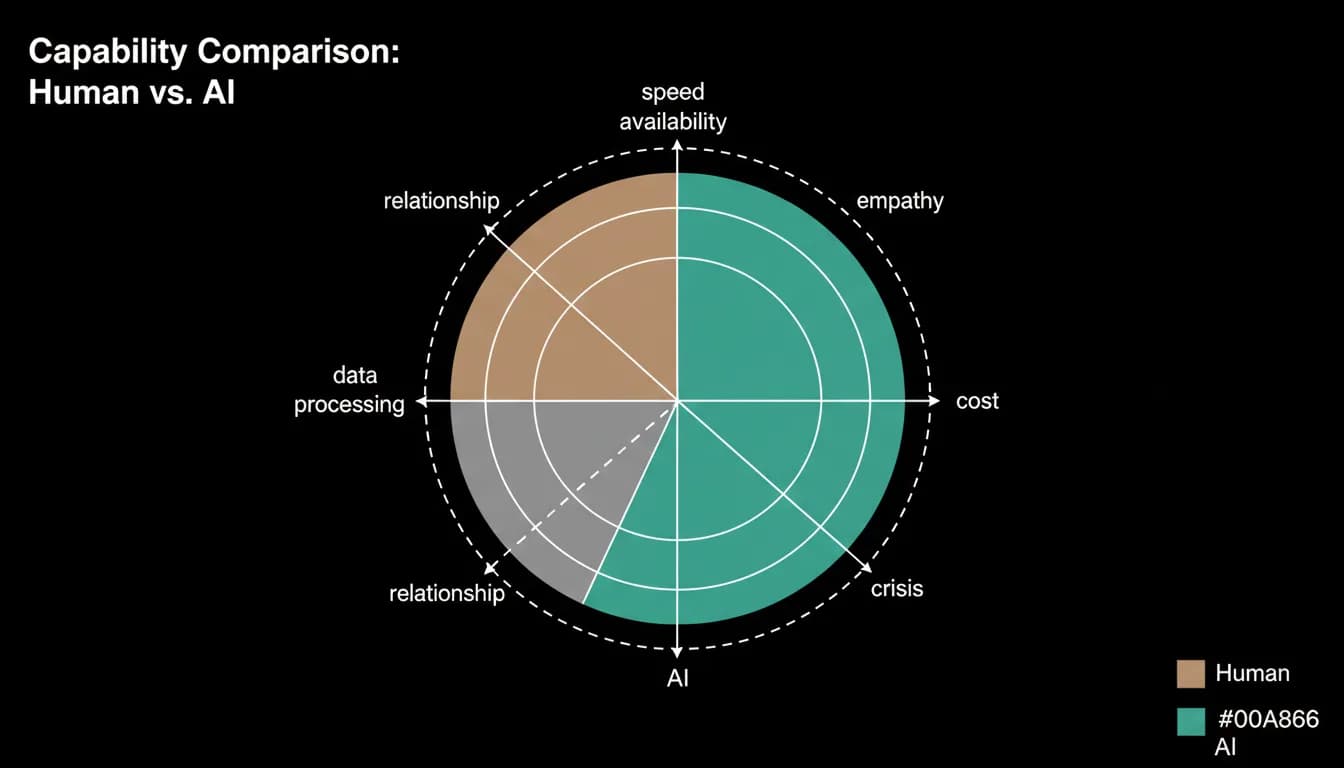
Where AI agents win clearly
Four dimensions where AI agents have a structural, permanent advantage.
Speed. A human agent takes 24 to 72 hours to research and book a trip. They need to check availability, call suppliers, compare options, and assemble a proposal. An AI agent completes the same process in 2 to 5 minutes. This is not a difference that human agents can close — the speed advantage is computational.
Availability. Human agents work business hours. Some offer after-hours emergency lines, but availability is limited. AI agents are available every second of every day, including holidays, weekends, and 3 AM when your connecting flight is canceled in a foreign country.
Data processing. A human agent manually searches 5 to 10 options across their preferred suppliers. An AI agent searches 300 or more airlines and thousands of hotels simultaneously, evaluating each option against your preferences. The human agent can provide a good recommendation. The AI agent can provide a statistically optimized one.
Cost. Luxury travel advisors charge $200 to $500 per trip or $2,000 to $5,000 per year on retainer. Even standard travel agents charge booking fees of $25 to $100. AI agents operate at effectively zero marginal cost per booking, funded by transaction fees or subscriptions that are a fraction of human agent fees.
These advantages are not temporary. They are architectural. No amount of human effort can match computational search speed, 24/7 availability, or zero marginal cost per interaction.
Where human agents still lead
Three dimensions where human agents maintain a genuine edge.
Relationship empathy. A human agent who has planned your trips for a decade knows things about you that are hard to capture in a preference profile. They remember that your last anniversary trip was emotional because it was the first after losing a parent. They intuit when you need a restful trip versus an adventurous one based on subtle conversational cues. This emotional intelligence — reading between the lines of what you say and what you need — remains distinctly human.
Crisis calm. When things go seriously wrong — a medical emergency abroad, a natural disaster, a family crisis mid-trip — the best human agents are extraordinary. They make phone calls, pull strings, negotiate with hotel managers, coordinate with insurance companies, and provide emotional reassurance while doing it. The human touch during a genuine crisis is qualitatively different from an AI agent's efficient but transactional problem-solving.
Ultra-bespoke arrangements. The dinner on a private island arranged through a personal favor. The after-hours museum tour secured through a relationship with the curator. The last-minute upgrade obtained by calling a hotel general manager they know by name. These arrangements require human networks, personal relationships, and sometimes creative problem-solving that AI agents cannot yet replicate.
The rapidly closing gap
The gap between AI and human agents is narrowing faster than most travelers realize.
Preference accuracy. After a handful of trips an AI agent is working from a detailed preference profile. A good human agent gets there too — but the AI agent serves every client at that depth simultaneously, while the human agent allocates attention across 50 to 100 clients.
Emotional context. Agentic memory systems are beginning to capture emotional and contextual information: "The traveler mentioned stress at work during the last booking. Previous post-work-stress trips emphasized quiet resorts and spa access." This is not empathy, but it is functional emotional awareness that produces empathy-like recommendations.
Network access. As more luxury experiences, exclusive tours, and special arrangements become bookable through APIs and platforms, the advantage of human networks diminishes. The hotel upgrade that required a phone call in 2020 is increasingly available through a loyalty program integration or a direct API in 2026.
Crisis management. AI agents are adding real-time crisis capabilities: automatic rebooking during disruptions, coordination with insurance providers, and multi-channel communication. The execution is improving rapidly, even if the emotional support component remains limited.
The hybrid future
The likely outcome is not AI replacing human agents or human agents surviving unchanged. It is a hybrid model where AI handles 90 percent of trips and human agents focus on the 10 percent where their advantages are decisive.
The 90 percent: standard leisure trips, business travel, straightforward bookings, routine changes and modifications, disruption handling, price optimization, and preference-based recommendations. AI agents handle these better, faster, and cheaper than human agents.
The 10 percent: ultra-luxury multi-week itineraries, crisis management requiring emotional intelligence, arrangements that depend on personal relationships, and travelers who value the human relationship itself as part of the travel experience.
Some human agents will evolve into hybrid practitioners — using AI agents as their operational backbone while adding the human layer for complex or emotionally sensitive situations. The AI handles the search, comparison, and logistics. The human provides the judgment, the relationship, and the reassurance.
The cost equation
The economics are unambiguous. A human travel agent who manages 80 clients and charges $300 per trip generates $24,000 per year per client if each client takes 80 trips (unrealistic) — or $900 per client per year at 3 trips each. The agent needs to earn a living, which means the fees must cover their salary, office costs, and business expenses.
An AI agent serving many clients at near-zero marginal cost can operate on a subscription fee in the region of $10 per month, or around $80 a year paid annually, versus $900 or more for a human agent. Nowah sits in that range.
For the traveler who takes 3 to 5 trips per year, the AI agent provides comparable or superior service at a fraction of the cost. For the ultra-luxury traveler taking one $50,000 trip, the $5,000 human advisor fee may be justified by the depth of service on that single high-stakes booking.
Match agent to trip
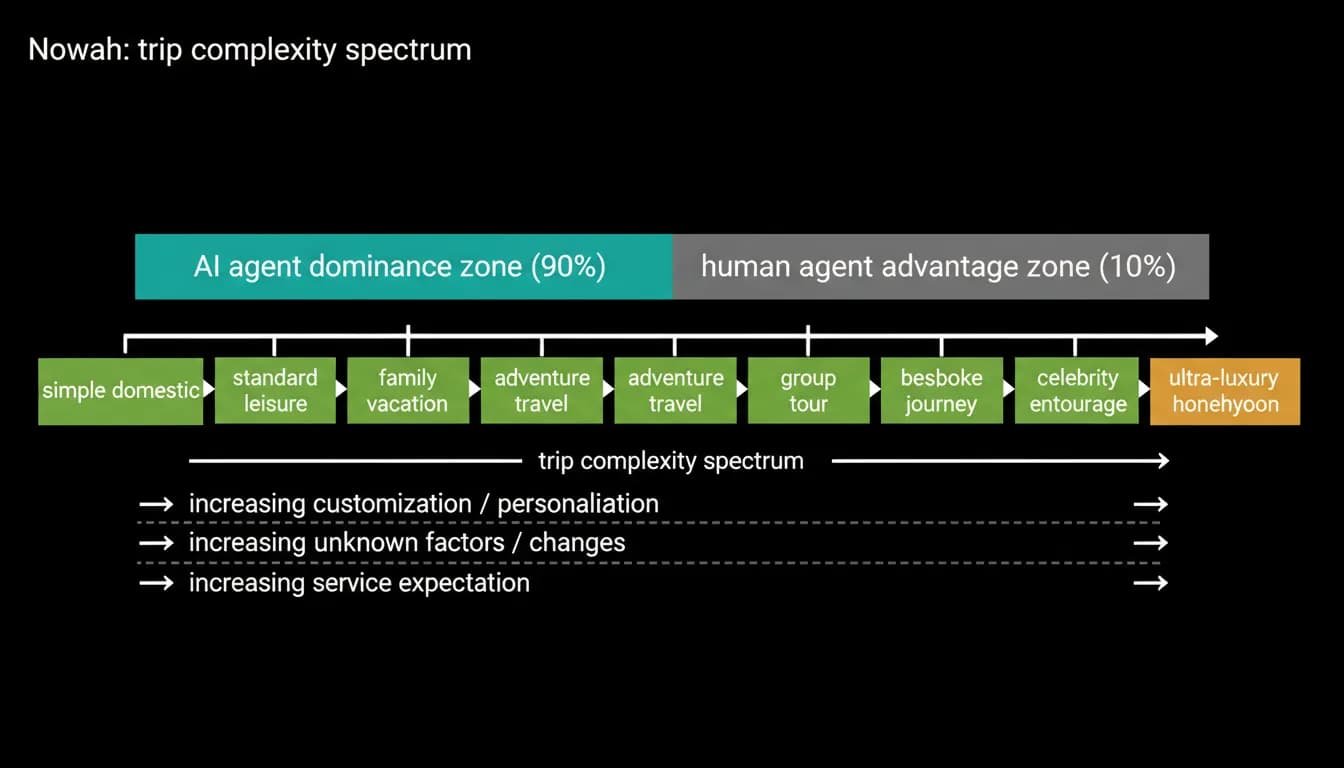
The decision framework is straightforward.
Simple domestic travel. AI agent. No question. Speed, cost, and availability advantages are decisive.
Standard international leisure. AI agent. The combination of cross-carrier search, preference memory, and visa/document checking matches or exceeds what most human agents provide.
Business travel. AI agent. The 24/7 availability and disruption handling advantages are critical for business travelers.
Complex multi-week luxury itinerary. Human agent or hybrid. The trip is high-stakes enough to justify the premium, and the bespoke arrangements may require human networks.
Crisis-prone destinations or situations. Consider a human agent as backup. The emotional support during a genuine crisis may be worth the cost.
For 90 percent of travelers on 90 percent of trips, the AI agent is the better choice on every measurable dimension. For the remaining situations, human agents retain a genuine, though narrowing, advantage. The honest comparison favors neither absolutely — it favors matching the right agent type to the right situation.
Nowah is an AI travel agent that searches and books real flights and hotels through conversation — no filters, no thirty open tabs. Plan your next trip.