How the AI Decides Between Direct and Connecting Flights
The direct-vs-connection tradeoff is not just price. Total travel time, connection risk, and personal preference all factor into the AI's routing decision.

A connecting flight saves $200 but adds four hours and requires a terminal sprint in Atlanta. Is that worth it? The answer is not universal. It depends on who is asking. A budget backpacker with flexible timing says yes. A business traveler who needs to arrive fresh says no. A parent traveling with a toddler says absolutely not. The direct-vs-connecting decision is one of the most personal tradeoffs in travel, and the AI treats it that way.
The price-time tradeoff
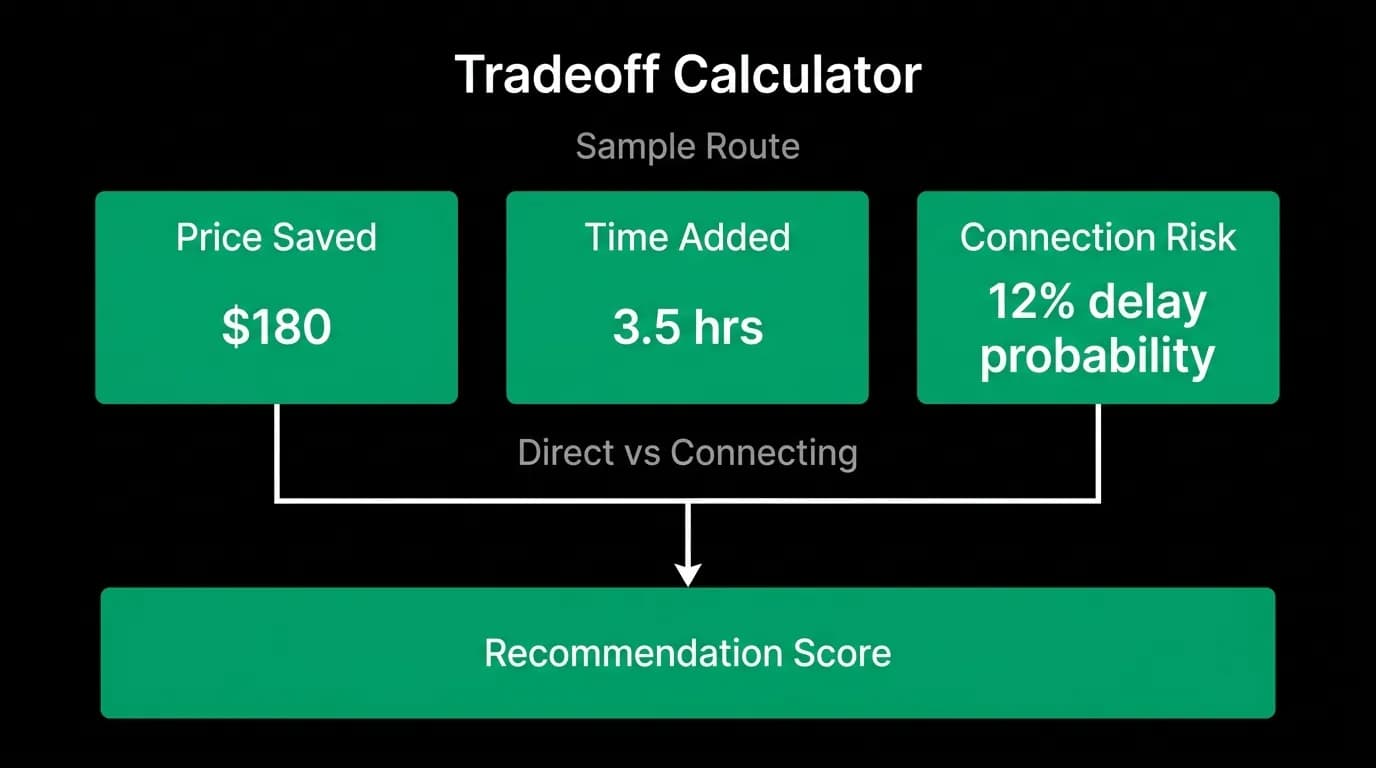
On competitive routes, direct flights command a premium of 20 to 40% over the cheapest connecting alternatives. This premium represents the market price of convenience — the value travelers collectively place on avoiding the time, hassle, and risk of a connection.
The AI quantifies this tradeoff in terms that make the decision concrete. If a direct flight costs $400 and the connecting alternative costs $250, the nonstop premium is $150 for roughly three to four hours of saved time. That works out to $37 to $50 per hour of travel time saved. Whether that is worth it depends on how the traveler values their time, which the AI infers from booking history and stated preferences.
For travelers who consistently choose direct flights, the AI weights the nonstop option more heavily. For travelers who consistently choose the cheapest option regardless of connection count, the AI weights price. The scoring is not ideological — it reflects individual behavior.
Connection risk: the hidden cost
The price-time comparison understates the real cost of connections because it ignores risk. A connecting itinerary introduces the possibility of a missed connection, which can cascade into rebooking, delay, and sometimes a lost day of travel.
Connection risk is a function of several compounding factors. The inbound flight's delay probability sets the base risk. The airport's transition difficulty amplifies or dampens it — a same-terminal connection with 90 minutes of padding is low risk; a terminal-change connection with 60 minutes at a congested airport is high risk. Weather exposure at the connecting airport adds seasonal risk.
The AI calculates a composite connection risk score for each connecting itinerary and factors it into the ranking. A connecting option that saves $150 but carries a 15% probability of a missed connection has a different expected value than one that saves $150 with a 3% miss probability. The risk is not visible in the ticket price, but it is visible in the recommendation score.
Terminal changes are a major risk factor. At airports where changing terminals requires exiting security and re-entering, terminal changes add 30 to 60 minutes to the real connection time. Airlines sometimes sell connections with published minimum times that assume everything goes perfectly. The AI applies more conservative estimates based on actual transit data.
When a connection is genuinely better
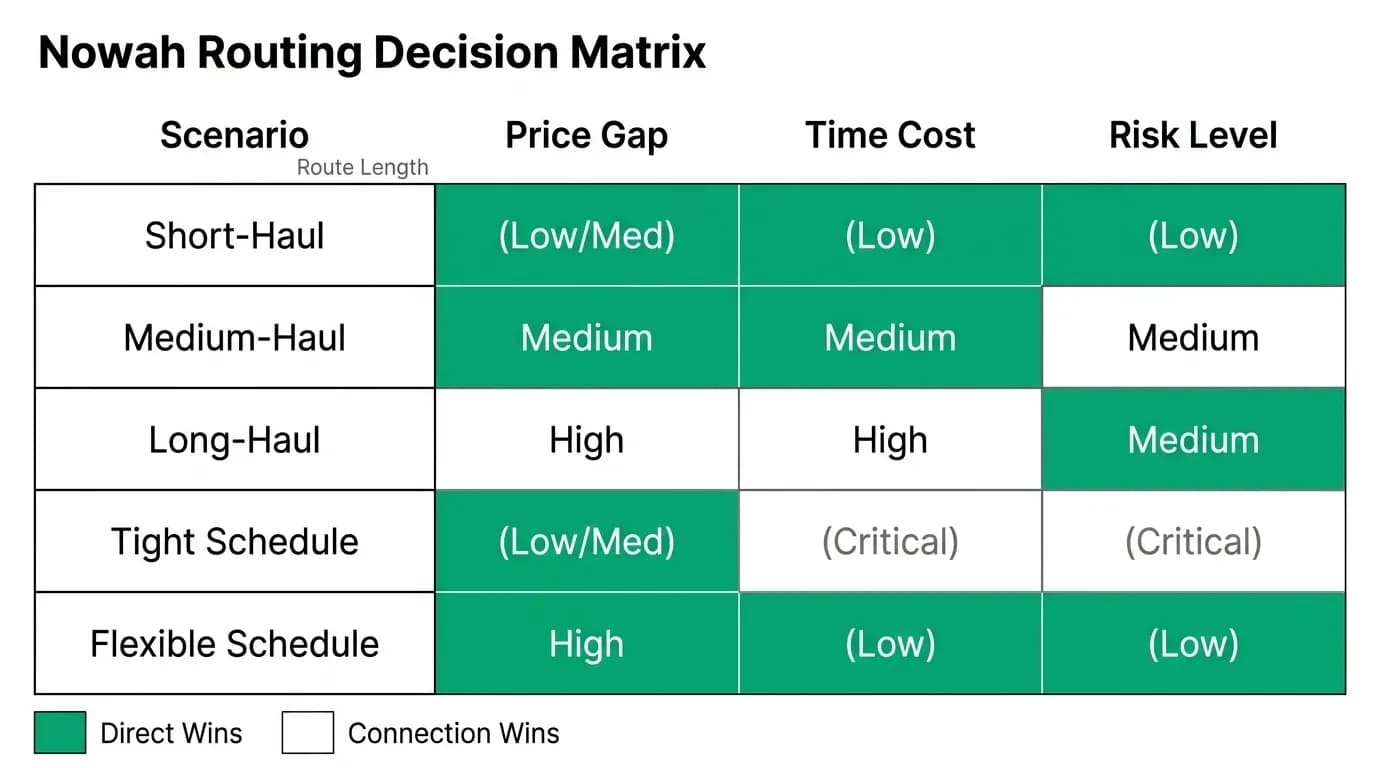
Not all connections are compromises. Some connecting itineraries are genuinely better than the direct alternative for specific travelers.
Layover airports that are pleasant experiences in their own right can make a connection feel like a bonus rather than a penalty. Certain Middle Eastern and Asian hubs have airport experiences — lounges, dining, gardens, amenities — that make a three-hour layover enjoyable. For travelers with lounge access (through credit card benefits or airline status), these layovers can be genuinely relaxing breaks in a long journey.
Price savings on connections can be substantial enough to fund upgrades. If the connecting flight saves $300, and premium economy on the direct flight costs $250 more than economy, the math suggests taking the connection in economy and upgrading on the direct for a net savings of $50 and a better flying experience. The AI surfaces these kinds of creative tradeoffs.
The personal preference factor
Some travelers have an absolute preference for nonstop flights. They will pay whatever premium exists to avoid connections. This is not irrational — it reflects a genuine utility preference for simplicity, certainty, and minimal airport time. The AI respects this as a near-hard constraint, showing the connecting alternative only when the price difference is extreme enough to warrant consideration.
Other travelers genuinely do not mind connections and view the layover as a break. For these travelers, the connecting option is not a compromise at all, and the AI scores accordingly.
The diversity guarantee ensures that when the direct-vs-connecting tradeoff is meaningful, both options appear in the top three. The budget pick might be the connection. The comfort pick might be the nonstop. The balanced pick might be a connection through a high-quality hub that offers most of the convenience of nonstop at a lower price.
Search on Nowah and see both direct and connecting options with transparent tradeoff data. The AI shows you exactly what you save, what you risk, and what you give up — so the routing decision is yours to make with full information.
Nowah is an AI travel agent that searches and books real flights and hotels through conversation — no filters, no thirty open tabs. Plan your next trip.