The Economics of Flight Search: Why Fewer Is Better
Time, cognitive load, decision regret, and opportunity cost — the hidden price of searching 38 sites. Data makes the case for AI curation.

You spent 12 hours comparing flights across a dozen websites. You found a fare $47 cheaper than the first option you saw. Was that worth your time?
If your time is worth $30 an hour (a conservative estimate for anyone with disposable income for travel), those 12 hours cost you $360 in opportunity cost. You "saved" $47. Net result: you are $313 poorer in time value. And that is before accounting for the cognitive load, the decision stress, and the nagging regret that maybe, somewhere on site number 39, there was an even better deal.
The economics of manual flight search are terrible. We just have not had an alternative good enough to stop doing it.
The time cost
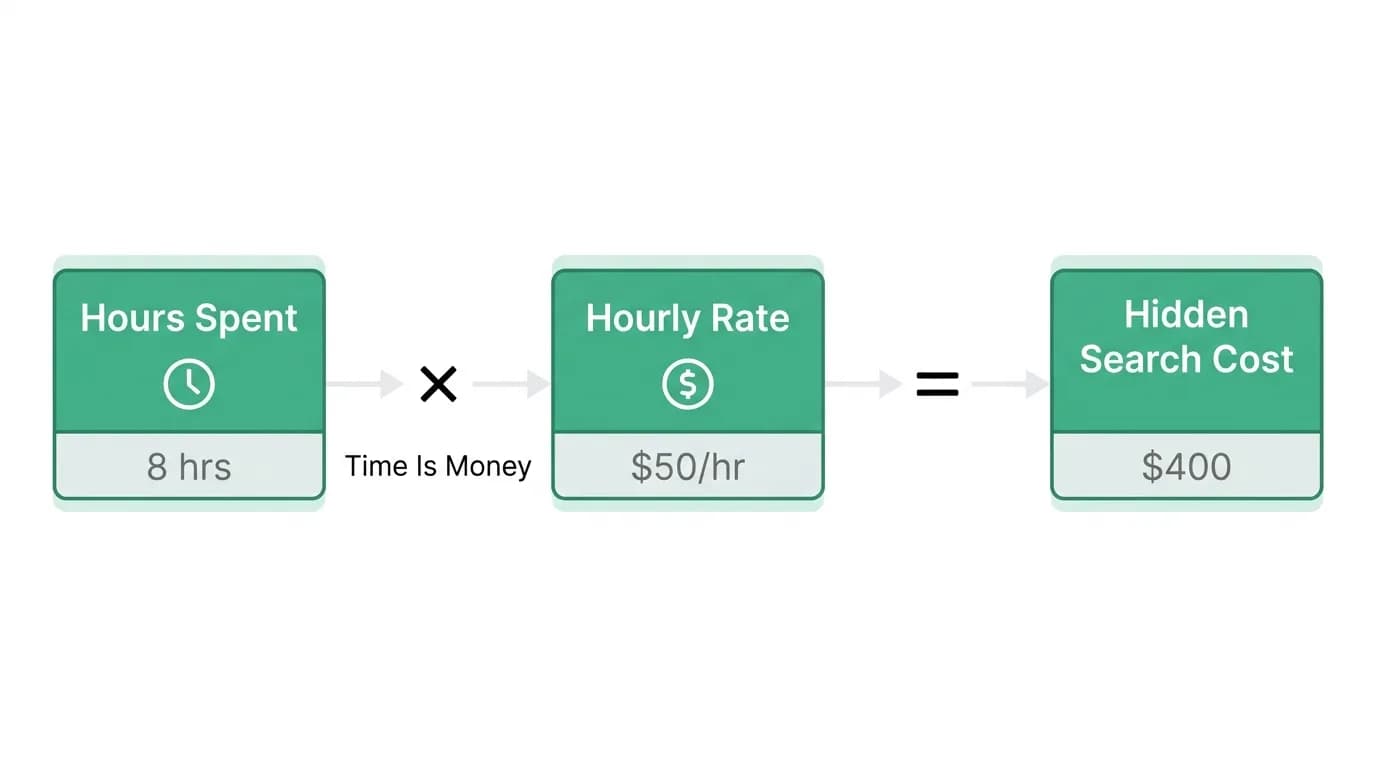
The average traveler visits dozens of websites over 45 sessions before booking a trip. For international flights, the average search-to-booking timeline stretches to 30-45 days. That is a month-long part-time job spread across dozens of browser sessions, each one a context switch that requires remembering where you left off.
I do not think most people calculate the time cost of their flight search because the time is spent in small increments. Fifteen minutes here, twenty minutes there. It does not feel like 12 hours. But it adds up, and the opportunity cost is real even if it is invisible.
What could you do with 12 hours? Sleep better. Spend time with your family. Work on something that actually pays you. Research the destination instead of researching how to get there. The irony of travel planning is that people spend more time searching for flights than they spend exploring what to do once they arrive.
Cognitive load and decision quality
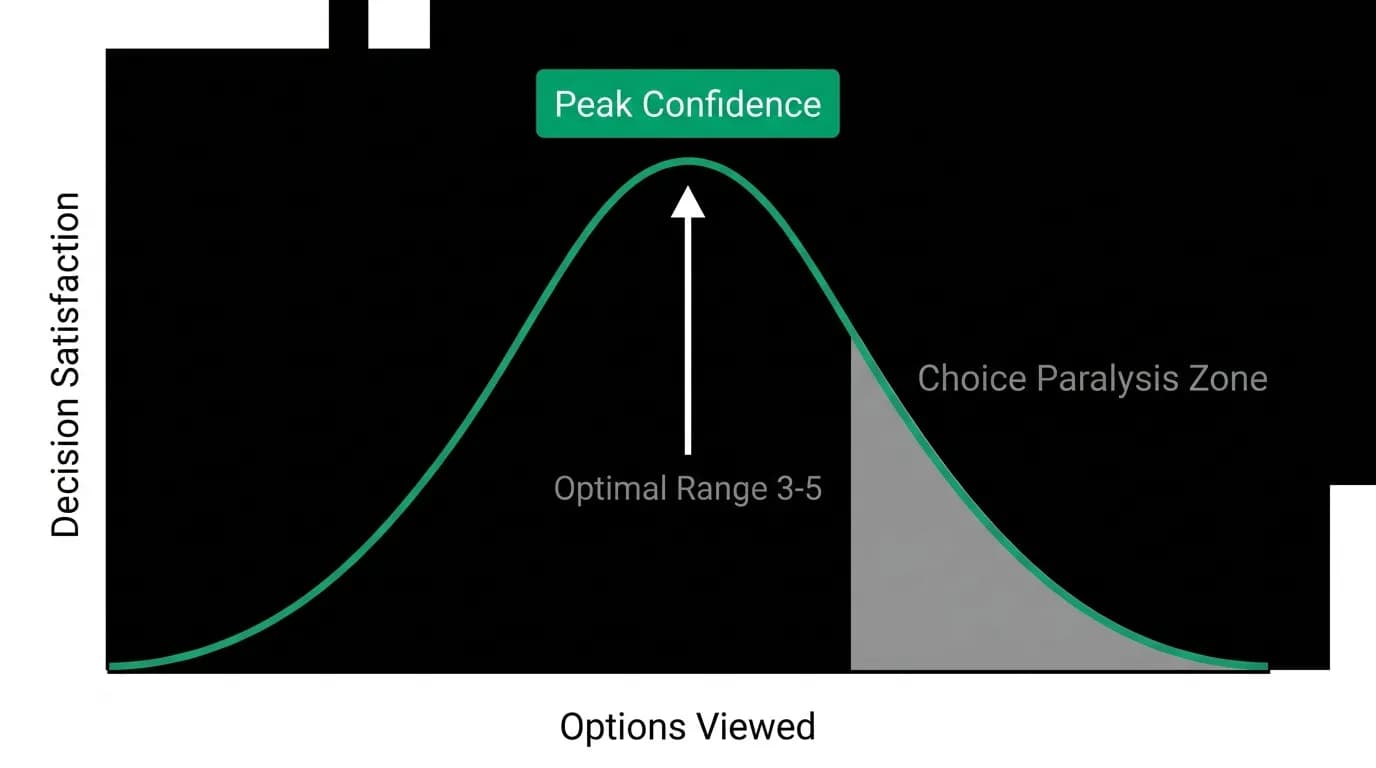
Decision quality degrades with option overload. This is not a theory. It is backed by decades of behavioral economics research. After evaluating ten flight options, your ability to distinguish meaningful differences between option eleven and option twelve is significantly impaired. By option fifty, you are not making rational comparisons anymore. You are satisficing, which means grabbing the first thing that seems acceptable to end the pain.
Many travelers report that booking is the most stressful part of trip planning. That stress is the subjective experience of cognitive overload. Too many options, too many variables (price, timing, stops, airlines, airports), and not enough guidance on which variables matter most for your specific situation.
Decision satisfaction decreases as option count increases beyond 3-5. This is the well-documented finding that having more choices makes you less happy with whatever you choose, because the existence of unchosen alternatives creates "what if" anxiety.
Decision regret
"What if I missed a better deal?" This anxiety persists after booking and sometimes for the entire trip. You see an ad for a lower fare on the same route. A friend mentions they found a better price. You check the price again and it dropped after you booked.
Decision regret is a real psychological cost of manual search. The more options you evaluated, the more unchosen alternatives haunt you. The more time you invested, the higher your expectations and the more painful any evidence that you chose suboptimally.
Curation reduces regret because it reframes the decision. Instead of "I chose this out of 200 options and I hope it was the right one," the framing becomes "the AI evaluated 200 options and recommended this one, and here is why." The burden of proof shifts from you to the system, and the explanation provides reassurance.
Opportunity cost of the booking process
The 30-45 day booking timeline for international flights has a hidden cost beyond time: delayed commitment leads to worse outcomes. Fares tend to rise as departure dates approach. Every day you spend deliberating instead of booking is a day where the price might increase.
Many travelers abandon bookings due to price uncertainty. Some of those abandoned bookings would have been good deals if booked at the time. The deliberation itself costs money by pushing the purchase into a higher price window.
Curated interfaces convert meaningfully higher than uncurated search. Part of that conversion lift comes from faster decision-making, which means booking earlier, which often means booking cheaper.
The case for AI curation
The math is simple. If AI curation saves you 10 hours of search time and produces a recommendation that is within $20 of what you would have found manually, the value proposition is overwhelmingly positive. You traded $20 in potential savings for 10 hours of your life. Nobody with the disposable income to travel should make that trade.
In practice, AI-curated recommendations often match or beat what manual search produces because the AI evaluates more options more systematically than any human can. It does not get tired. It does not forget which options it already checked. It does not get swayed by an attractive photo that has nothing to do with the flight itself.
Reclaim those 12 hours. Let Nowah search once and recommend the best three. The economics work out in your favor every time.
Nowah is an AI travel agent that searches and books real flights and hotels through conversation — no filters, no thirty open tabs. Plan your next trip.