From Chat to Booking: How a Conversation Becomes a Trip
Follow the complete data flow from your first message through AI processing, ranking, recommendation, payment, and booking confirmation.

You type "I need a flight to Paris." Seven words. In the seconds that follow, an entire pipeline activates: intent parsing, memory recall, live data retrieval, multi-factor scoring, diversity-guaranteed shortlist construction, explanation generation, and real-time streaming of the response back to your screen.
I want to walk through every stage because understanding what happens behind a recommendation builds trust in the recommendation itself.
Message intake: parsing intent and recalling memory
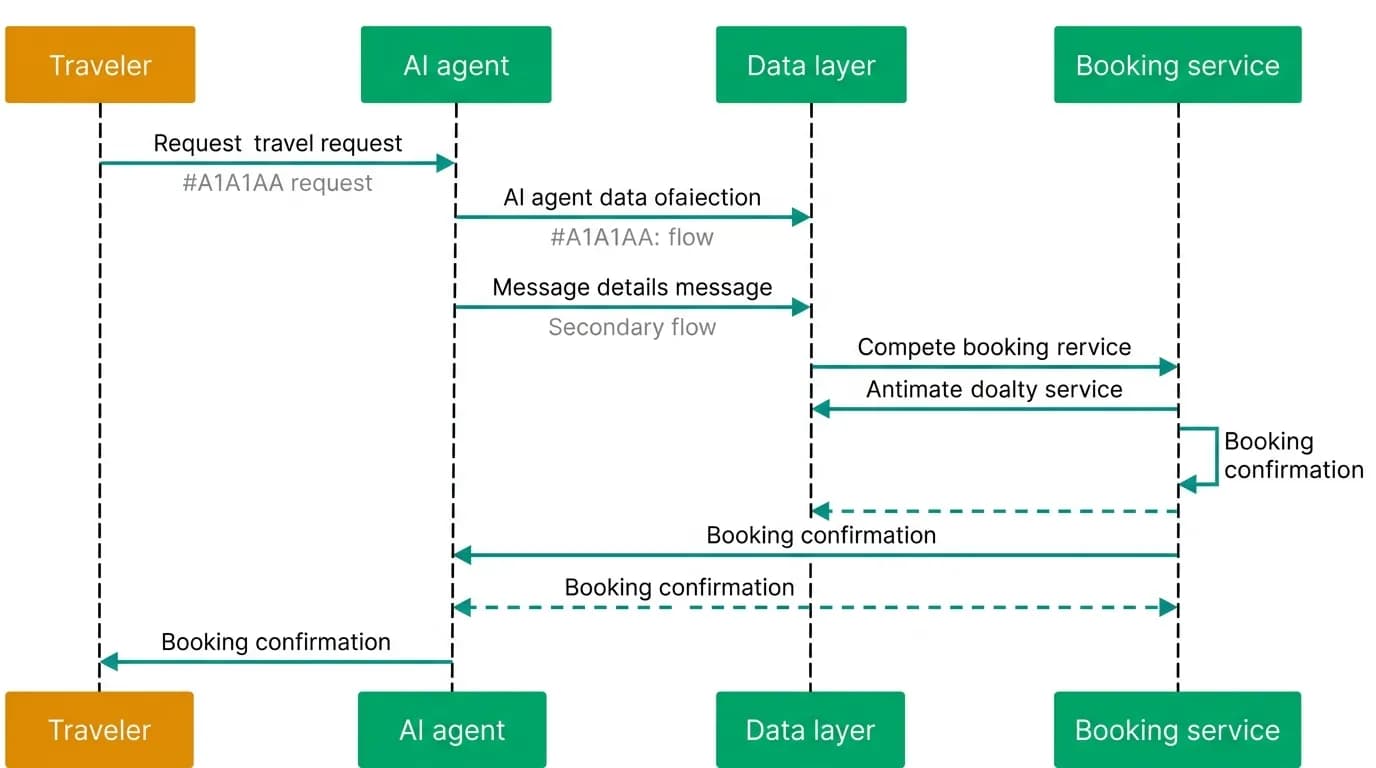
The moment your message arrives, two things happen in parallel. First, the AI parses your intent. "I need a flight to Paris" gets decomposed into structured constraints: travel mode (flight), destination (Paris), and implied origin (your home city or last-searched departure point).
Second, the AI queries your agentic memory. Before it does anything else, it recalls what it already knows about you. Your seat preference. Your airline loyalty. Your typical budget range. Your schedule patterns. Whether you have been to Paris before and what you thought of it. All of this context is loaded before the first search query fires.
This dual-track processing is what separates an AI-native booking from a chatbot bolted onto a search engine. The chatbot sends your query to the same search API and returns the same generic results. The AI agent starts with context about you.
Data retrieval: live pricing and availability
With your intent parsed and context loaded, the AI queries live flight inventory. It is not checking cached data or yesterday's prices. It is pulling real-time availability, real prices, and real seat inventory.
Roughly 180 candidate itineraries come back for a typical search. Each one has a departure time, arrival time, carrier, fare class, number of stops, layover airports and durations, and a price that is accurate as of that moment.
This is where the data layer earns its keep. Travel pricing is volatile. Airlines adjust fares 3-5 times daily on competitive routes. Stale data leads to the frustrating experience of seeing one price and being charged another. Real-time retrieval avoids that.
Multi-factor ranking and the diversity guarantee
The 180 candidates now enter the ranking engine. Each gets scored across several dimensions: price relative to historical median, schedule alignment with your preferences, comfort factors, layover quality, airline quality signals, and personal fit based on your memory profile.
The scoring produces a ranked list, but the AI does not just take the top three. It applies a diversity guarantee: the final shortlist must include at least one budget-optimized pick, one comfort-optimized pick, and one balanced option. This prevents the results from clustering around one narrow sweet spot and gives you meaningful choices.
Explanation generation
Each of the three finalists gets an annotation explaining why it was selected. "This is 22% below the 90-day average for your route." "Non-stop on your preferred alliance with a morning arrival." "Highest comfort score with premium cabin at a moderate premium."
The explanations are not generic. They reference your specific preferences and the specific data behind the recommendation. This is what turns a list of options into actionable intelligence.
Real-time streaming
You see all of this unfold in real time. The AI streams its response as it works, including status updates when it is searching for flights or evaluating options. There is no spinner that disappears after 30 seconds and dumps a wall of text. You watch the process happen.
Streaming serves two purposes. It keeps you engaged instead of wondering whether the app froze. And it builds trust because you can see the AI doing actual work on your behalf rather than generating a plausible-sounding response from nothing.
From selection to payment
You pick option B. The conversation continues. "Book this one." The AI confirms the details: passenger name, contact info, and payment. Your traveler details are already stored from previous trips, so there is nothing to re-enter. Your payment method is on file. The booking pipeline handles the transaction with redundancy built in to ensure reliability.
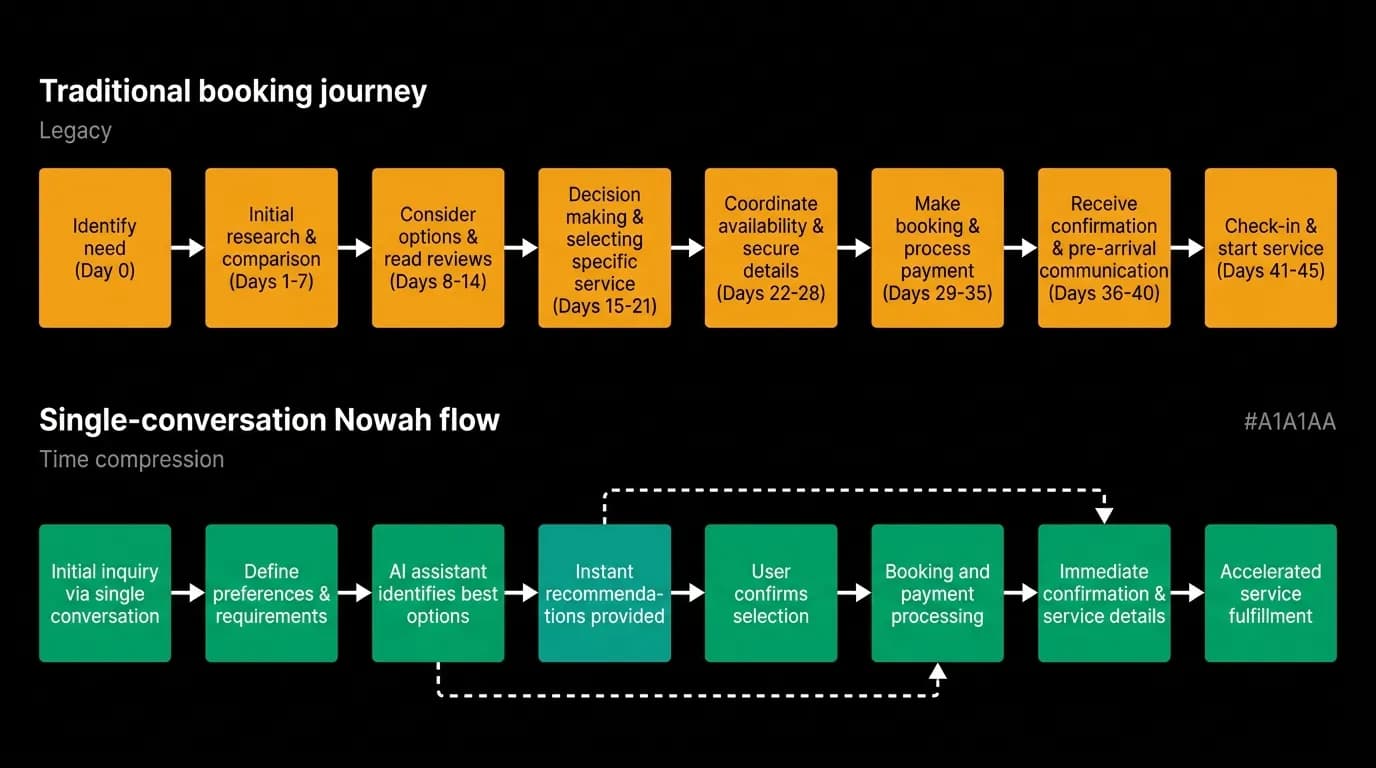
The entire journey from "I need a flight to Paris" to a confirmed booking collapses from the traditional 38-site marathon spanning 30-45 days to a single conversation lasting minutes. The data pipeline, the ranking intelligence, the memory system, and the booking infrastructure all work together to make that compression possible.
Start a conversation on Nowah and experience the full flow yourself. The gap between typing a message and holding a confirmed booking is shorter than you think.
Nowah is an AI travel agent that searches and books real flights and hotels through conversation — no filters, no thirty open tabs. Plan your next trip.