How the AI Handles Conflicting Preferences
\\\"Cheapest flight, great airline, no layovers\\\" — when preferences conflict, the AI detects the tradeoff, quantifies the cost, and explains your options.

"I want the cheapest nonstop flight on a great airline." It sounds like a reasonable request until you run the math. On most routes, the cheapest fare is rarely nonstop. The nonstop flights are rarely on the cheapest airline. And the "great" airlines rarely have the lowest prices. Something has to give.
Conflicting preferences are not exceptions in travel planning. They are the norm. Most travelers want low prices, high comfort, convenient schedules, and reliable airlines simultaneously. These goals frequently pull in different directions, and the AI's job is not to pretend they do not conflict but to detect the tension, quantify the cost of each compromise, and explain the tradeoffs clearly.
How the AI detects conflicts
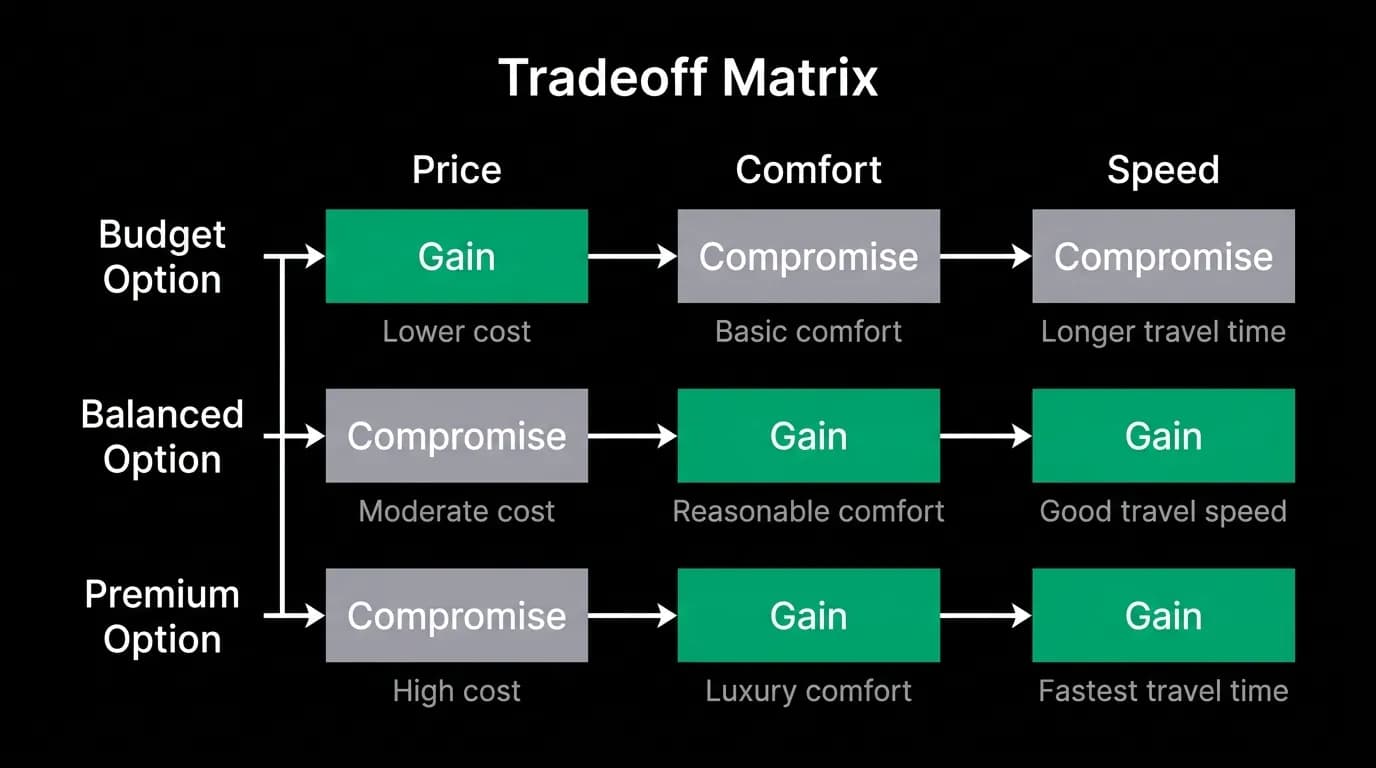
The detection starts during intent parsing, when the AI breaks down your request into individual constraints. "Cheapest" becomes a price-minimization objective. "Nonstop" becomes a routing constraint. "Great airline" becomes a quality filter. Each constraint is straightforward in isolation. The conflict emerges when satisfying one constraint makes another harder to satisfy.
The AI runs the scoring model and examines whether the top-ranked option under one objective is ranked poorly under another. When the cheapest flight is a two-stop on a carrier with low quality scores, and the best nonstop option costs significantly more, the system flags this as a tradeoff that the traveler should see explicitly.
Not all preference conflicts are obvious to the traveler. You might ask for an early morning departure and a short layover, not realizing that the only short-layover connections on that route require a mid-afternoon departure. The AI identifies these hidden conflicts and surfaces them rather than silently making a choice on your behalf.
Quantifying the cost of each compromise
The most useful thing the AI does with conflicting preferences is put a number on the tradeoff. "Nonstop costs $180 more than the cheapest one-stop option." "The highest-rated airline on this route charges $120 more than the budget carrier." "An afternoon departure instead of morning saves $95."
These numbers transform vague tradeoffs into concrete decisions. Instead of wondering whether nonstop is "worth it," you know exactly what it costs. Instead of debating whether to fly the better airline, you know the premium. The AI does not make the decision — you do — but it ensures you are making it with full information.
The quantification is personalized. The AI considers your historical behavior to estimate how much you typically value each dimension. If you have never paid for a direct flight premium in the past, the system might weight price more heavily in its initial recommendation. If you have consistently chosen nonstop flights even at a premium, that pattern informs how it presents the tradeoff.
Three-option diversity as tradeoff resolution
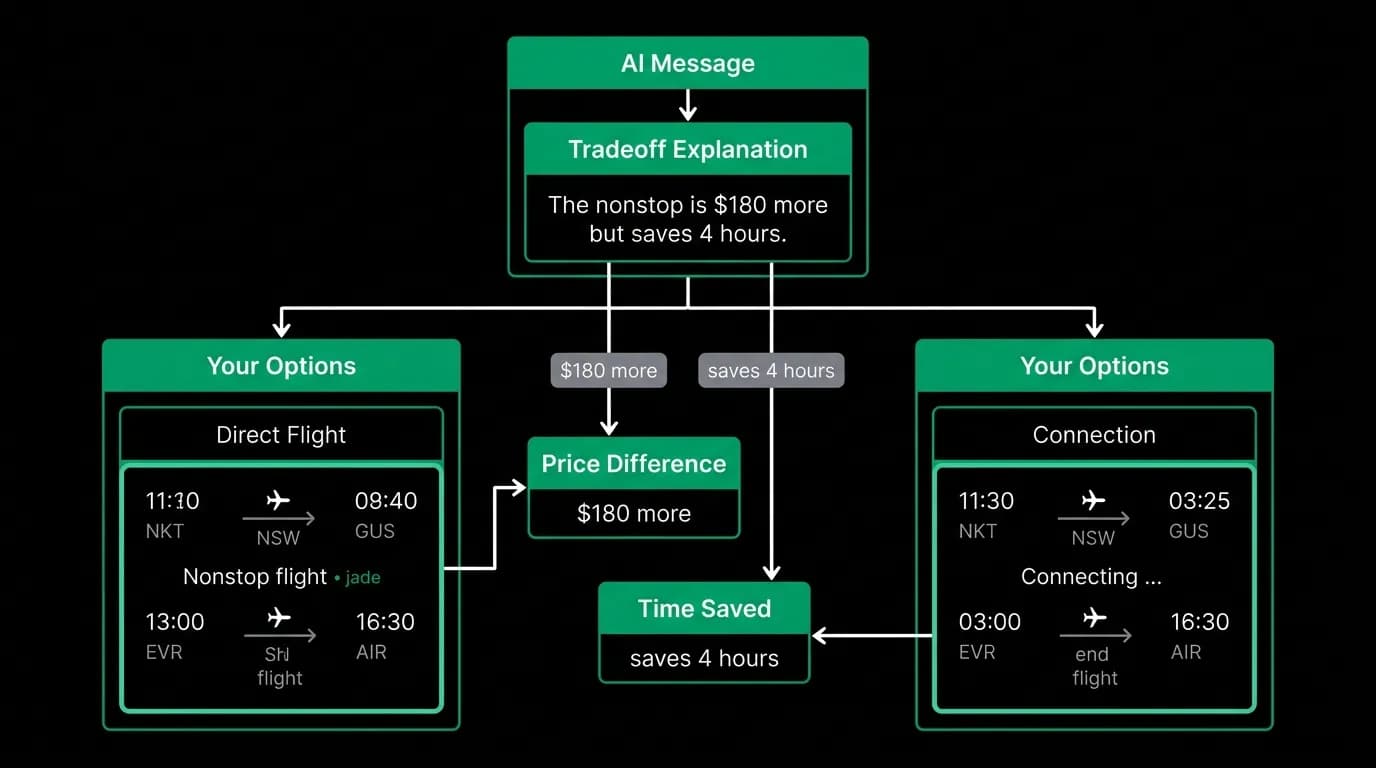
The three-option recommendation framework is specifically designed to handle tradeoffs. Instead of collapsing all preferences into a single "best" pick that inevitably compromises on something, the AI presents three options that resolve the tradeoff differently.
The budget pick prioritizes price, accepting compromises on other dimensions. It might be the connecting flight on the less prestigious carrier with a workable schedule. The comfort pick prioritizes experience, accepting a higher price. It might be the nonstop on the top-rated carrier. The balanced pick finds the middle ground that most travelers end up choosing — reasonable price, decent airline, acceptable schedule.
This structure acknowledges that "best" depends on what you value most in the moment, and it lets you see all three resolution strategies side by side. The AI annotates each option with why it was selected and what it traded off, so the comparison is transparent.
When the AI asks vs. when it decides
Sometimes the tradeoff is small enough that the AI resolves it silently. If the price difference between two airlines is $15 and one has significantly better quality scores, the AI simply ranks the better airline higher without flagging it as a tradeoff. The threshold for silent resolution is calibrated based on the traveler's demonstrated sensitivity to each dimension.
When the tradeoff is significant — defined as a difference that would change the traveler's decision based on their historical behavior — the AI communicates it explicitly. It might say: "I found a great nonstop option, but it is $220 more than a one-stop alternative that saves four hours of total travel time. Would you like to see both?"
This balance between autonomy and transparency is critical. An AI that asks about every minor tradeoff becomes exhausting. An AI that silently resolves major tradeoffs loses trust. The calibration improves over time as the system learns what threshold matters to each traveler.
Tell Nowah what matters most and see how it handles the tensions. The AI does not pretend your preferences never conflict — it shows you exactly what each compromise costs.
Nowah is an AI travel agent that searches and books real flights and hotels through conversation — no filters, no thirty open tabs. Plan your next trip.