Lessons from Building Real-Time Streaming AI
Making an AI agent's thinking visible in real time is harder than making it think. Here are the architecture challenges, the UX shifts, and the lessons learned.

Making an AI agent think is hard. Making its thinking visible in real time is harder. The streaming architecture that lets users watch the agent search, compare, and reason is one of our most important product features, and it required solving problems that are not obvious until you are deep in the implementation.
Why streaming matters
Users who see the agent working trust it more, wait more patiently, and engage more deeply. This is not a marginal improvement. It is a fundamental shift in the user's relationship with the product.
A loading spinner says "wait." Streaming says "watch me work." The psychological difference is enormous. Streaming thirty seconds feels faster to users than a loading spinner for ten seconds because visible progress creates a perception of forward motion.
Streaming also builds trust through transparency. When you see "Searching 147 flights on your route... Comparing prices across 12 airlines... Ranking by your preferences..." you know the agent is doing real work. It is not fabricating a response. It is executing a process you can observe.
The architecture challenge
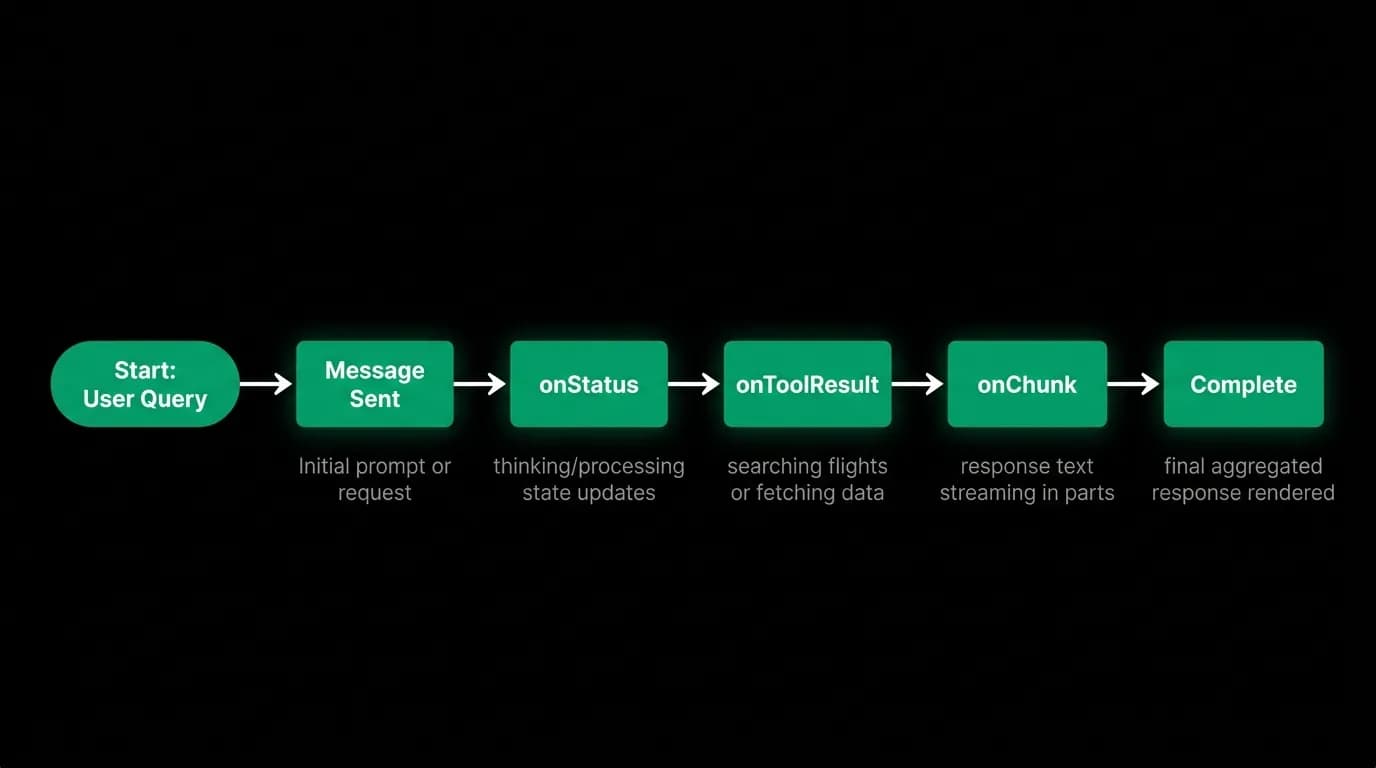
Our streaming implementation uses server-sent events. When a user sends a message, the backend begins processing and emits events as they occur. Four event types flow to the client.
Status events indicate what the agent is doing: thinking, searching, comparing. These give the user a high-level view of the process.
Tool result events appear when the agent completes a specific action: a flight search returned results, a hotel comparison completed. These show concrete progress.
Chunk events deliver the response text as it is generated, word by word. This is the most visible streaming, the text appearing progressively on screen.
The complete event signals that the response is finished and includes any structured data like booking options.
Managing the interleaving of these four event types on the client side, rendering them in the right order, handling tool calls that take three to fifteen seconds each, and maintaining a responsive UI throughout, is genuinely complex engineering.
Balancing speed with accuracy
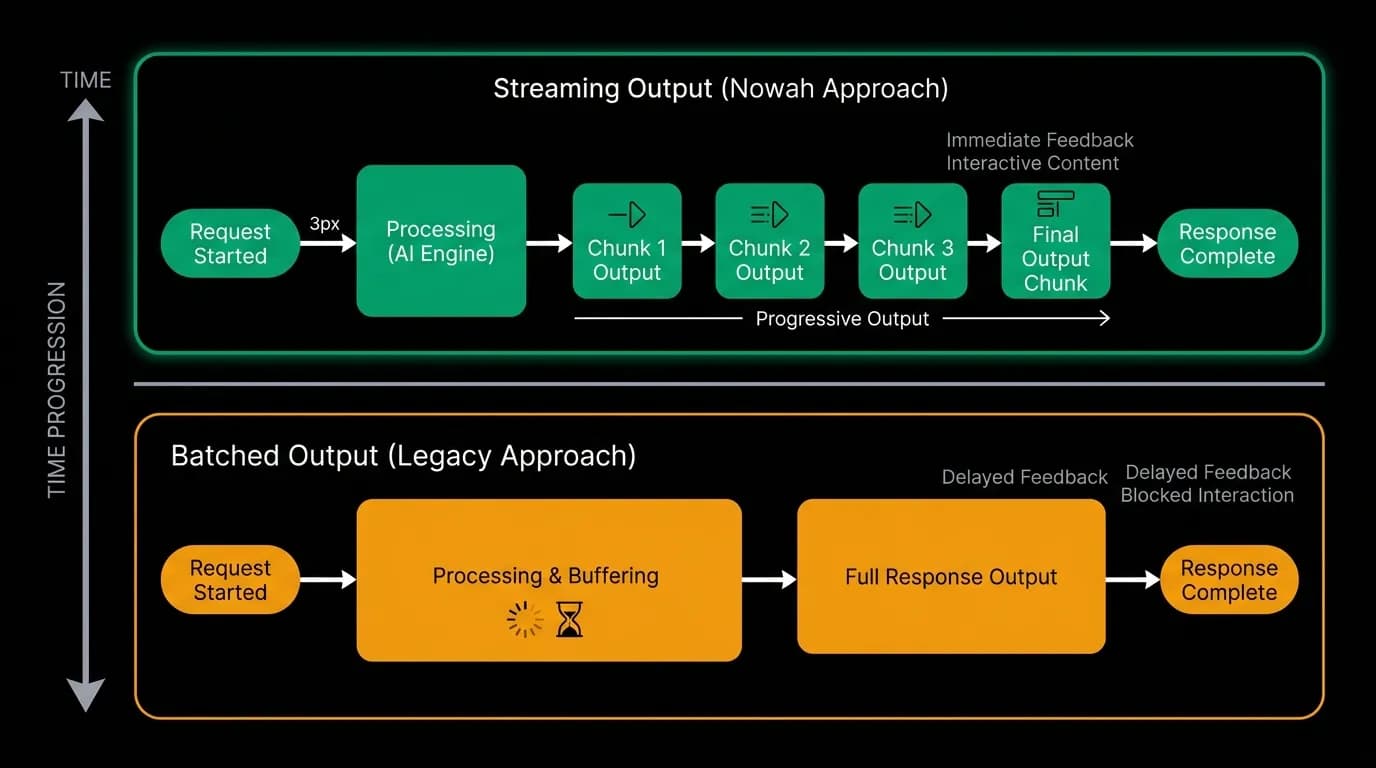
Streaming creates a tension: the agent starts sending output before it has finished reasoning. This means the beginning of a response is generated before the agent has fully evaluated all the data.
We manage this by structuring the agent's response pattern. It acknowledges the request first (fast), describes what it is doing (streaming status), executes tool calls (streamed as status updates), and then delivers the reasoned recommendation (streamed as text). The reasoning happens during the tool call phase, so by the time the recommendation text begins streaming, the analysis is complete.
Edge cases
The hardest edge case is a tool call that takes an unusually long time. If a travel data API call takes fifteen seconds, that is fifteen seconds where the streaming output pauses. We handle this with status messages that keep the user informed: "Still searching, your route has a lot of options..." This prevents the perception that the system has frozen.
Connection drops mid-stream are another challenge. Mobile users lose connectivity regularly. The client must gracefully handle a reconnection and recover the conversation state without losing context.
Lessons for AI builders
If you are building an AI product, start with streaming from day one. Retrofitting streaming onto a batch-response architecture is painful. The entire interaction model changes: from request-response to progressive disclosure. Design for it from the start.
Streaming is not a performance optimization. It is a trust feature. It changes how users perceive your product, how much patience they have, and how much confidence they place in the AI's output. Treat it as a core product requirement, not an enhancement.
Nowah is an AI travel agent that searches and books real flights and hotels through conversation — no filters, no thirty open tabs. Plan your next trip.