Why Millennials and Gen Z Are Switching to AI Travel Booking
The first AI-native generation expects personalization, speed, and conversation — not search boxes. Here is the data behind the generational shift.

There is an entire generation of travelers who never used a travel agent. They grew up booking flights on their phones, reading hotel reviews on Reddit, and planning trips from TikTok comments. They are the most traveled generation in history — Millennials and Gen Z take 35 percent more trips per year than Boomers — and they are already done with the search-filter-scroll model their parents used.
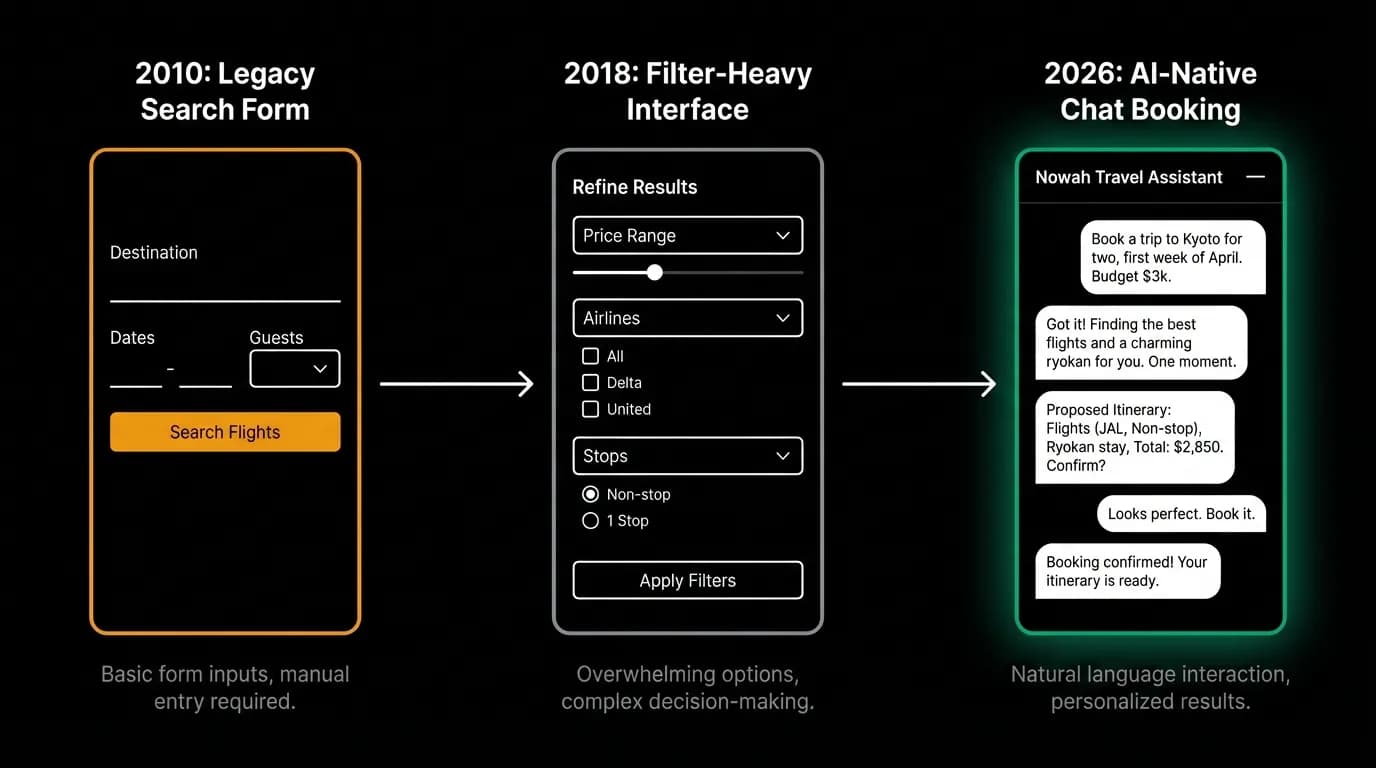
The reason is straightforward. This generation grew up with AI. They talk to voice assistants. They get personalized recommendations from streaming platforms that know their taste better than they do. They expect software to learn and adapt. And when they encounter a travel booking platform that makes them fill out a search form, scroll through 200 results, and manually compare options in 2026, it feels as outdated as a phone book.
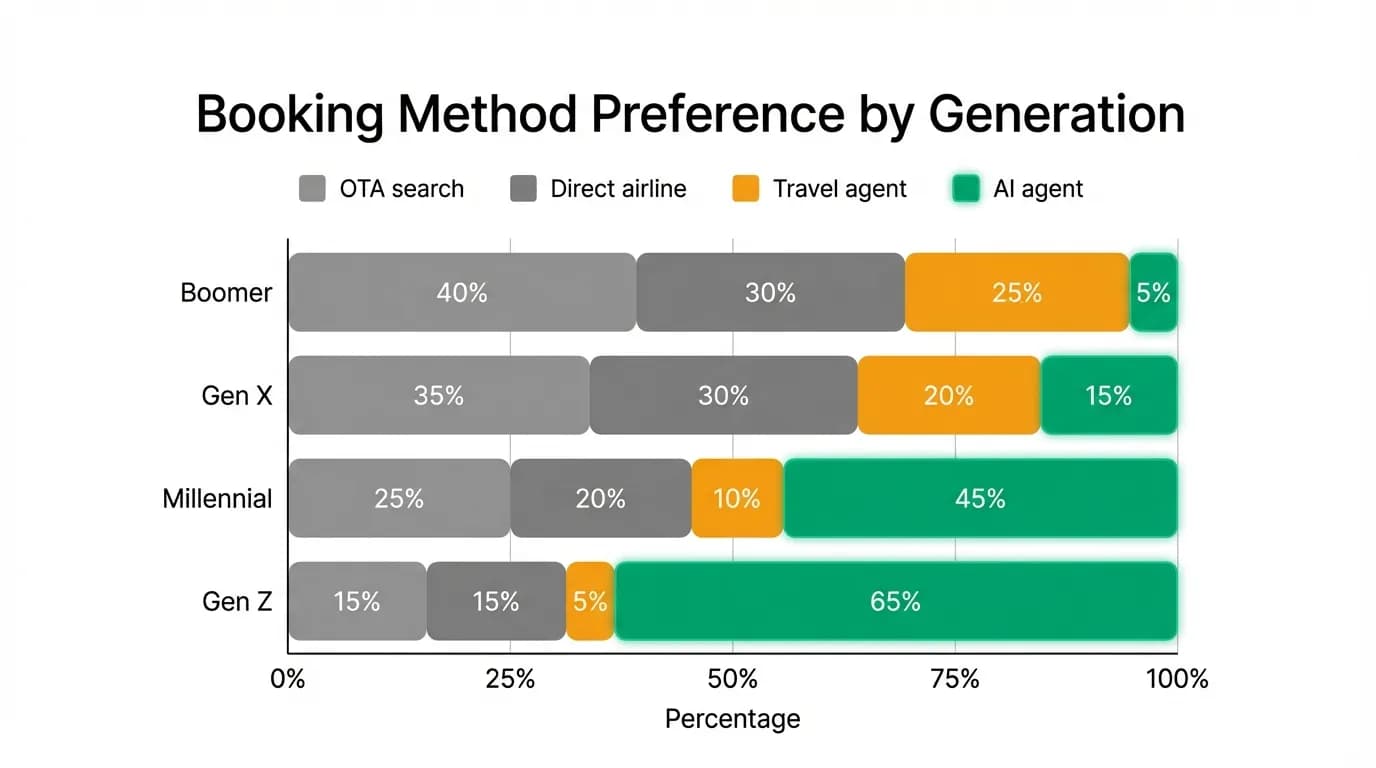
AI comfort level: beyond the threshold
Seventy-two percent of adults aged 18 to 34 are comfortable using AI for purchase decisions. Not just browsing or research — actual purchasing. This is a watershed number because it means the adoption barrier that limited AI travel tools for years has effectively disappeared for the largest travel-spending demographic.
The comfort is not abstract. It is behavioral. Younger travelers already use AI to choose music, recommend restaurants, suggest workout routines, and curate social media feeds. They have trained themselves to trust algorithmic recommendations, evaluate them quickly, and provide feedback that improves future suggestions. Applying this same model to travel booking is a natural extension, not a conceptual leap.
What is less intuitive is that this demographic trusts AI recommendations more than the algorithmic search results on traditional OTAs. The reason is transparency. When an AI agent says "I picked this hotel because it is 5 minutes from your meeting, includes the breakfast you prefer, and is within your company's rate cap," the reasoning is visible. When an OTA shows "Preferred Partner" results, younger travelers increasingly understand this means "paid placement" — and they discount the recommendation accordingly.
Mobile-first, mobile-only
Eighty-three percent of Gen Z prefers mobile for travel research. Not mobile-compatible. Mobile-first. The phone is the primary device, and for many, the only device used for travel planning.
This has massive implications for interface design. Traditional OTA interfaces were designed for desktop screens with large monitors, multiple columns, extensive filter sidebars, and results that display 15 to 20 options per page. These translate poorly to 6-inch phone screens. Filters become hidden behind menus. Comparison requires endless scrolling. Form fields are tiny and frustrating to fill on touchscreens.
Conversational AI is inherently mobile-native. A chat interface works identically on a phone and a desktop. Text input is what people already do on their phones all day. Voice input, which reduces booking time by an additional 40 percent compared to typing, is a natural extension of how younger travelers communicate. They send voice notes to friends. They ask voice assistants for directions. Speaking a booking request while packing a bag is not futuristic to them. It is obvious.
The Spotify-ification of travel
Younger travelers expect personalization at a depth that makes traditional OTA capabilities look prehistoric.
Spotify does not make you search for music. It learns what you like and surfaces recommendations that feel personal. Netflix does not show you every movie available. It curates a feed based on what it knows about your taste. This is the baseline expectation for Millennials and Gen Z consumers. Software that requires manual configuration is software that is not trying hard enough.
Travel booking has lagged far behind in personalization. OTAs know your recent searches and maybe your email address. An AI travel agent knows your seat preference, your airline loyalties, your dietary restrictions, your preferred hotel style, your budget patterns, and how your travel behavior changes when you are traveling for work versus leisure. It learns these things from conversation, not from cookies, and it uses them to make every recommendation more relevant.
The expectation gap is severe. A 25-year-old who is used to Spotify Discover Weekly and Netflix's "Because you watched" algorithm opens a major OTA and finds a platform that treats them like a stranger every time they visit. That platform is losing, and it does not understand why.
Voice-first and social-first
Gen Z books travel the way they communicate: with voice, through messaging, and inspired by social content.
Forty-five percent of Gen Z prefers voice input for search queries. This is not because typing is difficult — it is because speaking is faster and more natural, especially on mobile. When you can say "find me flights to Barcelona next month, keep it under $600, direct if possible" while walking through an airport, the idea of sitting down and filling out a search form feels pointlessly slow.
Social media has replaced guidebooks and review sites as the primary discovery channel for this demographic. Sixty percent of Gen Z discovers travel destinations on TikTok or Instagram before ever searching for flights. The path from "that looks amazing" to "I want to go there" happens in seconds, and they expect the path from "I want to go there" to "booked" to be nearly as fast.
AI agents bridge this gap. See a destination on social media, message your AI agent "I want to go there in April," and within minutes you have flight options, hotel recommendations, and a rough itinerary. No tab-switching. No form-filling. No 38-website research odyssey.
Speed as a value
For older generations, time spent researching travel was partially recreational — the anticipation of the trip was part of the experience. For Gen Z, time is not something to spend on logistics. It is something to spend on the experience itself.
The average 30-minute OTA booking flow is not just slow to this demographic. It is offensive. They live in an economy where anything that takes longer than 30 seconds to load gets abandoned. A booking flow that requires 8 steps and 20 minutes of active input loses them at step 3.
AI agents that compress booking to 2 to 5 minutes are not just preferred — they are the minimum acceptable experience for a generation that grew up with same-day delivery and instant streaming. The 30-minute OTA session is a relic of an era when you had no choice. You do now.
Three ways to make your next booking feel like texting a friend
First, use voice. If your travel platform supports it, speak your request instead of typing it. You will be surprised how natural it feels and how much faster the process becomes.
Second, front-load your preferences. Tell your AI agent about your seat preferences, dietary needs, loyalty programs, and travel style before your first booking. Every subsequent booking will feel effortlessly personalized.
Third, start from inspiration instead of logistics. Instead of "flights to Barcelona, March 15-22, two adults," try "I want a warm European city for a week in March, great food, walkable, under $3,000 for two people." Let the agent do the translation from vibe to itinerary. That is what it is built for.
The generation that talks to book is not the future. It is the present. And the platforms that do not speak their language are already losing them.
Nowah is an AI travel agent that searches and books real flights and hotels through conversation — no filters, no thirty open tabs. Plan your next trip.