Multimodal Models and the Future of Travel AI
\\\"Find me a hotel like this photo.\\\" Vision, voice, and document understanding expand what AI travel agents can do — and when each modality arrives.

Last week a user sent our agent a photo of a rooftop bar overlooking a Mediterranean harbor and typed "I want to stay somewhere with a view like this." Today, our agent cannot process that image and extract the aesthetic preferences embedded in it: the whitewashed buildings, the blue water, the intimate scale, the European coastal vibe. In six months, it will.
This is the multimodal frontier for AI travel booking. Text has been the primary input and output modality for AI agents, but travel is one of the most sensory, visual, and experiential domains that exists. The gap between what users want to express and what text alone can capture is about to close.
Beyond text
Travel is inherently multi-sensory. People plan trips by looking at photos on Instagram, watching YouTube videos of destinations, listening to friends describe their experiences, and flipping through physical documents like passport pages and printed itineraries. Forcing all of this through a text interface is a constraint, not a feature.
Multimodal models that process text, images, and audio in a single inference call are production-ready in 2026. The question is no longer "can AI understand a photo?" but "how do we integrate visual understanding into a travel booking workflow in a way that actually helps users?"
The answer, I think, is modality by modality, starting with the ones that solve the most immediate user problems.
Voice: already here, already transforming the experience
Voice input is live in our product today and it has changed how people interact with the agent. Voice-based travel queries are growing over 40% year over year across the industry, and the reason is simple: travel planning is conversational by nature.
Nobody thinks in form fields. People think in sentences. "I want to take my parents somewhere warm for their anniversary, maybe Spain or Greece, sometime in late October, and they would prefer a hotel with a pool." Typing that is work. Speaking it is natural.
Voice captures nuance that typing drops. Emphasis, hesitation, enthusiasm. When someone says "I guess Barcelona could work..." versus "Oh, Barcelona would be amazing!" the difference matters for recommendation quality. We are not yet using prosodic analysis to inform recommendations, but the capability exists in current multimodal models.
Mobile is the primary voice input device, and mobile accounts for over 60% of travel bookings. The combination of mobile-first usage and voice-first input is converging into an interaction model where the best travel app is the one you talk to while walking to work.
Vision: the next frontier
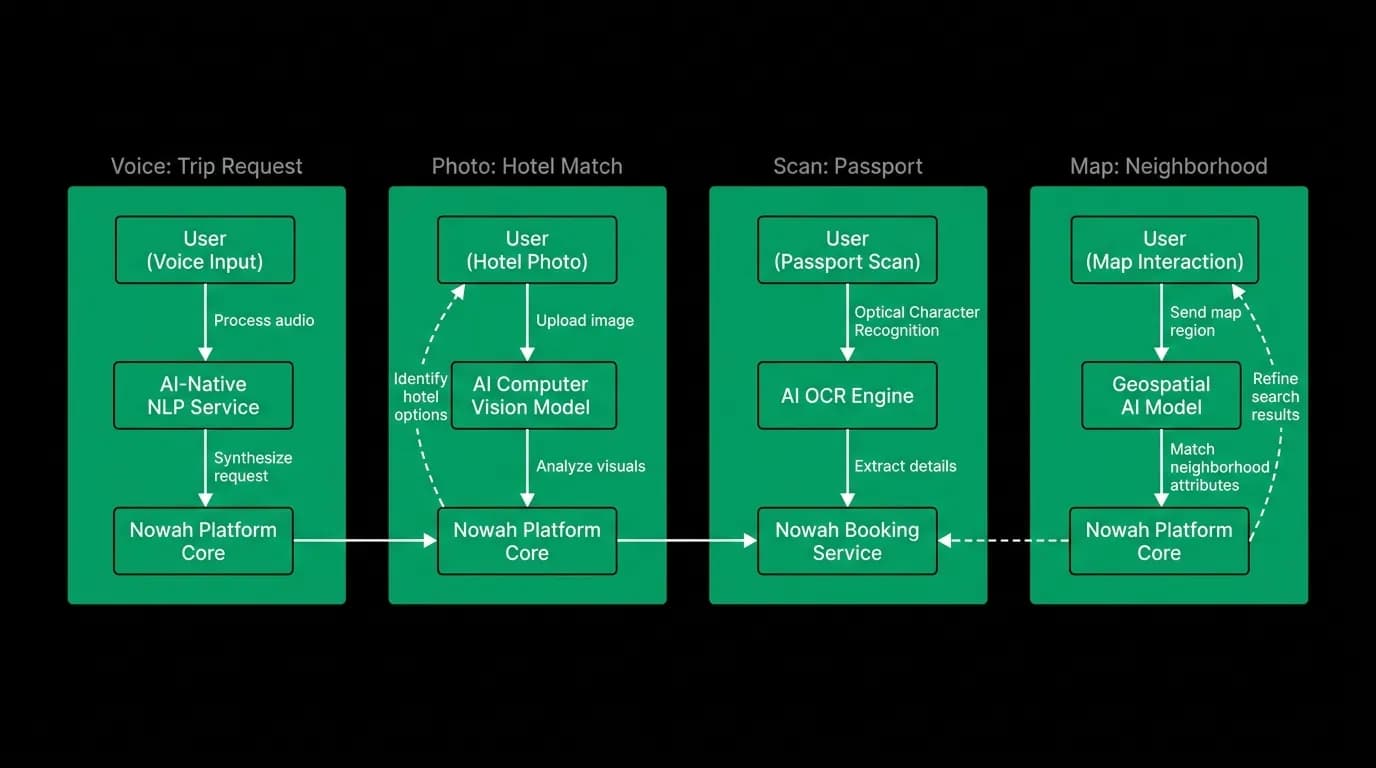
Image understanding for travel AI is in the late beta stage. The models can do it. The product integration is what is still being figured out.
Here are the use cases I am most excited about:
"Find me a hotel like this." Users screenshot a hotel room they liked, a view from a balcony, or a restaurant ambiance photo. The AI extracts visual features (modern vs. traditional decor, natural light, view type, room size) and matches them against hotel inventory. This is preference matching through visual semantics rather than keyword filters.
Visual itinerary input. Someone took a photo of a handwritten travel plan, a whiteboard from a planning session, or a friend's itinerary screenshot. The AI reads the text in the image and imports the trip details directly into the planning conversation.
Destination discovery through imagery. Instead of searching "best beaches in Southeast Asia," a user shares a photo of the kind of beach they like. The AI identifies the characteristics (white sand, clear water, palm trees, quiet, no high-rises) and suggests matching destinations.
The timeline for these features becoming production-quality is 2026. Multimodal models already handle image understanding well in controlled settings. The engineering work is in building the pipelines that connect visual analysis to travel inventory search and preference matching.
Document intelligence: solving real friction
This one is already in production and it solves one of the most annoying parts of travel: data entry from documents.
Passport extraction. A user photographs their passport. The AI reads the machine-readable zone and the visual information zone, extracts full name, nationality, passport number, date of birth, expiration date, and issuing country. No manual typing. No typos that cause booking failures.
Visa verification. Combined with passport data and destination information, the agent can determine visa requirements automatically. "Your US passport is valid for 14 more months. Japan allows 90-day visa-free entry. You are good to go."
[Boarding pass](/blog/boarding-pass-problem-documents-chat) parsing. Users forward their boarding pass emails or photograph their physical passes. The agent extracts flight number, gate, boarding time, and seat assignment. This data feeds into trip management automatically.
Document parsing eliminates the kind of tedious, error-prone data entry that makes traditional booking flows frustrating. It is one of those features where the multimodal capability directly reduces friction in a way that text-only AI cannot.
Spatial awareness: further out but high impact
The modality I think about most, but that is furthest from production, is spatial understanding. Travel is inherently spatial. Where is the hotel relative to the things I want to do? How walkable is this neighborhood? Is this hotel actually "near the beach" or is it a 20-minute drive?
Current AI agents can answer these questions through tool calls to mapping APIs. But imagine pointing your phone's camera at a city street and asking "find me a hotel within walking distance of here" or dragging a finger on a map in the chat to say "somewhere in this area."
Spatial input turns the map from a read-only display into an interactive input device for the AI agent. This requires the convergence of multimodal models with real-time location awareness, and I expect it to reach production quality around 2027.
The timeline for production readiness
Not all modalities are created equal in terms of production readiness:
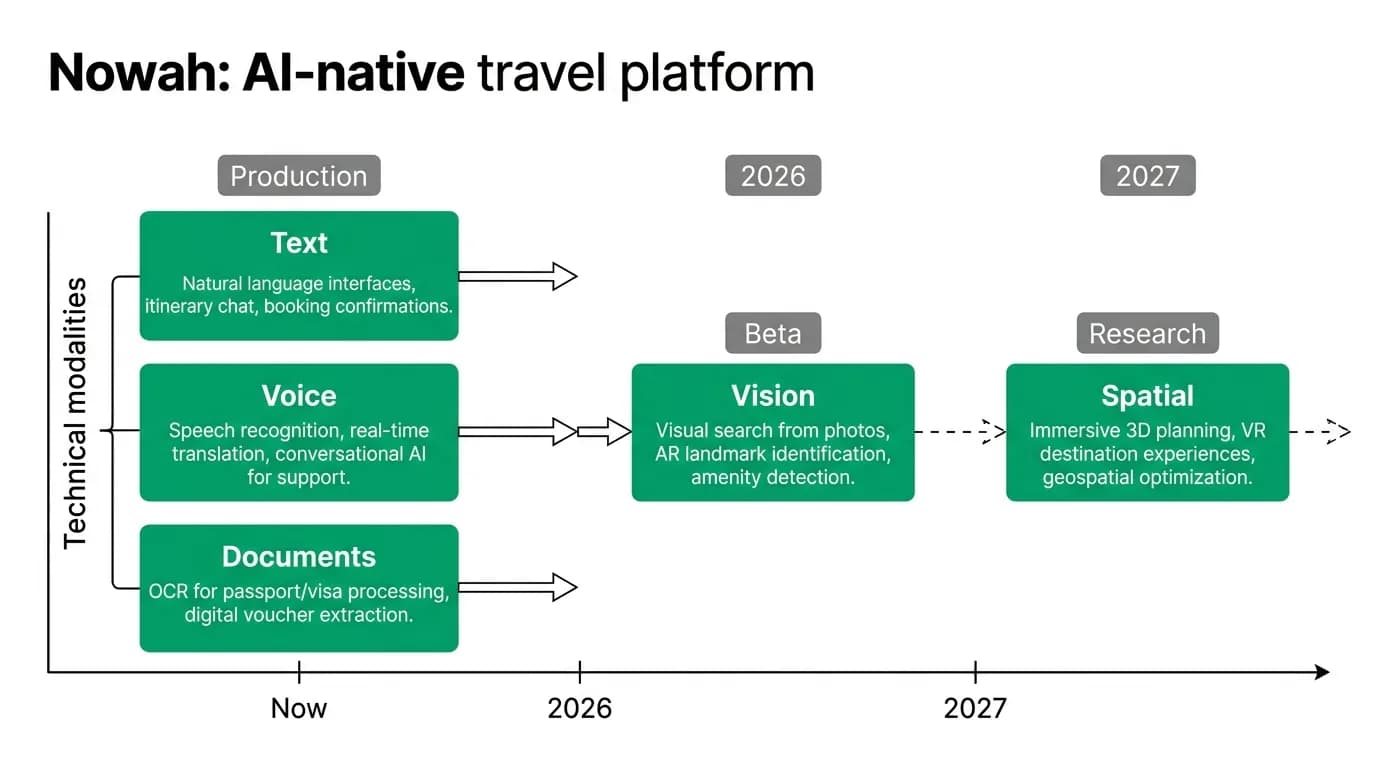
Text is the bedrock. Fully mature. Handles 95% of travel planning communication today.
Voice is production-ready now. Accuracy is sufficient for travel queries. The main engineering challenge is handling noisy environments and accented speech gracefully.
Documents are production-ready now. Passport and boarding pass parsing works reliably. The edge cases are damaged documents, unusual formats, and non-Latin scripts, all solvable with current technology.
Vision for preference matching is beta-quality in 2026. The models understand images well, but the pipeline from "I like the look of this hotel" to "here are three hotels with similar aesthetics in your destination" requires semantic matching infrastructure that is still being built.
Spatial is research-quality with a path to production by 2027. Map-based interaction and real-time location-aware queries require tight integration between multimodal models and geospatial data layers.
The practical impact on AI trip planning is that each new modality removes a category of friction. Voice removes typing friction. Documents remove data entry friction. Vision removes the "I cannot describe what I want but I know it when I see it" friction. Spatial removes the "where exactly?" friction.
If you are building an AI travel agent today, invest in voice and documents now. Start prototyping vision. Watch spatial. By 2028, users will expect all of these to work seamlessly, and the platforms that figured them out first will have a meaningful head start.
Nowah is an AI travel agent that searches and books real flights and hotels through conversation — no filters, no thirty open tabs. Plan your next trip.