The Next Five Years of Travel App Design
Zero-UI booking, predictive itineraries, real-time adaptation, social travel AI, and multimodal input — five predictions for how AI reshapes travel product design by 2031.
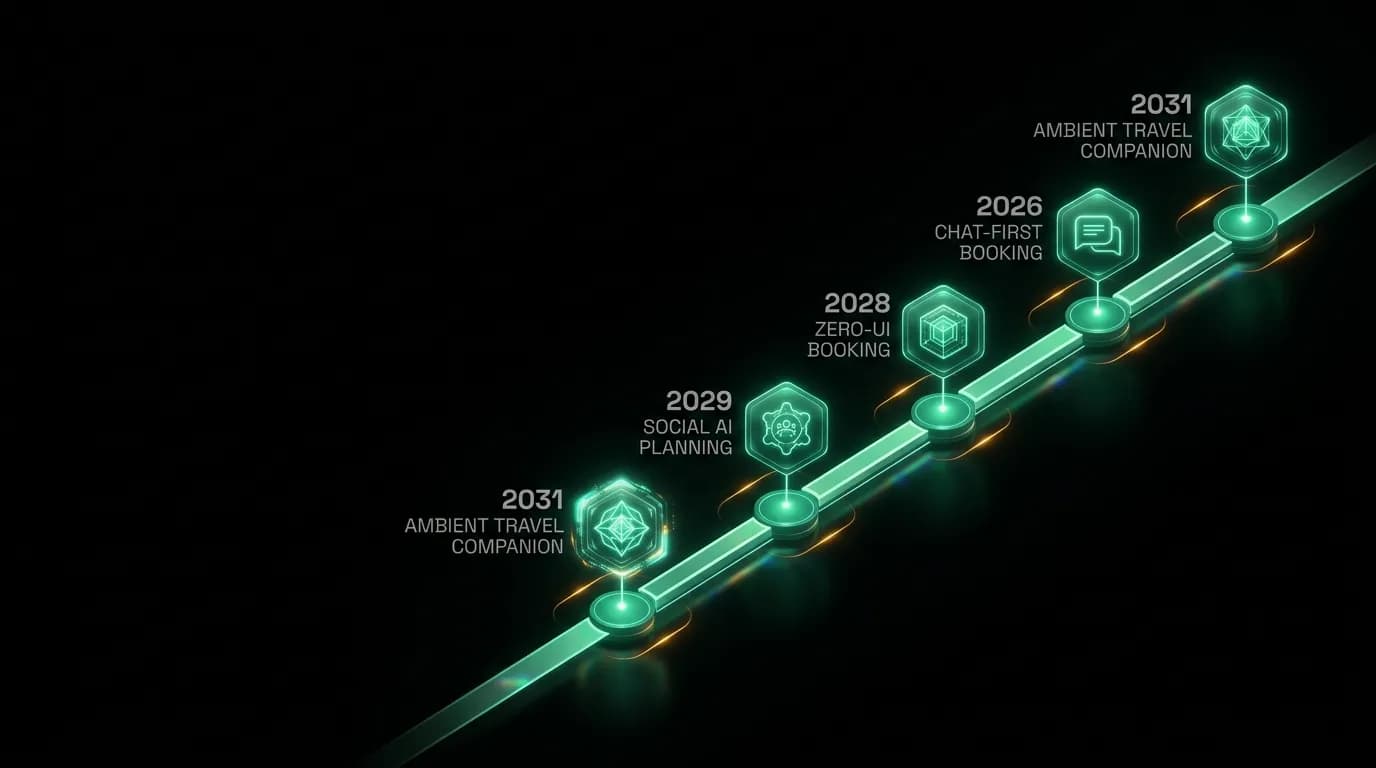
Five years ago, nobody was designing for AI travel agents. The state of the art was a search form, a results list, and a checkout flow. Every major booking platform looked roughly the same because they all solved the same problem the same way: display inventory, let the user filter, hope they buy.
Today, conversational AI is rewriting the interaction model. Chat-first interfaces replace search forms. AI curation replaces result lists. Memory-enabled agents replace stateless searches. The shift is underway and accelerating.
Where does it go from here? Here are five predictions for how AI reshapes travel product design by 2031, based on the trajectories we see in the technology, the user behavior data, and the competitive landscape.
Prediction 1: zero-UI booking
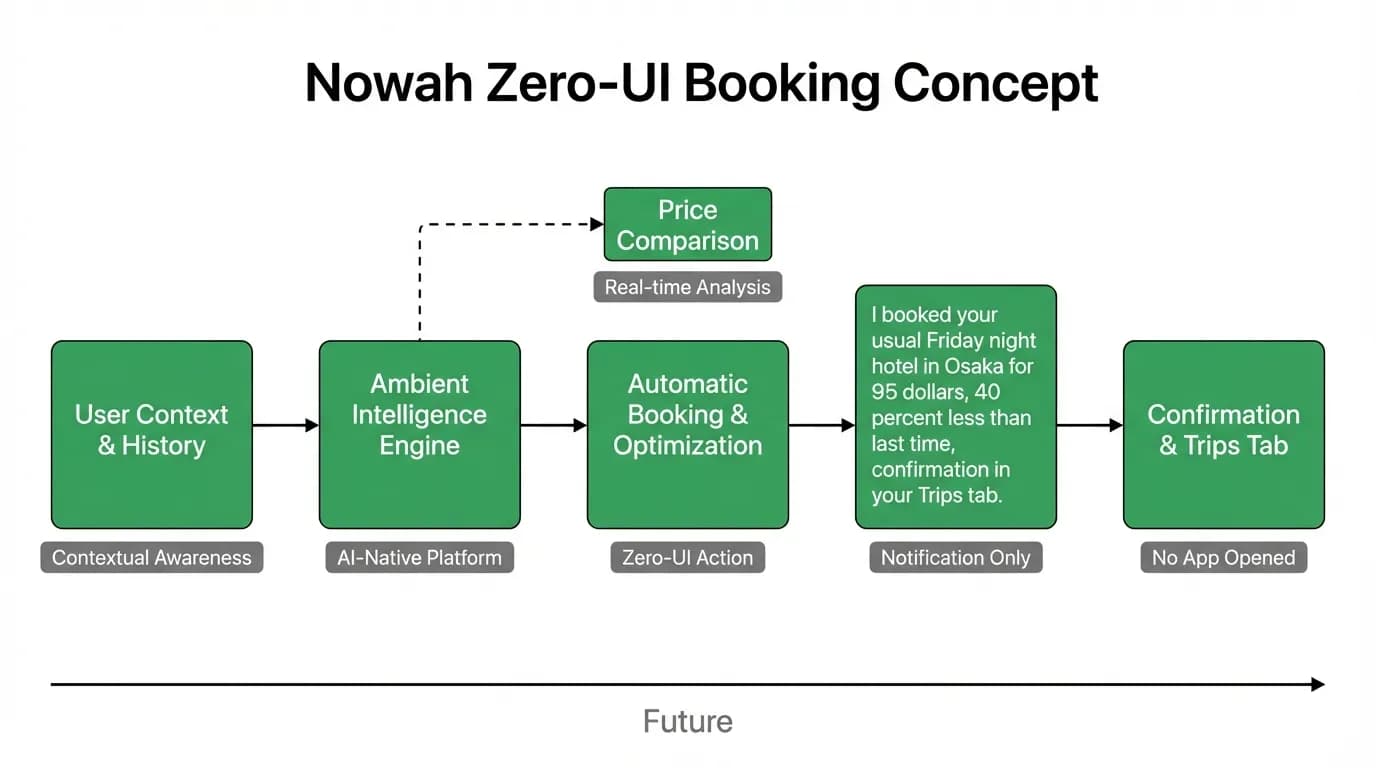
By 2028, routine travel bookings will happen without the user looking at a screen. The AI knows your patterns. It monitors prices. When conditions align, it sends a notification: "I booked your usual Friday evening hotel for tomorrow at the rate you prefer. Confirmation in your trips."
The user did not open the app. Did not compare options. Did not fill out forms. The booking happened because the AI had enough confidence in the user's preferences and the booking's parameters to act autonomously.
Zero-UI booking requires extremely high confidence in the AI's understanding of the user. It will not work for novel trips or complex itineraries. But for the frequent business traveler who stays at the same hotel in the same city every week, or the family that books the same vacation rental every summer, the AI has all the information it needs to act alone.
The design challenge is not the booking itself. It is the notification that tells the user what happened. That notification needs to be complete enough to confirm the booking was correct and provide an effortless undo path in case it was not. The notification is the entire interface.
Prediction 2: predictive itineraries
By 2028, AI agents will suggest trips before users ask for them. The AI analyzes patterns: the user visits Japan every spring, their partner's birthday is in October, they have not taken a vacation in four months. Based on these patterns, the AI generates a fully formed trip suggestion.
"You usually visit Japan in April. Cherry blossom season starts March 28 this year. Here is a 5-night itinerary based on your past trips, adjusted for new hotel openings. Want me to check prices?"
Predictive itineraries are not random suggestions. They are deeply personalized inferences based on years of conversation history, booking data, and stated preferences. The AI is not guessing. It is projecting patterns.
The design for predictive itineraries is essentially an invitation. The AI presents the suggestion as a conversation starter, not a fait accompli. The user can engage ("Yes, check prices"), modify ("Make it 7 nights this time"), or dismiss ("Not this year"). The suggestion respects the user's autonomy while demonstrating the AI's understanding.
Prediction 3: real-time itinerary adaptation
By 2029, itineraries will adapt in real time during a trip. Your flight is delayed two hours. The AI automatically rebooks your airport transfer, notifies your hotel of late check-in, and suggests a restaurant near the airport for the wait. You get a notification summarizing what changed, not a problem to solve.
Real-time adaptation requires the AI to monitor multiple data streams simultaneously: flight status, weather, traffic, venue hours, reservation statuses. It also requires the authority to make changes within defined guardrails. The design challenge is communicating changes clearly enough that the user trusts what happened and feels informed rather than surprised.
The interface for real-time adaptation is a change summary: "Your flight was delayed 2 hours. I adjusted your transfer to the later time and notified your hotel. Your dinner reservation is still on time." Clear, complete, and requiring no action unless the user disagrees with a change.
Prediction 4: social travel AI
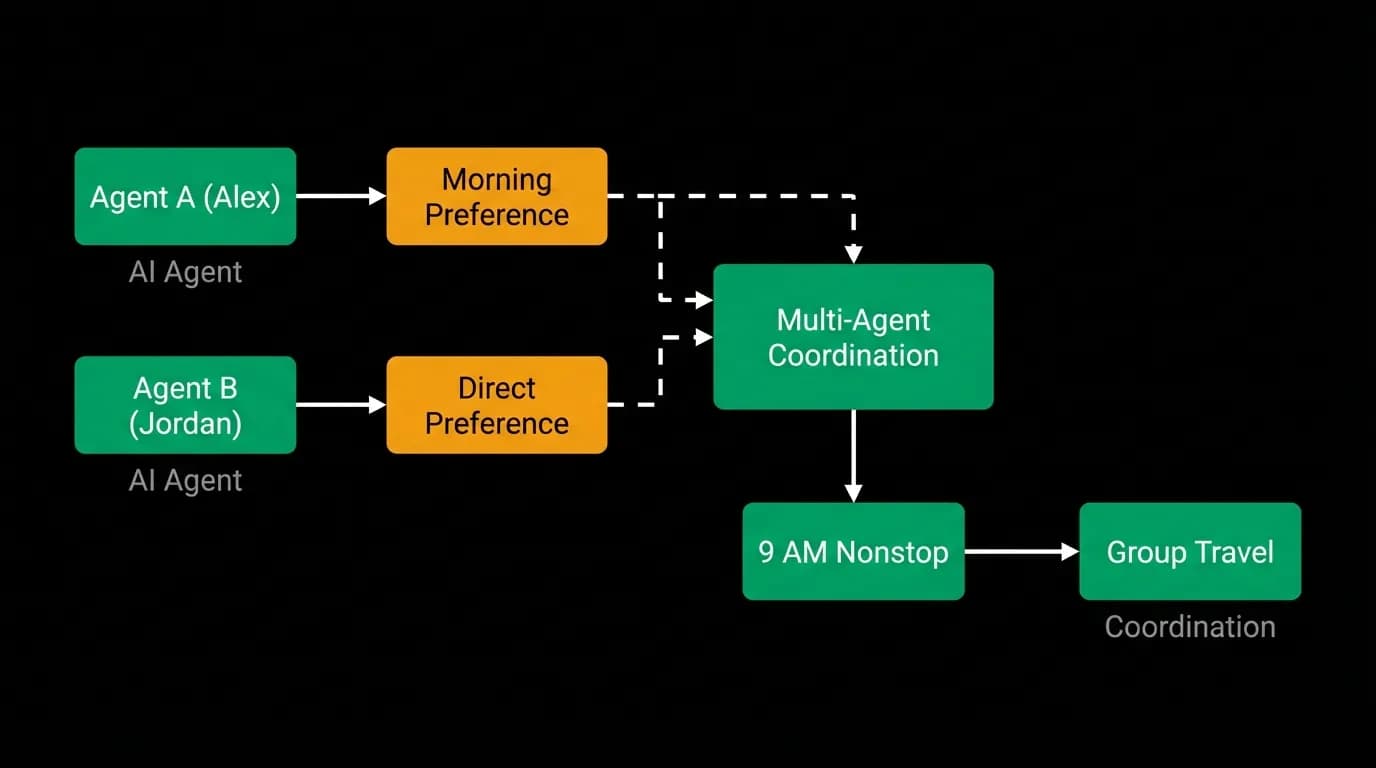
By 2030, AI agents will facilitate collaborative trip planning-trip-planning-ai-shines). Two friends planning a trip together currently coordinate through text messages, shared documents, and separate searches. The future model: both users' AI agents communicate, merge preferences, resolve conflicts, and present a unified plan.
"Alex prefers morning flights. Jordan prefers nonstops. I found a 9 AM nonstop that works for both of you." The AI agents negotiated a solution that satisfies both sets of preferences without either user doing the comparison work.
Social travel AI extends to group trips, family planning, and corporate travel coordination. Each participant has their own preferences managed by their own agent, and the agents collaborate to find solutions that optimize across all participants.
The design challenge is representing multi-agent recommendations. Whose preferences drove which decisions? The interface needs to make the negotiation transparent: "This hotel is closer to the conference center (Alex's priority) and has a pool (Jordan's priority)."
Prediction 5: multimodal input
By 2031, text and voice will be joined by image, video, and gesture as equal input modes. A user photographs a restaurant they walk past and asks: "Can we get a reservation here tomorrow?" The AI identifies the restaurant from the image and makes the reservation.
A user takes a photo of a crowded train schedule in a foreign language. The AI translates it, identifies the relevant train, and offers to book tickets. A user gestures at a landmark and asks "What is that?" The AI uses location and visual data to identify it and provide information.
Multimodal input makes the AI more contextually aware. It can see what the user sees, hear what the user hears, and respond to the full richness of the real-world context. The interface design for multimodal input is minimal: a camera button alongside the text input and microphone. The AI handles the interpretation.
What to build today
Each of these predictions rests on capabilities that need to be built incrementally. Persistent memory enables predictive suggestions. Price monitoring enables zero-UI booking. Real-time data integration enables itinerary adaptation. Multi-user architecture enables social AI. Multimodal processing enables image and gesture input.
The products that will lead in 2031 are the ones building these capabilities today, not as futuristic experiments but as foundational infrastructure that improves the current product while preparing for the next paradigm.
The global online travel market exceeds 800 billion dollars. AI-powered travel is growing rapidly. The companies that design for where the industry is heading, not where it is today, will capture a disproportionate share of that growth.
Nowah is an AI travel agent that searches and books real flights and hotels through conversation — no filters, no thirty open tabs. Plan your next trip.