The Death of the Travel Search Form
For twenty years, origin-destination-dates was the interface. Conversational AI replaces the form with a dialogue that handles fuzzy intent and iterative refinement.

You have filled out this form a thousand times. Origin. Destination. Departure date. Return date. Number of travelers. Cabin class. Search.
The form has looked roughly the same since the late 1990s when the first online travel agencies put it on the web. It is the most recognized UI pattern in travel technology, replicated across every booking site, every airline, every hotel chain, every metasearch engine on the planet. It is also dying.
Not because it is ugly. Not because users complain about it. But because it was designed for a problem that no longer matches how people actually think about travel.
Why forms fail for fuzzy queries
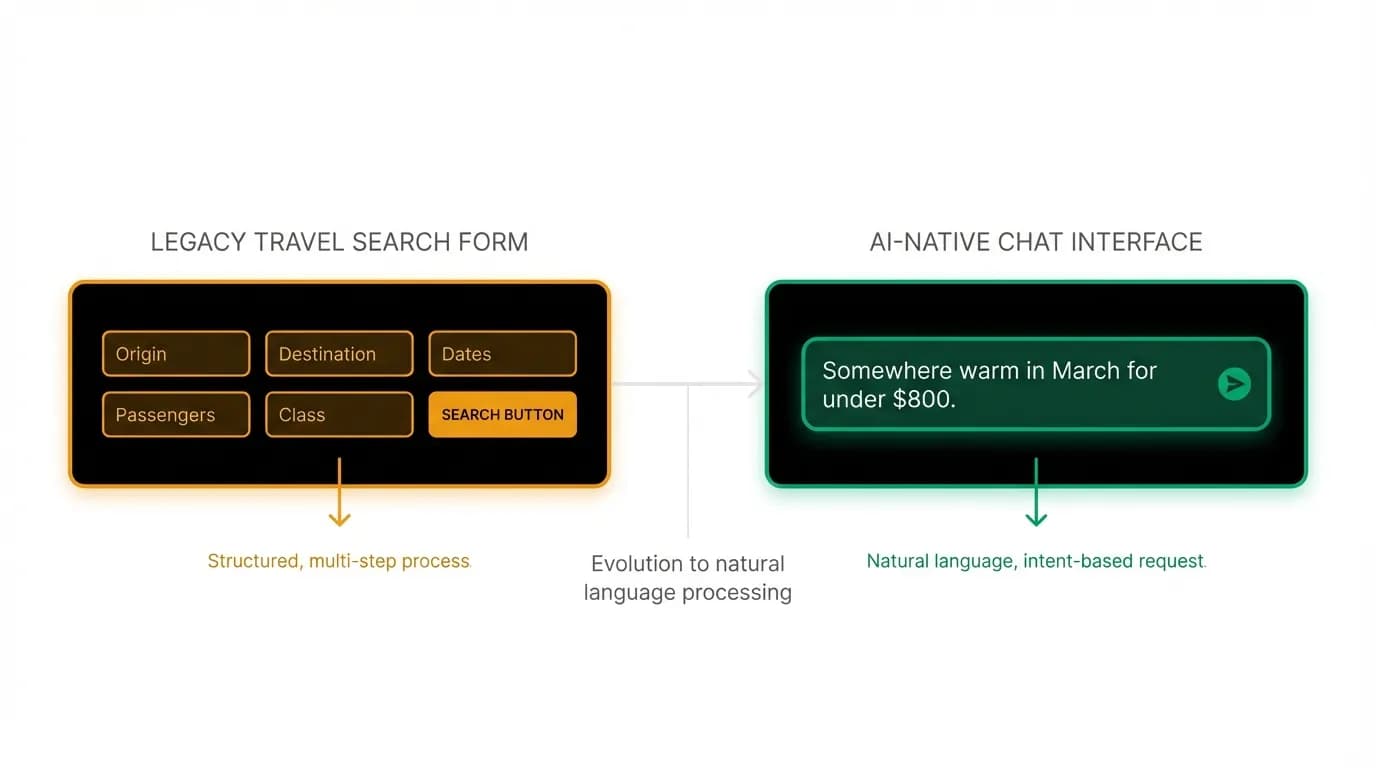
Here is a query a real human being has: "I want to go somewhere warm in March for under $800."
Try typing that into a search form. You cannot. The form demands an origin, a destination, specific dates, and a passenger count before it will return a single result. But the person asking does not have a destination yet. They might not have exact dates. They have a vague intention, a budget, and a preference for warm weather.
Forty-five percent of travelers abandon the booking process because they feel overwhelmed by options, according to Skift Research from 2024. Part of this is the results page problem, which we will get to. But a significant part is that the search form forces users to make decisions they are not ready to make. You have to pick a destination before you can see prices. You have to pick dates before you can compare flexibility. The form front-loads every decision.
This is like walking into a restaurant and being asked to specify your exact order before you can see the menu. It works if you already know what you want. It fails for everyone else.
Front-loaded effort versus progressive conversation
Traditional travel search requires the user to provide all inputs before seeing any outputs. Six form fields, minimum. Some sites ask for more: flexible dates, nearby airports, preferred airlines, hotel preferences. The cognitive load sits entirely on the user's shoulders before they receive any value in return.
A conversation inverts this dynamic. The user shares what they know — as much or as little as that happens to be — and the AI fills in the gaps through follow-up questions. "Somewhere warm in March for under $800" is a perfectly valid opening. The AI can ask: "Are you flying from New York? Do you prefer beach or city? Are you flexible on the exact week?"
Each question reduces the possibility space. Each answer provides value back to the user in the form of progressively narrower, more relevant options. The user never faces a blank form with six required fields. They face a conversation that feels like talking to a knowledgeable friend.
The difference is not just emotional. It is mathematical. Hick's Law tells us that decision time increases logarithmically with the number of options. Three options versus thirty reduces decision time by approximately 70%. But the insight goes deeper than the results page. The search form itself presents six simultaneous decisions (origin, destination, departure, return, travelers, class). A conversation serializes those decisions into manageable, sequential questions.
How the AI decomposes a natural-language request
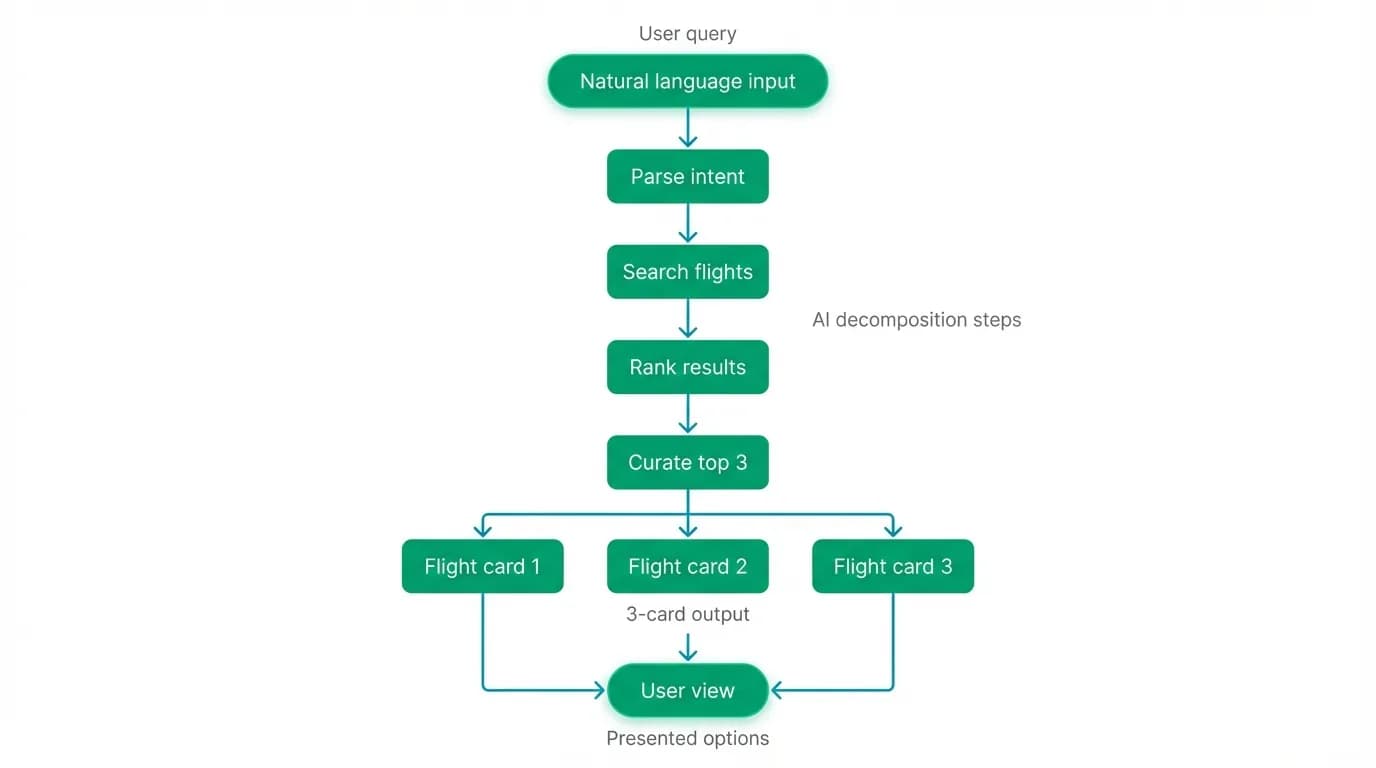
When a user sends "somewhere warm in March for under $800," the AI does not just parse keywords. It decomposes the request into a structured set of constraints and unknowns.
Known constraints: warm climate, March timeframe, budget ceiling of $800. Unknowns: origin city, exact dates, number of travelers, destination.
The AI resolves unknowns through two strategies. First, it checks memory. If the user has a home airport saved from a previous conversation or from onboarding preferences, origin is resolved without asking. Second, it asks the minimum necessary questions. "Where are you flying from?" fills the last required gap.
With origin resolved, the AI can now search across multiple warm-weather destinations within the budget. It queries live flight inventory for routes from the user's home airport to destinations that meet the climate and price criteria. It does this in parallel — checking Cancun, Lisbon, Bangkok, and Bali simultaneously rather than requiring the user to search each one individually.
The result is not a list of 300 flights. It is three curated options: the cheapest warm destination, the best value considering flight quality and destination appeal, and the most interesting option the user might not have considered. Each comes with a brief explanation of why it was selected.
The six-field search form has been replaced by a single chat input and one follow-up question. That is not a minor UX improvement. That is a structural change in how travel search works.
The results page problem
Even if you manage to fill out the search form correctly, the next screen is often worse. A typical online travel agency returns between 15 and 30 flight results. Google Flights shows 10 to 25. Some aggregators show hundreds.
These results are sorted, usually by price. They can be filtered by stops, departure time, airline, and duration. But sorting and filtering are blunt instruments. They cannot express preferences like "I hate connecting through that one airport" or "I would pay $50 more for a morning departure" or "I want the airline with the best seat pitch because I am tall."
More fundamentally, a long list of results shifts the burden of evaluation to the user. You have to scan, compare, weigh tradeoffs, and decide. This is the work that a travel agent used to do. The form-based interface automated access to inventory but failed to automate the actual decision-making process.
The average traveler visits many websites before booking a trip, according to Expedia Group research. That number reflects a search experience that provides data without providing guidance. More options without better curation just means more tabs to open and more decisions to agonize over.
What conversational refinement looks like in practice
A conversation handles refinement naturally. After presenting three options, the AI waits for the user's reaction. "I like the Lisbon option but is there anything with a shorter flight?" or "What about the Cancun one but a week later?" or simply "Show me more like option two."
Each refinement narrows the search without starting over. Context accumulates. The AI remembers that you preferred Lisbon, that you want a shorter flight, that you are flexible on dates but firm on budget. This context persists across the entire conversation and, critically, across future conversations.
In a traditional search, switching from Lisbon to Cancun means going back to the form and starting a new search. Changing dates means another search. Comparing hotels at both destinations means two separate hotel searches on two separate pages. Each interaction is stateless.
In a conversation, complexity is just more words. "What if we did three nights in Lisbon and then flew to Barcelona for two more?" That is a multi-city trip with a mid-trip flight, two hotel bookings, and different date ranges per segment. In a form-based interface, this requires multiple searches across multiple tools. In a conversation, it is one sentence.
Building a chat input that replaces six form fields
The single most important design decision in replacing the search form is making the chat input feel inviting and capable. If the text field looks like a messaging app, users will type short, chat-like messages. If it looks like a search box, users will type keywords. Neither is wrong, but the design should encourage natural language.
Our input bar sits at the bottom of the screen with a text field, a voice input button, and a send button. The placeholder text rotates through examples: "Where do you want to go?" and "Plan a weekend trip" and "Find flights under $300." These examples teach users the expected interaction model without a tutorial.
Above the input bar, suggested prompt chips offer tappable starting points. "Plan a weekend getaway." "Find cheap flights to Tokyo." "Where is warm in March?" Each chip is a complete query that demonstrates conversational search in action. Tapping one sends it immediately, and the user sees the AI decompose the query, ask any needed follow-ups, and return results — all within seconds.
The search form is not gone. It still exists, inside the AI's toolset, as the structured query the system uses to call flight and hotel APIs. But the user never sees it. They see a conversation. The form became an implementation detail rather than an interface.
What dies and what survives
The search form will not disappear overnight. It will persist on legacy platforms for years, the same way paper boarding passes persisted long after mobile check-in became standard. Some users will always prefer the control of explicit fields.
But for the majority of travelers — the ones who do not have exact dates, who have not picked a destination, who want guidance rather than raw data — the conversation is simply a better interaction model. It meets users where they are instead of where the database schema expects them to be. It handles ambiguity, accumulates context, and reduces the 38-website marathon to a single chat thread.
The search form solved the problem of its era: getting airline inventory online. The conversation solves the problem of ours: actually helping people decide.
Nowah is an AI travel agent that searches and books real flights and hotels through conversation — no filters, no thirty open tabs. Plan your next trip.