Pricing Design: How We Are Structuring Nowah's Subscription Tiers
How we are designing free vs paid tiers — what booking requires, what membership unlocks, and the principles behind the model.
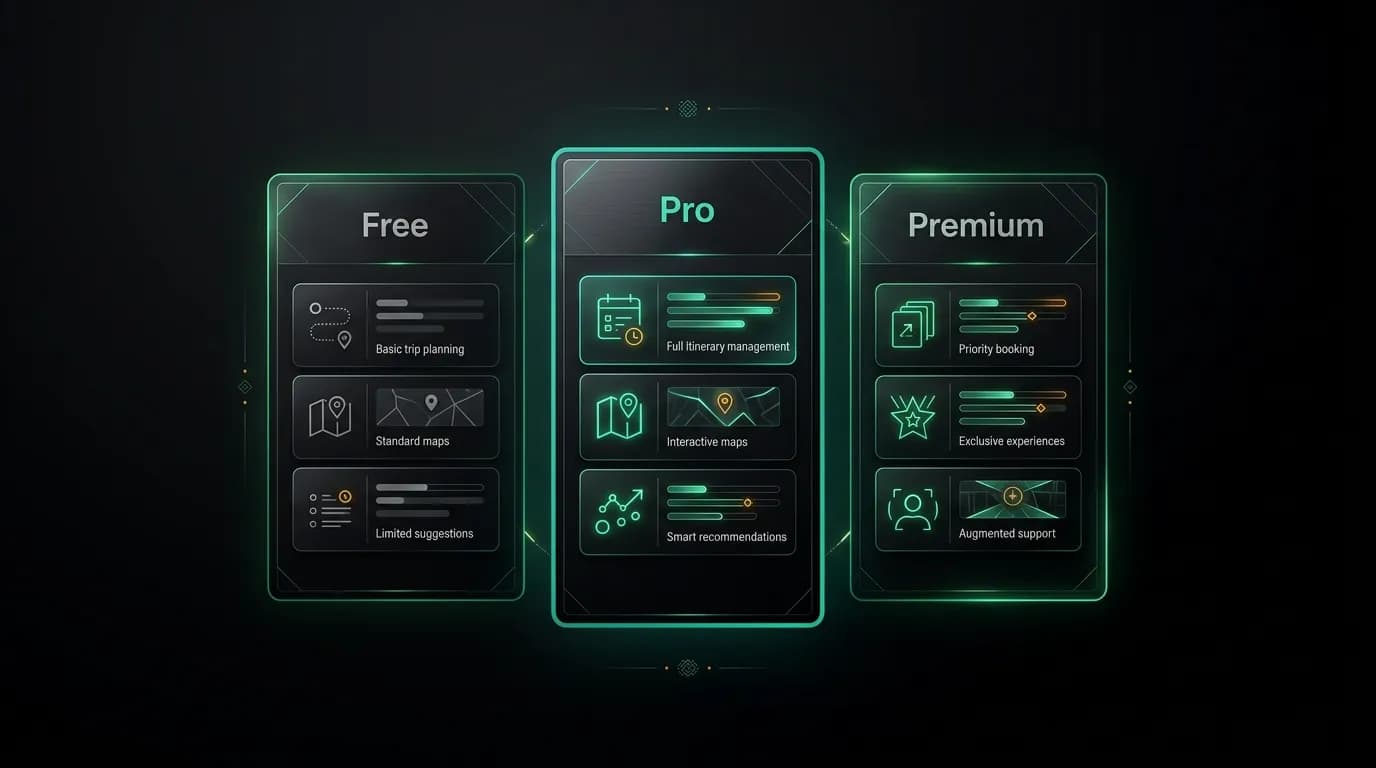
Pricing is product. The core debate is simple: what does free include, and what does membership unlock? We are designing tiers before public launch so messaging, paywalls, and booking economics stay consistent on day one.
Free tier design
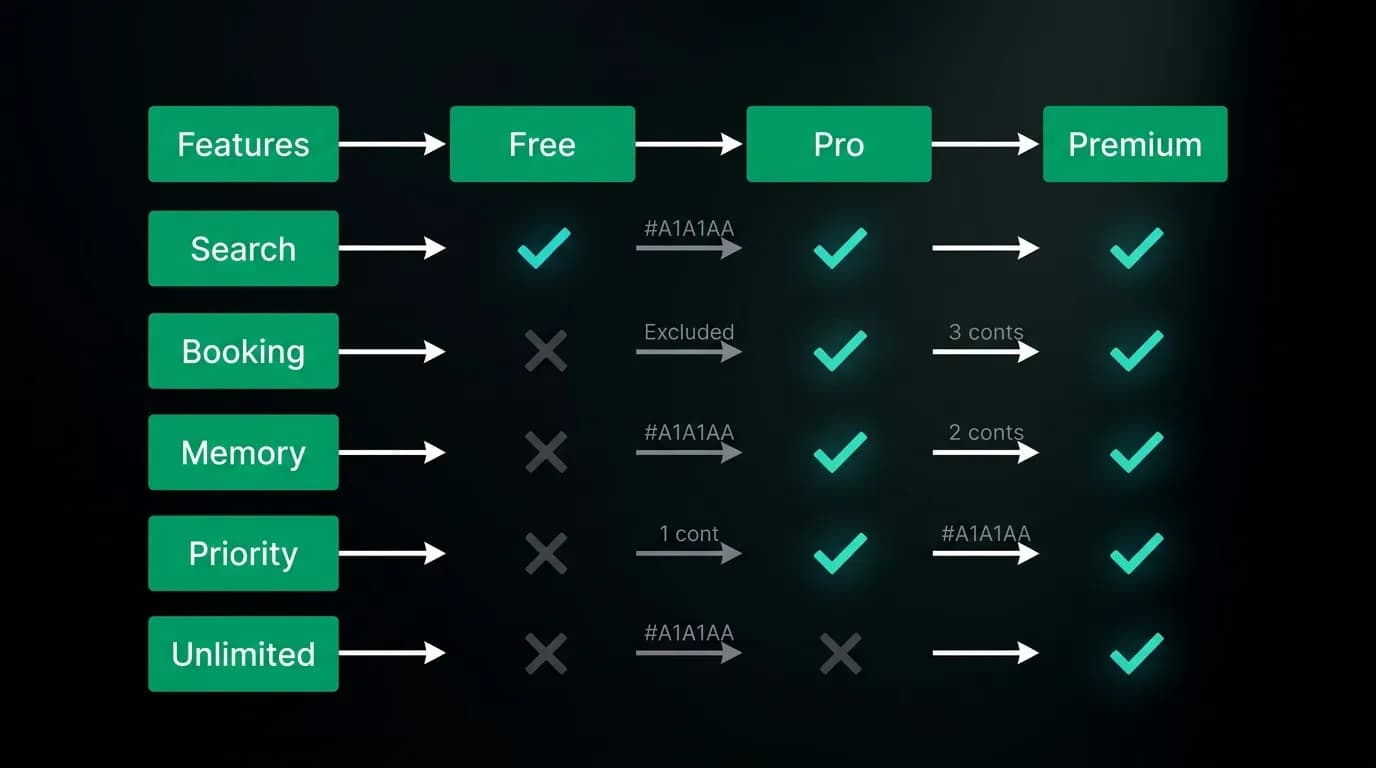
The free tier exists for one reason: to let travelers experience the AI agent's capabilities without friction. A free tier that is too limited feels like a bait-and-switch. A free tier that is too generous eliminates the reason to upgrade. The boundary between the two is where pricing strategy lives.
Our free tier includes unlimited search, a limited number of bookings per month, and basic conversation memory within a single session. The traveler can talk to the agent, search flights-layer-ai-agent-search-flights) and hotels, compare options, and complete a small number of bookings. They experience the full quality of the agent's intelligence. What they do not get is the depth of the relationship: cross-session memory, priority search access, and unlimited booking volume.
This design reflects a principle we kept returning to during the pricing debate: the free tier should demonstrate the product's ceiling, not its floor. A free user should think "this is incredible, and the paid version is even better" rather than "this is limited, maybe the paid version is decent."
We studied how other AI products handle free tiers and found that the most successful ones gate quantity and depth rather than quality. A free user who experiences low-quality AI decides the product is low quality. A free user who experiences high-quality AI but wants more of it decides to upgrade.
Premium feature gating
Deciding which features justify a subscription required mapping every capability against two criteria: does the feature cost us significantly more to provide, and does the feature represent ongoing value rather than a one-time utility?
Memory across sessions is a premium feature because it costs more to maintain per user and because its value increases over time. The agent that remembers a traveler's preference for aisle seats, dietary restrictions, and preferred airlines becomes more valuable with every conversation. That compounding value justifies a recurring subscription.
Priority search access is premium because search infrastructure has real costs. Each search hits external travel data providers with rate limits and per-query pricing. Free users get standard search. Premium users get priority queue placement, which matters during high-demand periods when search latency increases.
Unlimited bookings are premium because each booking triggers a chain of API calls, payment processing, and confirmation handling. The marginal cost per booking is not zero. Limiting free-tier bookings keeps our infrastructure costs sustainable while demonstrating the booking experience.
We built the subscription gating to work across all platforms with a single source of truth. Whether a traveler uses the mobile app on iOS, the Android app, or the web interface, their subscription status is consistent. The subscription management layer handles platform-specific purchase flows while maintaining a unified view of what each traveler has access to.
On the client side, a subscription hook checks the traveler's current tier before rendering premium features. On the server side, every premium API endpoint verifies subscription status independently. Client-side gating provides a smooth experience. Server-side verification prevents circumvention.
Setting price points
We set initial price points using three inputs: competitive analysis, willingness-to-pay research, and cost modeling.
Competitive analysis showed that travel subscription products range from free to roughly thirty dollars per month. Most cluster around ten to fifteen dollars. But direct comparison was misleading because no competitor offers the same value proposition. Traditional travel apps charge for features like price alerts and trip organization. We charge for an AI agent that handles the entire booking workflow. The value is categorically different.
Willingness-to-pay research involved surveying travelers about how much they would pay for an AI that handles their travel booking. The responses clustered around what we expected: most travelers would pay between five and twenty dollars per month, with the median around ten. But the more interesting finding was that willingness to pay increased dramatically after travelers actually used the agent. Pre-experience surveys underestimate willingness to pay for AI products because people cannot accurately imagine the value until they experience it.
Cost modeling was the most concrete input. We calculated the cost of providing the service per user per month: LLM inference costs per conversation, external API costs per search, payment processing fees per booking, infrastructure costs per active user. The per-user cost varies significantly based on usage intensity. A traveler who books monthly costs more to serve than one who books quarterly. Our pricing needed to cover the highest-usage subscribers while remaining attractive to occasional travelers.
The final prices landed at a free tier, a mid-range tier for regular travelers, and a premium tier for frequent travelers and business users. The mid-range tier covers our costs with margin at average usage levels. The premium tier is profitable even for heavy users.
Subscription lifecycle management
Subscription events flow through webhooks that handle the full lifecycle: initial purchase, renewal, cancellation, expiry, and reactivation. Each event updates the traveler's subscription status in our database and triggers the appropriate access changes.
When a subscriber cancels, they retain access until their current billing period ends. We do not immediately downgrade access because doing so feels punitive and generates negative sentiment. The traveler chose to cancel, and respecting their remaining paid period is the minimum courtesy.
When a subscription expires, the downgrade to the free tier preserves the traveler's data but limits their access to free-tier capabilities. Their conversation history remains accessible. Their preferences are preserved. If they resubscribe, they pick up exactly where they left off with no data loss.
We display subscription status transparently on the profile page. Travelers always know what tier they are on, when it renews, and what capabilities their tier includes. No hidden information, no dark patterns, no confusion about what they are paying for.
Early results
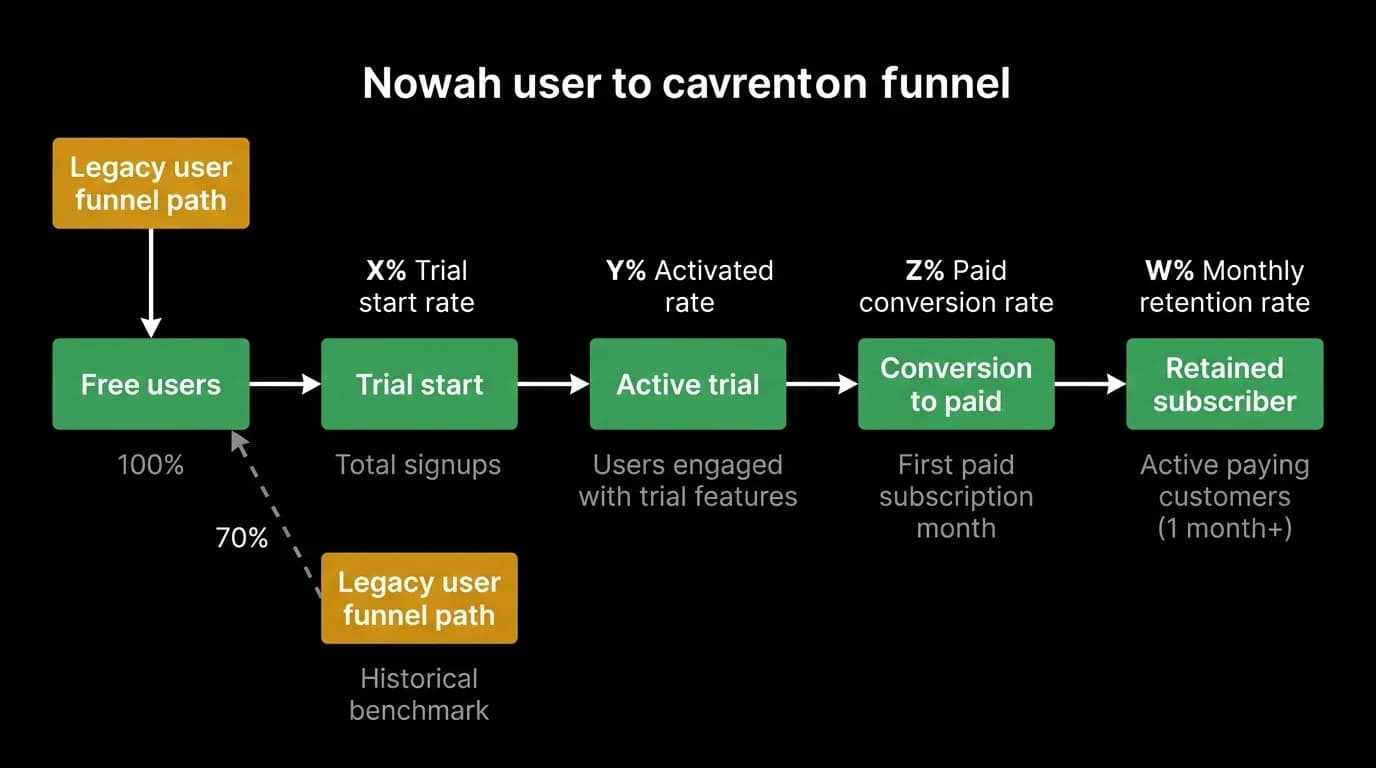
The first month of subscription data told a clear story: conversion from free to paid was lower than we hoped but higher than the industry average for travel apps. The free-to-paid conversion rate for travelers who completed at least one booking was significantly higher than for those who only searched. This supports our free tier design: letting travelers book, even in limited quantity, was essential for demonstrating the value that justifies a subscription.
Churn in the first month was higher than we wanted. Exit surveys revealed that most churning subscribers cited usage frequency: they loved the product but did not travel often enough to justify a monthly subscription. This was a pricing structure problem, not a product quality problem.
Average revenue per user exceeded our projections because premium-tier adoption was stronger than expected. Frequent travelers and business users immediately saw the value of unlimited bookings and priority access. They were not price-sensitive. They were value-sensitive, and the value was clear.
Pricing adjustments
The churn data drove our first major pricing adjustment. We introduced an annual plan at a significant discount to the monthly rate. Travelers who knew they would use the service but not every month could lock in a lower rate. Annual plan adoption reduced churn because the commitment horizon was longer and the per-month cost was lower.
We also adjusted the free tier booking limit upward after analyzing the data. Our initial limit was too restrictive for travelers to fully experience the booking flow. Increasing it by a small amount improved the free-to-paid conversion rate because travelers had enough experience to make an informed subscription decision.
The mid-range tier price stayed the same. The premium tier price increased slightly, paired with additional features that justified the increase. Premium subscribers were the least price-sensitive segment and the most responsive to feature additions.
Pricing is never done. We continue to monitor conversion rates, churn, and revenue per user. Each data point refines our understanding of where travelers perceive value and what they are willing to pay for it. The three-hour meeting was just the beginning of an ongoing conversation between our pricing model and our travelers' behavior.
Nowah is an AI travel agent that searches and books real flights and hotels through conversation — no filters, no thirty open tabs. Plan your next trip.