The Psychology of Travel Booking Decisions
Anchoring, loss aversion, social proof, and the paradox of choice — behavioral psychology explains why you book the way you do and how AI can help.
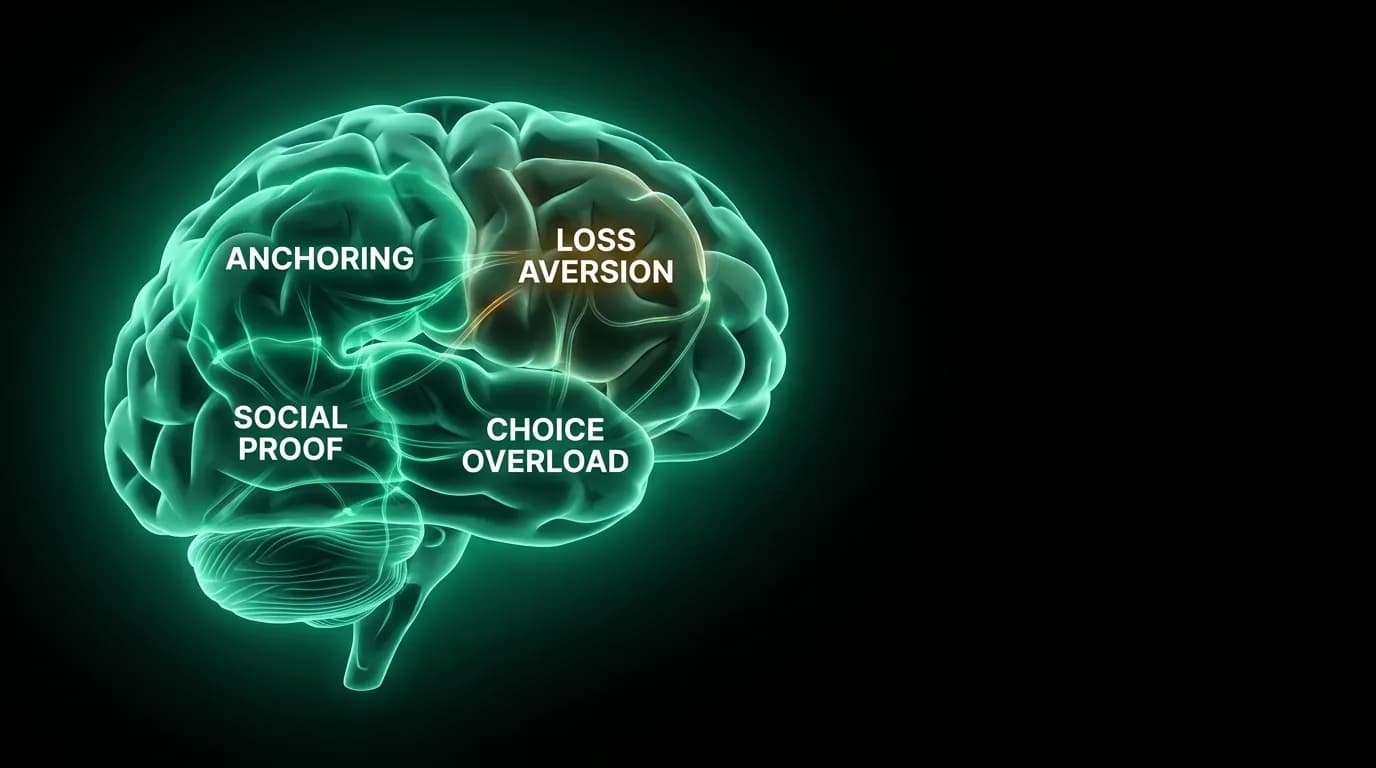
You chose that flight because the first price you saw anchored your sense of what "expensive" means. You almost booked an hour ago but hesitated because the price might drop, then panicked when it went up by $30. You picked the popular destination over the interesting one because more people go there so it must be good. And you spent 45 minutes comparing eight hotels before choosing the third one you looked at because you were too exhausted to keep looking.
None of these decisions were fully rational. All of them are predictable. Behavioral psychology has mapped the cognitive shortcuts that govern how humans make complex decisions under uncertainty, and travel booking hits every trigger: high stakes, many options, imperfect information, and time pressure. Understanding these biases does not just explain your behavior — it reveals how better tools can help you make decisions you actually feel good about.
Anchoring: the first price shapes everything
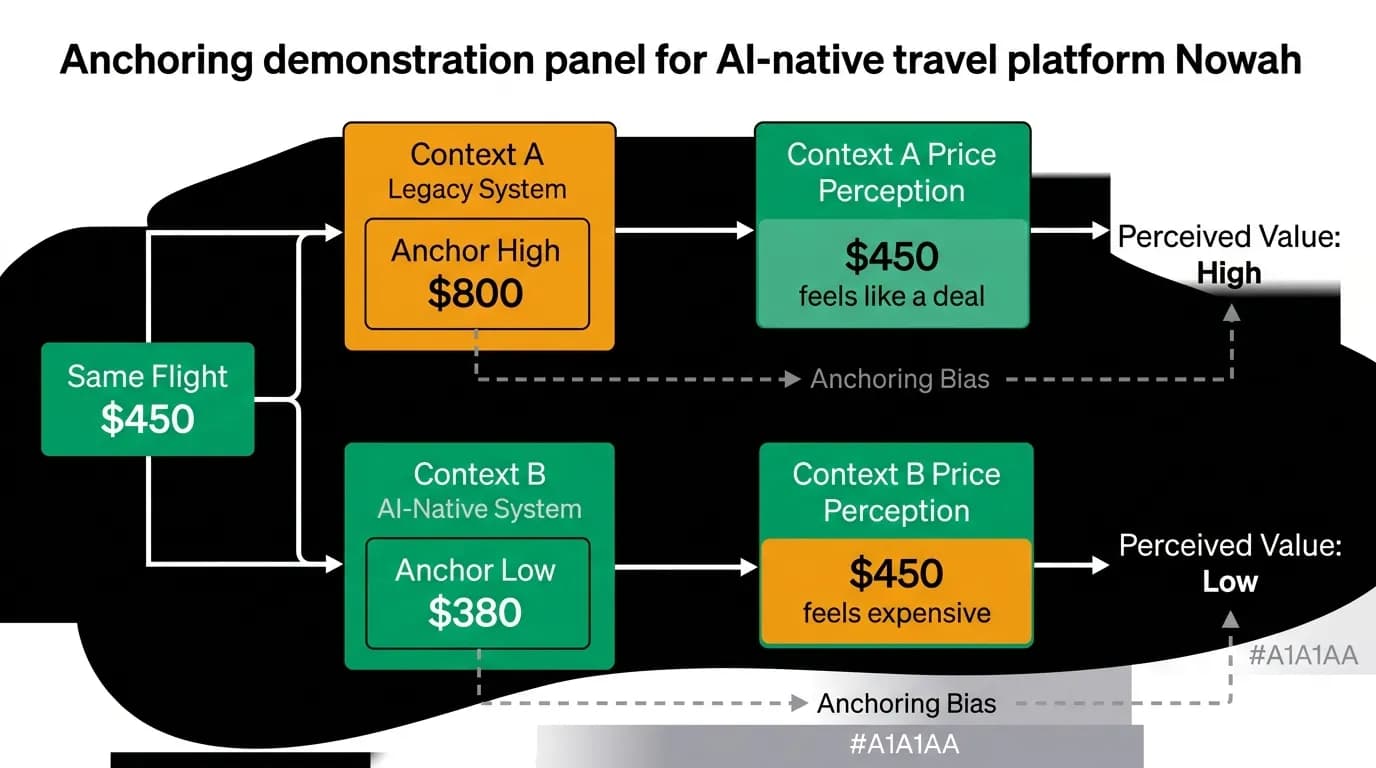
Anchoring is the tendency to rely heavily on the first piece of information you encounter when making a judgment. In travel booking, the first flight price you see becomes your reference point. Everything after that is evaluated as "cheaper than" or "more expensive than" that anchor.
The average traveler visits dozens of websites before booking a trip. Each website resets the anchor. You see a $500 flight on the first site, and $480 feels like a deal on the second. Then you see $520 on the third site, and suddenly $480 feels even better. But if you had started with a site showing $440, the $480 option would feel overpriced.
This is why comparison shopping across many sites can actually make you less confident rather than more. Each new price creates a new anchor, and the anchors conflict with each other. You end up uncertain about whether any price is good, which is one of the reasons 70% of travelers report feeling overwhelmed during the booking process.
The AI counters anchoring by providing historical pricing context. Instead of showing you a price in a vacuum, it shows you where that price sits relative to the 90-day average for the route. "This is 15% below the typical fare" is a stable reference point that does not shift every time you look at a new site. It replaces arbitrary anchors with data-driven context.
Loss aversion: the fear of missing out on a better price
Loss aversion is the principle that people feel the pain of a loss roughly twice as strongly as the pleasure of an equivalent gain. In travel booking, this manifests as the fear that the price will drop after you book. The potential loss of overpaying by $50 weighs more heavily than the certain gain of having your trip booked and settled.
This fear causes a specific and costly behavior: delayed booking. Travelers who could have locked in a good price wait, hoping for a better one, and end up paying more when prices rise. Many travelers say booking is the most stressful part of trip planning, and price anxiety is a major contributor.
The AI addresses loss aversion with price trajectory signals. When the data suggests a fare is at or near its floor, the AI says so: "Fares on this route typically rise in the next two weeks. The current price is in the lowest 20% of what we have seen for these dates." This information does not guarantee the price will not drop further, but it gives you a rational basis for your decision instead of leaving you in an anxious void.
Social proof: popularity is not quality
Social proof is the tendency to follow the crowd. In travel, this means booking popular destinations, highly reviewed hotels, and well-known airlines, often at the expense of equally good or better options that simply have less visibility.
Social proof is not entirely irrational. Popular destinations are popular for reasons, and heavily reviewed hotels have a track record. But the bias becomes problematic when it discourages exploration. An emerging destination that matches your preferences perfectly might get overlooked because it does not have the social proof of the established alternative.
The AI recognizes social proof as one signal among many. High review counts and popular demand are factors in the recommendation model, but they are balanced against personal fit. A quiet, less-reviewed hotel that matches your specific preferences (walkable neighborhood, boutique style, included breakfast) might rank above a heavily reviewed chain property that does not match as well.
The paradox of choice
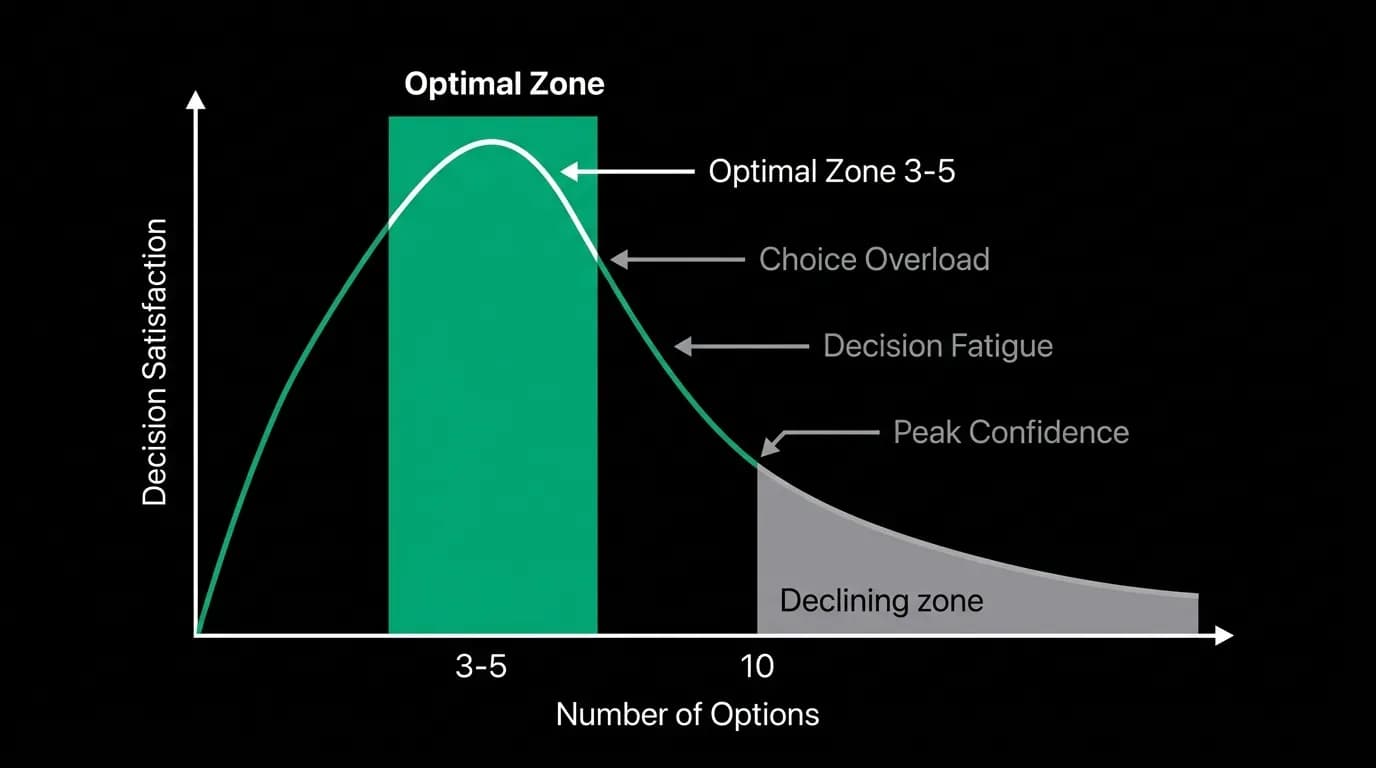
The most well-documented psychological trap in travel booking is the paradox of choice. Research consistently shows that decision satisfaction decreases as the number of options increases beyond three to five. More options create more comparison anxiety, more fear of making the wrong choice, and less confidence in whatever you ultimately pick.
Traditional travel search leans into the paradox by showing you 200 flight results and letting you sort and filter. This feels empowering in theory but is exhausting in practice. By the time you have scrolled through 30 options, you are no longer making a careful evaluation. You are looking for a reason to stop searching.
The AI's three-option recommendation structure is a direct response to the paradox of choice. Three curated options — budget, balanced, comfort — give you enough variety for meaningful comparison without triggering analysis paralysis. Each option is annotated with why it was selected, which further reduces the cognitive load of evaluation.
Designing for clear thinking
The goal is not to exploit these biases — that is what urgency counters ("Only 2 seats left!") and hidden-fee pricing do — but to mitigate them. Transparent pricing context counters anchoring. Price trajectory data counters loss aversion. Preference-weighted ranking counters social proof. Curation counters choice overload.
Book on Nowah where recommendations are designed for clear thinking, not impulse. The AI helps you make travel decisions you are genuinely confident about — not because it tricked you into confidence, but because it gave you the information to earn it.
Nowah is an AI travel agent that searches and books real flights and hotels through conversation — no filters, no thirty open tabs. Plan your next trip.