Regulation and AI Travel Agents
Consumer protection, price transparency, GDPR for AI memory, liability for booking errors. The regulatory landscape is evolving — build for compliance now.
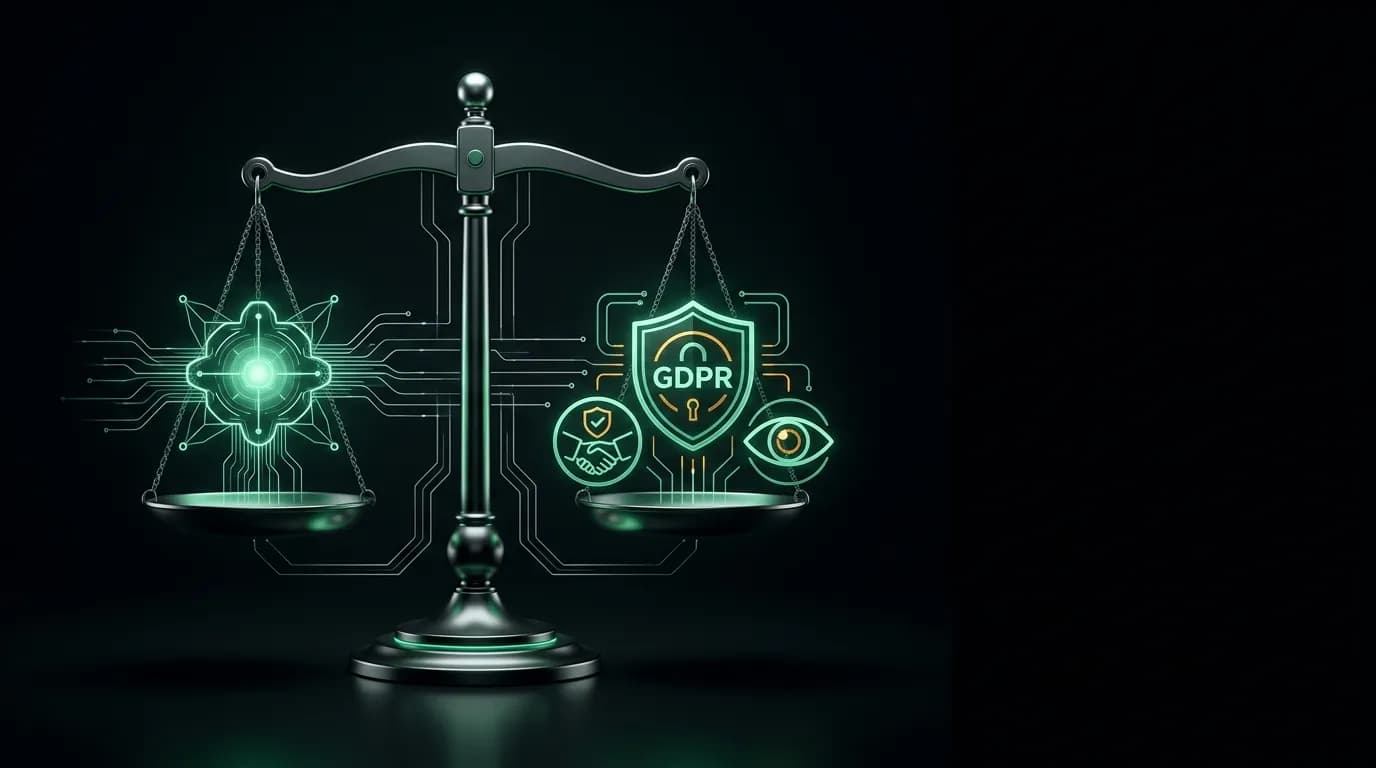
The regulatory environment for AI travel agents is still forming. Most existing travel regulations were written for human agents and online travel agencies. They do not neatly address the specific characteristics of AI-powered booking: automated recommendations, persistent memory of user preferences, conversational data collection, and autonomous decision-making on financial transactions.
This is both a risk and an opportunity. The risk: regulations could arrive suddenly and impose requirements that are expensive to retrofit. The opportunity: companies that build compliance into their architecture from the start gain a competitive advantage when regulations formalize.
I believe in proactive compliance. Not because I love regulation, but because doing the right thing for users happens to also be the right thing for the business.
The regulatory landscape
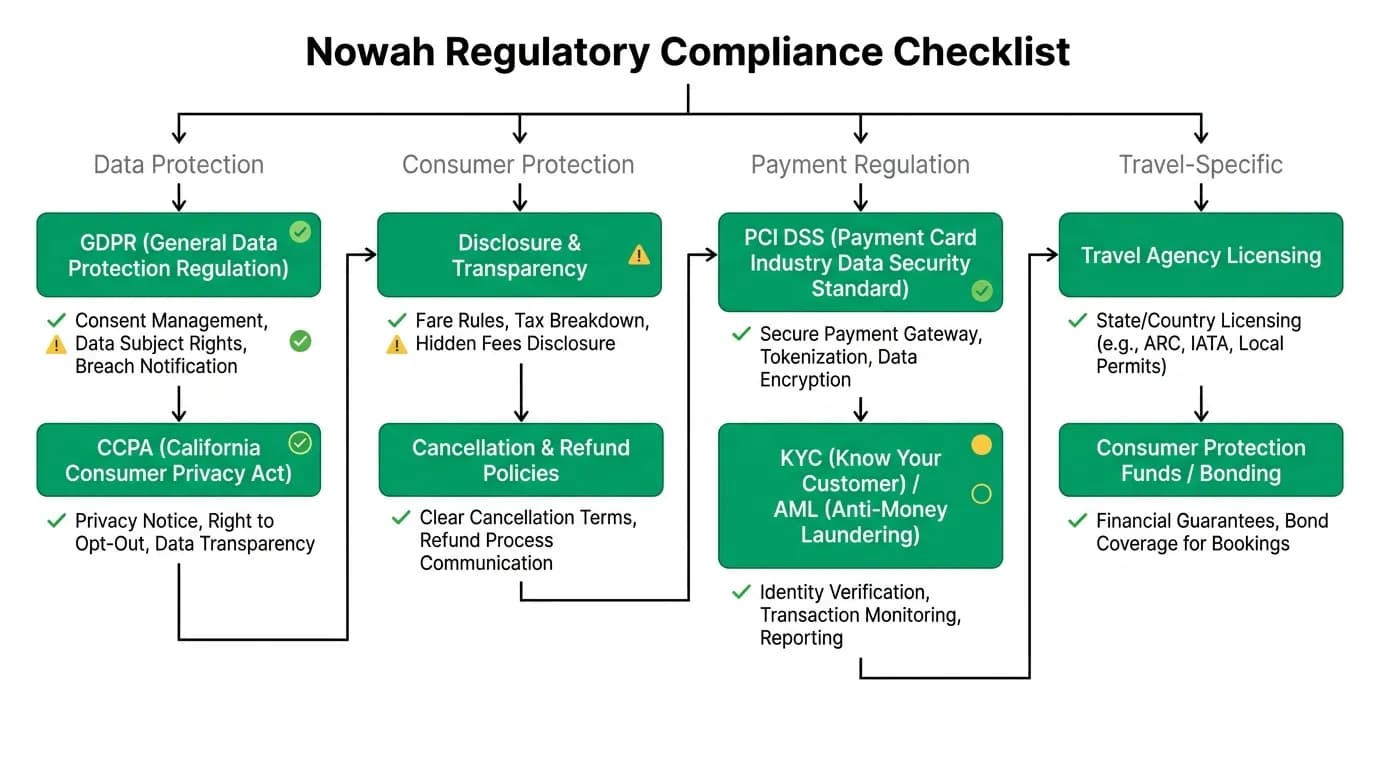
Several regulatory domains affect AI travel agents today or will within the next 1-2 years:
Consumer protection. Existing consumer protection laws already apply to AI-generated recommendations. If your AI agent recommends a hotel, and the recommendation is based on a commercial relationship rather than the user's best interest, that may constitute deceptive practice in many jurisdictions. Disclosure requirements are tightening.
Data protection. GDPR in Europe and CCPA in California grant users rights over their personal data: the right to access, correct, and delete. These rights explicitly apply to AI memory systems that store user preferences, travel history, and behavioral patterns. Users must be able to request deletion of their preference profile, and the deletion must propagate across all storage systems (relational database, vector database, cached embeddings).
Price transparency. Travel-specific regulations in some jurisdictions require that prices shown to consumers include all mandatory fees and that comparison rankings are not distorted by commercial relationships. AI-curated results must genuinely reflect the user's best options, not commercially advantageous ones.
AI-specific regulation. The EU AI Act categorizes AI systems by risk level. AI travel booking agents likely fall into a "limited risk" category requiring transparency obligations: users must be informed they are interacting with an AI, and automated decisions must be explainable.
Consumer protection for AI recommendations
This is the area where I think many AI travel companies are currently non-compliant without realizing it.
When an AI agent recommends "book this flight, it is the best option," the user reasonably assumes that recommendation is based on their interests. If the recommendation is actually influenced by which airline pays a higher commission, or which hotel has a preferred partnership, that is a conflict of interest that requires disclosure.
We handle this by keeping our recommendations purely user-aligned. The ranking algorithm weights user preferences, price, quality, and convenience. It does not weight commercial relationships. When we present three options, they are genuinely the three best options for this user based on their stated and inferred preferences.
If a commercial relationship ever did influence ranking (say, a promoted placement from a hotel chain), it would be labeled clearly: "Promoted: Marriott is offering a special rate for your dates." The user can see the distinction between organic recommendations and sponsored ones.
This is not just good ethics; it is good product design. Users who discover that their "trusted advisor" was actually showing them commercially biased results will leave and never come back.
Data protection and AI memory
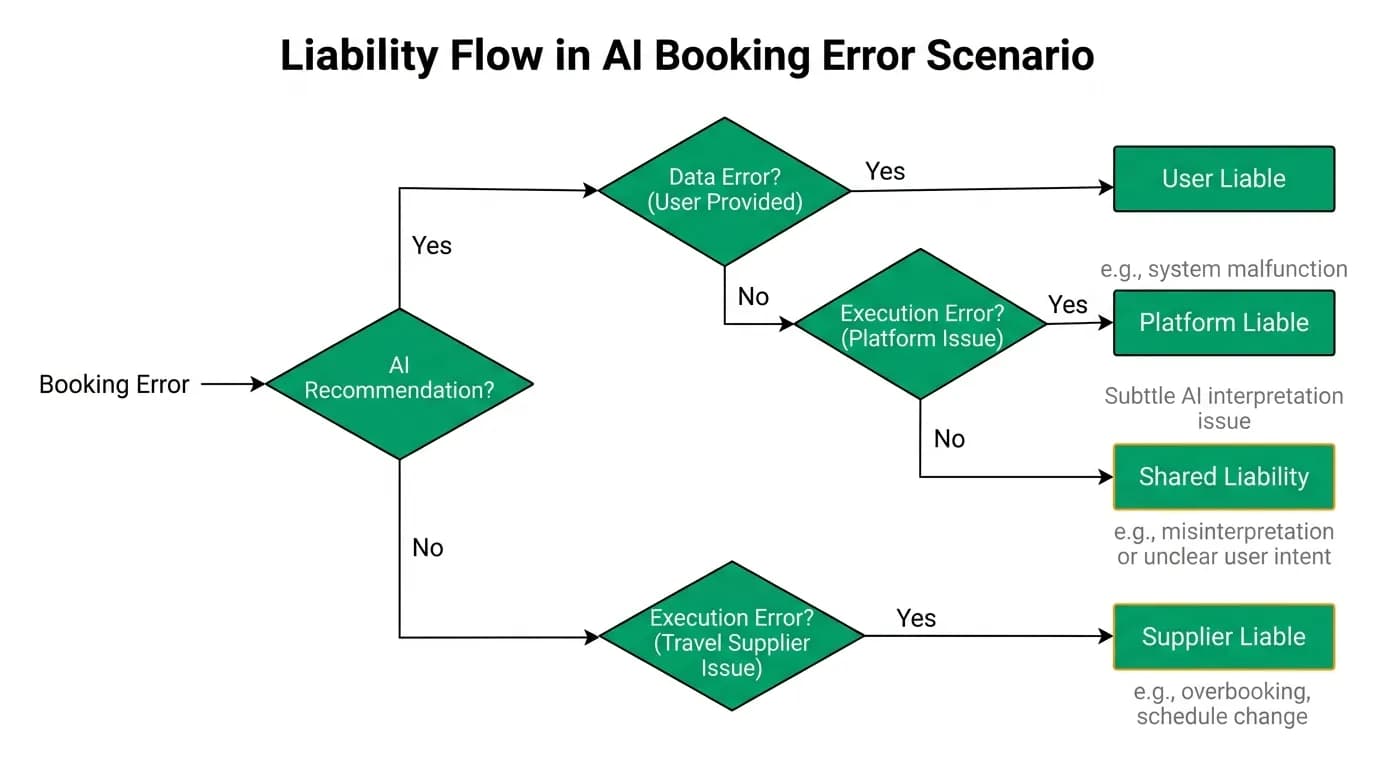
GDPR's "right to be forgotten" has specific implications for AI travel agents with persistent memory.
When a user requests data deletion, the following must happen:
- Their user profile is deleted from the relational database
- Their preference embeddings are deleted from the vector database
- Their conversation history is deleted from chat storage
- Their behavioral patterns are purged from analytics systems
- Any cached data containing their information is invalidated
This is technically challenging because AI memory systems are designed to be persistent and interconnected. A preference embedding that encodes "this user likes boutique hotels" might be linked to multiple trip memories, conversation threads, and recommendation logs. Deleting it completely requires tracing all references.
We built deletion propagation into our architecture from the start. A single deletion request triggers a cascade across all storage systems with verification that the deletion completed fully. This is harder to retrofit than to build in.
Data portability is the other GDPR requirement worth noting. A user who wants to switch to a competing travel agent should be able to export their preference profile in a standard format. We support this, and I think it actually benefits us: users who know they can leave are more confident in staying.
Liability for booking errors
Who is responsible when the AI makes a mistake?
Scenario: the AI agent recommends a flight with a "free cancellation" flag. The user books based on that flag. It turns out the cancellation policy was misread from the data source, and the ticket is actually non-refundable. The user needs to cancel and faces a $500 penalty.
Is the AI platform liable? The data provider? The airline?
This question does not have a clear legal answer yet in most jurisdictions. But several principles are emerging:
The platform is liable for its recommendations. If the AI made a claim about cancellation policy, and that claim was wrong because of a bug in the data processing, the platform bears responsibility. We invest heavily in data accuracy for exactly this reason.
The supplier is liable for their data. If the airline's API returned incorrect cancellation policy data, and the AI faithfully presented that data, liability shifts toward the supplier. But proving this requires audit trails.
Shared liability is common. In practice, consumer-facing disputes often result in the platform absorbing the cost because it is simpler than litigating the data chain. Booking errors can cost hundreds or thousands of dollars, which is why data accuracy and error detection are not optional.
We maintain detailed audit logs of every data retrieval and presentation. When the agent shows a cancellation policy, we log the raw data source, the processing logic, and the presented text. If a dispute arises, we can trace exactly what happened and where an error occurred.
Proactive compliance as competitive advantage
Companies that exceed regulatory requirements today will have a structural advantage when regulations formalize.
If you have already built GDPR-compliant deletion propagation, the next data protection regulation is just a configuration change. If you have already separated commercial interests from recommendations, the next consumer protection rule does not require a product redesign. If you have already built audit trails for booking decisions, the next AI transparency requirement is already met.
Proactive compliance is expensive upfront and cheap to maintain. Reactive compliance is free upfront and incredibly expensive to retrofit.
We chose proactive compliance not because we anticipated specific regulations, but because building for transparency, user control, and accountability produces a better product. Users who trust that the AI is working in their interest, that their data is protected, and that errors will be handled fairly are users who stay.
Regulation is coming for AI travel agents. Build for it now. Your users will thank you, and your future self will too.
Nowah is an AI travel agent that searches and books real flights and hotels through conversation — no filters, no thirty open tabs. Plan your next trip.