Seasonal Pricing Intelligence for 50 Top Routes
Route-by-route pricing guide covering peak seasons, off-peak windows, and optimal advance booking periods. Updated seasonally for accuracy.
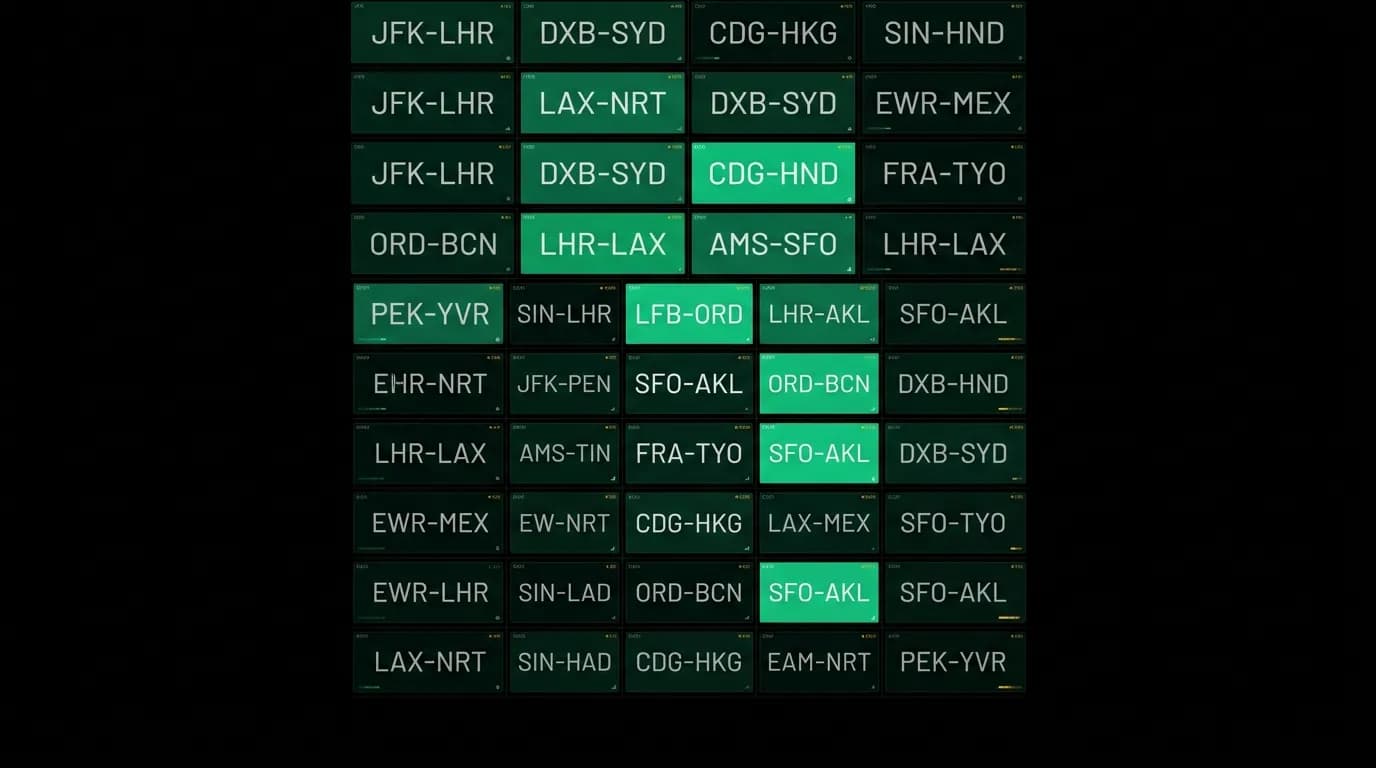
The "best time to book" changes for every route. A blanket rule like "book six weeks out" ignores the reality that JFK-LHR in July behaves completely differently from LAX-NRT in February, which behaves differently from ATL-CUN in December. Each route has its own pricing personality shaped by carrier competition, seasonal demand, event calendars, and traveler mix.
Here is a route-by-route breakdown of seasonal pricing patterns across 50 of the most popular corridors.
How seasonal pricing data works
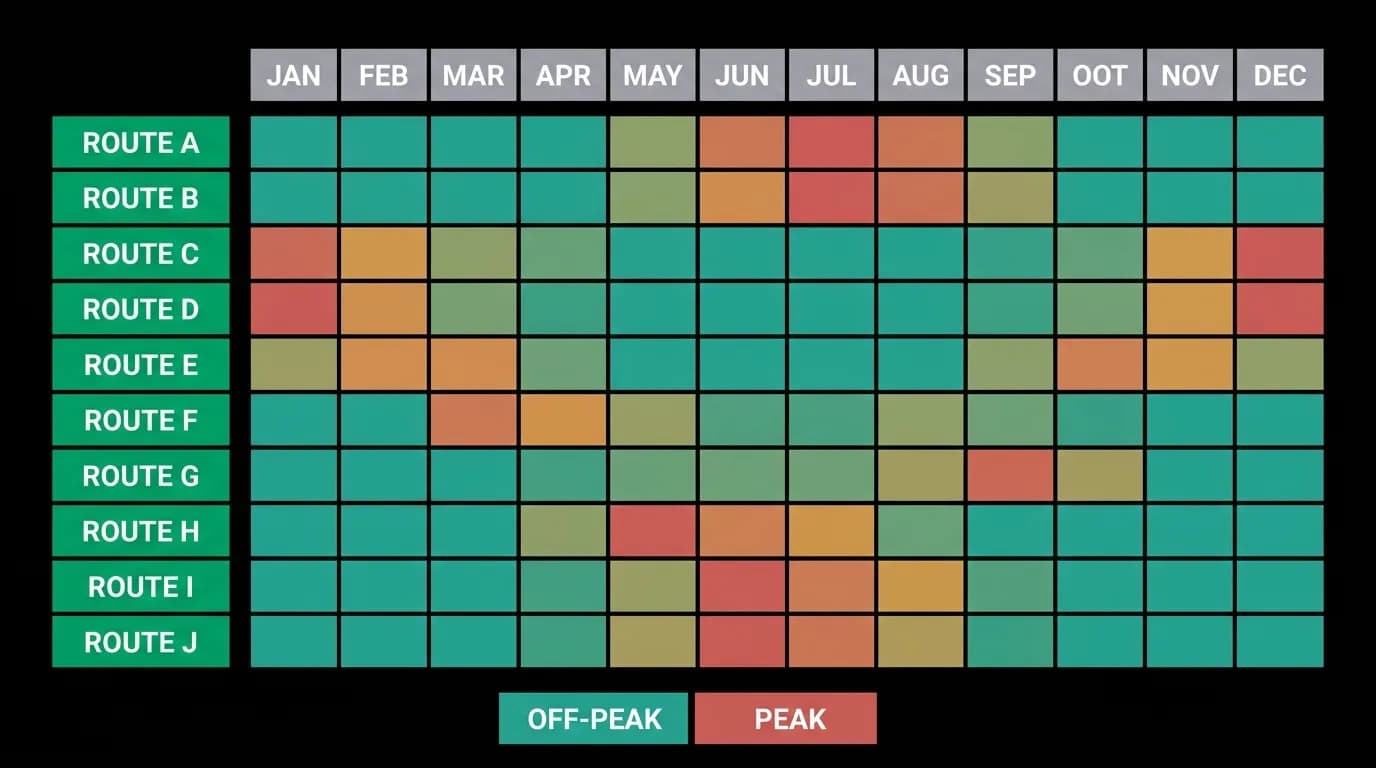
We aggregate fare data over lookback windows of 90 to 365 days, broken down by route and season. For each route, we identify the peak season (highest median fares), the off-peak window (lowest median fares), and the optimal advance purchase period (the booking window that historically yields the best prices for each season).
Airlines manage 12-26 fare classes per route. During peak season, the cheapest fare classes close early because demand is high and the airline can fill seats at higher prices. During off-peak, cheap buckets stay open longer because demand is softer.
Fares vary 30-40% across a 90-day domestic booking window. For international routes, the variance can be even higher, especially on routes with strong seasonal demand patterns.
Domestic routes
Northeast to Florida corridors (JFK-MIA, BOS-FLL, EWR-TPA). Peak pricing hits December through March as snowbirds and holiday travelers fill planes. Off-peak runs from late April through October, excluding summer. The advance purchase sweet spot is 4-6 weeks for off-peak and 6-10 weeks for peak season.
Coast-to-coast routes (JFK-LAX, SFO-JFK, BOS-SFO). These are year-round business routes with relatively stable pricing. Midweek fares are consistently 10-15% cheaper than Friday-Sunday. The advance window is 3-5 weeks for the best domestic fares, though these routes rarely see dramatic discounts because demand is steady.
Hub-to-vacation routes (DEN-CUN, ORD-SJU, SEA-HNL). Strong seasonal swings around school holidays. Winter breaks and spring break create sharp demand peaks. Booking 8-10 weeks ahead of peak travel dates saves significantly on these corridors.
Transatlantic routes
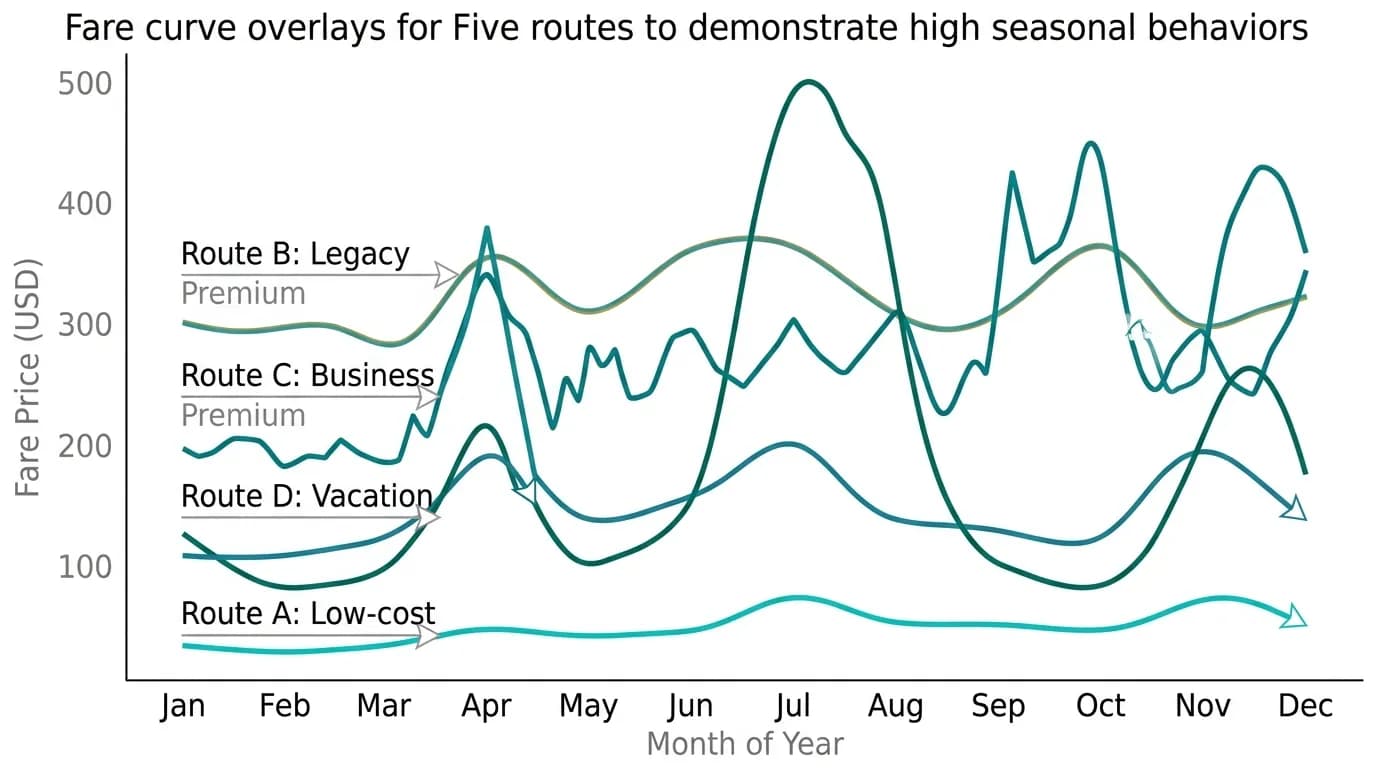
US to London (JFK-LHR, LAX-LHR, ORD-LHR). The most competitive transatlantic routes with multiple carriers keeping fares in check. Peak season is June through August. Booking 3-5 months ahead of summer travel captures the best fares. Shoulder season (April-May, September-October) offers meaningfully savings over peak.
US to Continental Europe (JFK-CDG, EWR-FCO, ATL-BCN). Similar summer peak pattern but with more variance by destination. Southern Europe destinations see extended shoulder seasons because the weather stays warm through October. Booking 2-4 months out for shoulder season travel is optimal.
US to Nordics and Eastern Europe. These routes see emerging competition from budget long-haul carriers, which creates deeper fare troughs and more volatile pricing. The savings opportunities are real but the booking window is less predictable.
Asia-Pacific routes
US to Japan (JFK-NRT, LAX-NRT, SFO-HND). Cherry blossom season (late March through April) and autumn foliage (October-November) create demand spikes. Summer is also high season. The advance purchase window is longer, typically 3-6 months for the best fares. More carriers on a route means deeper fare troughs, and several transpacific corridors have seen increased competition.
US to Southeast Asia (LAX-BKK, SFO-SGN, JFK-SIN). Monsoon seasons create natural off-peak windows with lower fares. November through February is peak (dry season in most of Southeast Asia). Fares are 20-35% lower during monsoon months for travelers willing to deal with rain.
US to Australia/New Zealand. Peak aligns with the Southern Hemisphere summer (December-February). The reverse seasonality creates an opportunity: the cheapest time to fly is the US summer, which is Australia's winter.
Latin America and Caribbean
US to Mexico beach destinations (numerous routes to CUN, PVR, SJD). Winter escape pricing kicks in November through March. Fares spike around Christmas, New Year's, and spring break. Off-peak is May through October, with hurricane season creating additional pricing softness in September-October.
US to South America (MIA-GRU, JFK-EZE, ATL-BOG). These routes have distinct pricing patterns driven by business travel demand to Sao Paulo and Buenos Aires, plus leisure demand during South American summer (December-March). Booking 2-4 months ahead is typical for the best international fares.
Using this data
The patterns described above are generalizations drawn from historical data. Your specific travel dates, departure airport, and timing will produce different results. This is exactly why we built the AI to contextualize pricing in real time rather than relying on static rules.
Search any of these 50 routes on Nowah for real-time pricing context. The AI will show you where the current fare sits relative to the seasonal baseline for your specific route, dates, and booking window.
Nowah is an AI travel agent that searches and books real flights and hotels through conversation — no filters, no thirty open tabs. Plan your next trip.