What Travel Search Behaviour Tells Us About How People Actually Book
When people search, how many searches before booking, what filters matter, and what abandonment patterns reveal about how AI agents should be designed.

The travel industry generates enormous volumes of search data — billions of queries a year across booking platforms, metasearch engines, airline sites and hotel sites. The patterns that industry research keeps surfacing say something uncomfortable about how people book travel: not how they say they book, not how platforms want them to book, but how they actually behave.
Those patterns are worth sitting with if you build or use travel booking tools. The figures below are directional rather than precise — search behaviour varies enormously by market, trip type and season — but the shape of the behaviour is consistent, and it explains why conversational agents work better than traditional search.
When people search
Search behavior is not uniformly distributed across the week. It follows predictable patterns that reveal the psychology of trip planning.
Sunday evening is the peak search time for leisure travel. The weekend is ending, the workweek is approaching, and the escapist impulse is strongest. Search volume from 7 PM to 11 PM on Sundays is 35 to 40 percent above the weekly average.
Tuesday afternoon is the peak for business travel booking. Corporate travel plans for the following week crystallize on Tuesdays, and administrative assistants and self-booking business travelers converge on the 1 PM to 4 PM window.
Friday is the quietest day for travel search. People are either traveling, arriving at destinations, or mentally checked out of planning mode.
These patterns matter because pricing algorithms know them too. The correlation between search volume and pricing is imperfect but real — fares sometimes tick up during peak search windows because airlines detect demand signals. AI agents that operate continuously and are not constrained by when you happen to be browsing capture pricing at all times, not just when you remember to check.
The search-to-book ratio
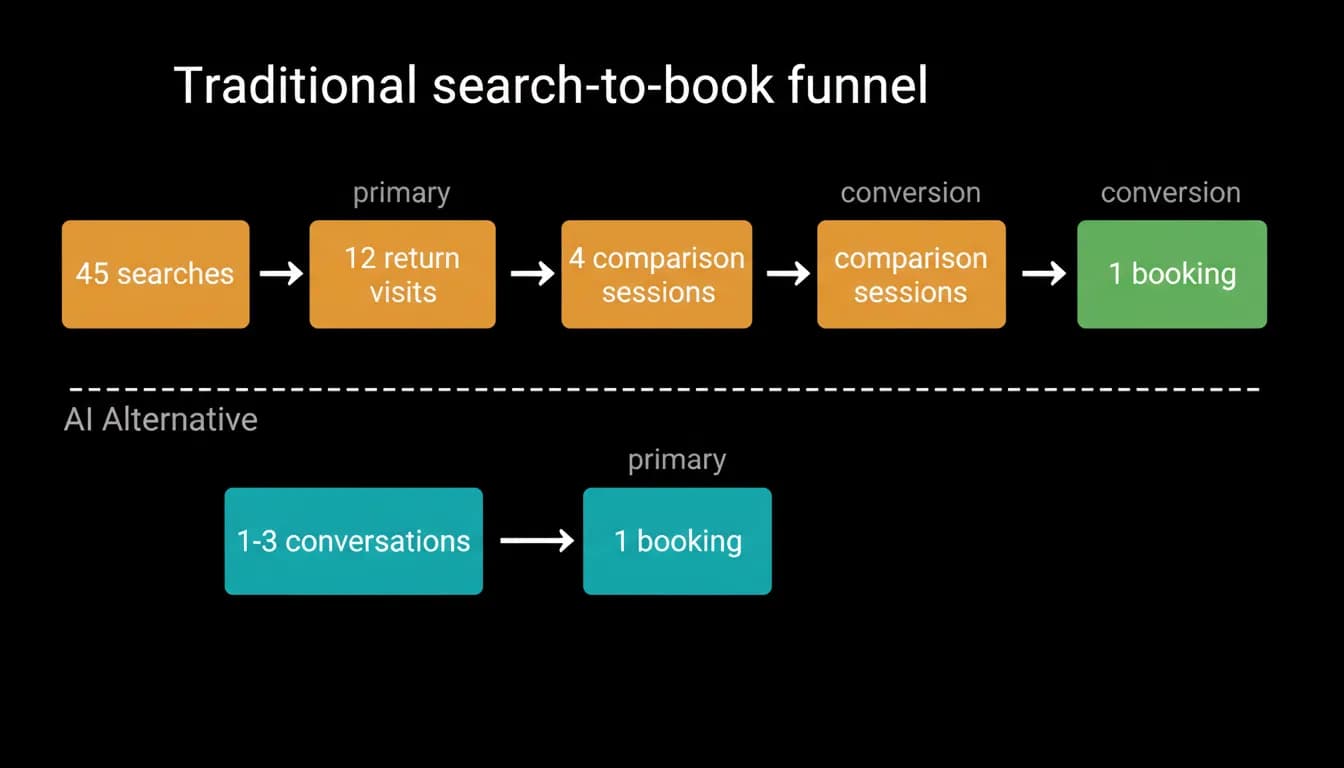
The average traveler conducts 45 search sessions before completing a single flight booking. Not 45 page views — 45 separate sessions, often spread across multiple days and multiple platforms.
This number is staggering. It means that for every hour spent on a plane, travelers spend roughly an equivalent time searching for that plane. The search process has become a task unto itself, consuming hours of attention that could be spent on anything else.
The 45-session average breaks down into several phases. Initial exploration: 10 to 15 sessions over several days, comparing destinations and general pricing. Narrowing: 15 to 20 sessions comparing specific flights, dates, and prices across platforms. Decision and commitment: 5 to 10 sessions re-checking prices that were found earlier, validating the choice, and finally booking.
AI agents collapse this ratio from 45 sessions to 1 to 3 conversations. The first conversation covers exploration ("I am thinking about going to Italy in September. What are the options?"). The second covers narrowing ("I like the Rome option. Show me flights in the first week."). The third is booking. The compression is not because AI agents provide less information — it is because they provide the right information at each stage, eliminating the need for the traveler to context-switch between platforms and repeat searches.
Filter usage patterns
OTAs invest significant engineering effort in building sophisticated filter systems. The data reveals that most of this effort serves a minority of users.
Price range is the most used filter at 78 percent of sessions. This makes sense — every traveler has a budget.
Dates are the second most used at 65 percent, though this is largely a function of the interface requiring date input to perform any search at all.
Number of stops is used in 52 percent of sessions. Direct versus connecting is a fundamental preference that significantly affects the results.
After these three, filter usage drops sharply. Departure time window is used in only 18 percent of sessions. Airline preference is used in only 12 percent. Arrival time, connection duration, cabin class — all used in under 15 percent of sessions.
This does not mean travelers do not care about these factors. It means the filter interface is too cumbersome to use effectively. Selecting a departure time window requires navigating a slider or entering specific hours. Filtering by airline requires knowing which airlines serve the route. The cognitive cost of using detailed filters exceeds the perceived benefit for most travelers.
AI agents handle these preferences naturally because the traveler states them in conversation rather than navigating interface elements. "Morning departure, avoid connections, prefer a full-service carrier" is a single sentence that applies five filters simultaneously. The natural language interface removes the friction that suppresses filter usage on traditional platforms.
Abandonment triggers
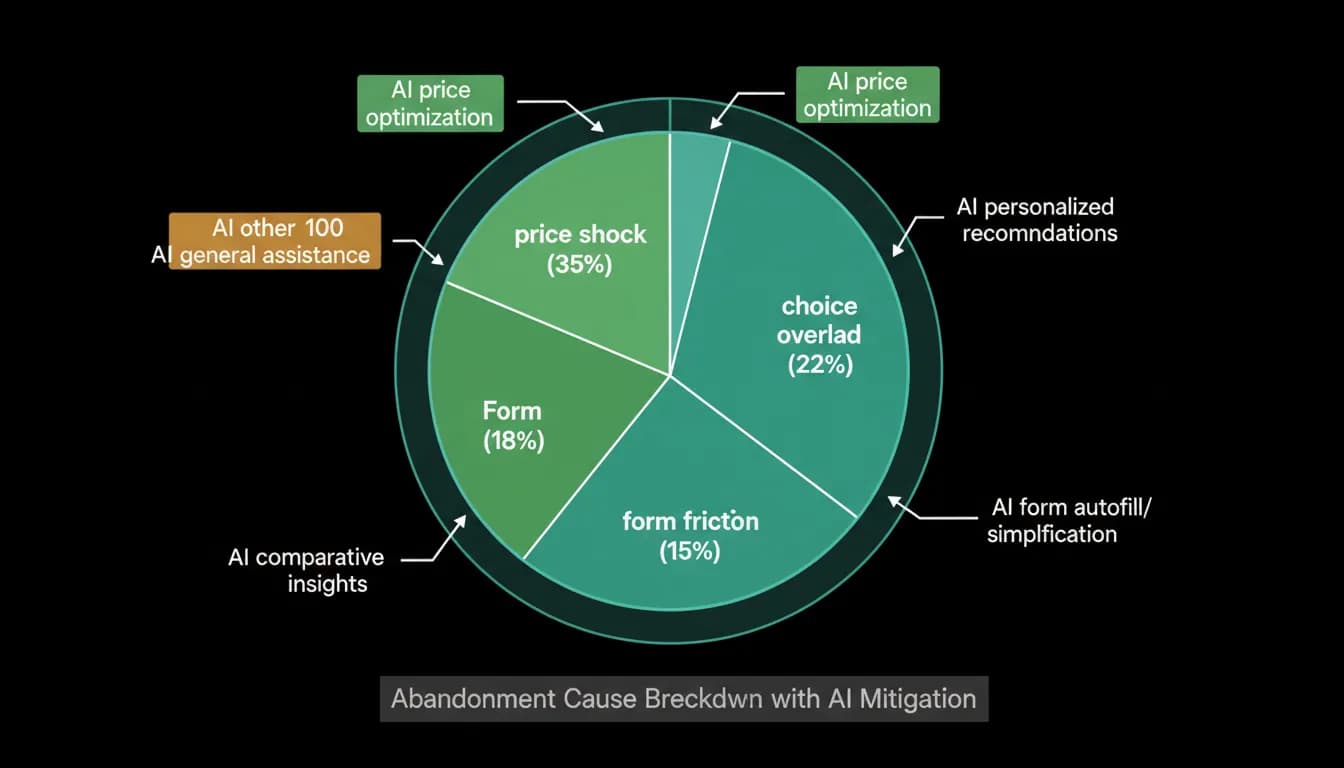
Understanding why travelers leave without booking reveals the structural problems that AI agents solve.
Price shock (35 percent of abandonments). The traveler has a mental budget. The search results exceed it. Rather than adjusting expectations, the traveler leaves. AI agents address price shock by providing price context upfront: "Flights to Barcelona in July typically range from $600 to $900 from your city. Your budget of $500 is below the typical range. Here are your options: fly in the first week of June for $480, or consider Lisbon for $420 in July."
Too many options (22 percent of abandonments). Choice overload, as described by decision fatigue research, is the second largest abandonment trigger. The traveler evaluates 10 to 15 options, loses confidence in their ability to find the best one, and gives up. AI curation eliminates this by presenting 2 to 4 curated options.
Form friction (18 percent of abandonments). The traveler finds a flight, commits to booking, and then faces screens of form fields: passenger details, payment information, ancillary selections. On mobile, this is particularly painful. AI agents with stored profiles eliminate most form entry.
Comparison urge (15 percent of abandonments). "Let me just check one more platform." The traveler leaves to compare prices elsewhere, often never returning. AI agents that provide cross-platform pricing context ("this rate is competitive — I checked 300+ airlines") reduce the urge to comparison-shop elsewhere.
Cross-device behavior
One of the most telling patterns in travel search data is the device gap. Sixty percent of travel research happens on mobile. But 55 percent of bookings are completed on desktop.
This gap reveals a fundamental friction mismatch: the mobile experience is good enough for browsing but not good enough for buying. Travelers research on their phones — on the couch, on the bus, during lunch — but switch to desktop when it is time to enter payment details and passenger information. The mobile booking experience is sufficiently painful that travelers defer the final step to a larger screen.
AI agents eliminate the device gap because the interface — a conversation — works identically on mobile and desktop. There are no tiny form fields to navigate. There is no multi-screen ancillary selection process. The same conversation that started on your phone during lunch can be completed on your phone during lunch. The booking completion rate on mobile for AI agents is comparable to desktop, while for OTAs it is significantly lower.
Designing for real behavior
These search behavior patterns collectively explain why AI agents work better than traditional search — not from theoretical principles but from empirical observation.
Travelers search too many times (45 sessions) because each session provides incomplete information. AI agents provide complete information in 1 to 3 conversations. Travelers use few filters because the interface is cumbersome. AI agents accept natural language preferences. Travelers abandon because of price shock, choice overload, and form friction. AI agents address all three through context, curation, and stored profiles.
The data does not just describe how travelers behave. It prescribes how booking tools should be designed. The tool that matches how people actually behave — not how platform designers wish they behaved — wins. And AI agents, built around conversation rather than forms, curation rather than abundance, and profiles rather than cookies, match observed behavior far more closely than any search-based alternative.
Nowah is an AI travel agent that searches and books real flights and hotels through conversation — no filters, no thirty open tabs. Plan your next trip.