The Unbundling of Online Travel Agencies
OTAs aggregate and compare. AI agents curate and book. When curation replaces aggregation, the OTA value proposition collapses.

In 2000, the value proposition of an online travel agency was radical: see airline and hotel inventory from your computer without calling a travel agent. That was worth the 15-25% commission hotels paid and the per-booking fees airlines absorbed. Access to information was genuinely scarce.
In 2026, that value proposition is gone. Every airline has a website. Every hotel has a booking page. Real-time travel inventory is accessible through APIs that anyone can integrate. The information scarcity that justified OTAs has evaporated.
And yet OTAs still process hundreds of billions of dollars in bookings annually. Not because their value proposition is strong, but because nobody has built a better alternative at scale. Until now.
Why aggregation loses value
OTAs are aggregators. They pull inventory from hundreds of suppliers and display it in one place. This was revolutionary when the alternative was visiting each supplier individually. It is unremarkable when a user's actual problem is not "I cannot find options" but "I have too many options and I cannot choose."
The average traveler visits many websites and has 45+ touchpoints before booking. That is not a discovery problem. That is a decision problem. OTAs solved discovery and ignored decisions.
AI agents flip the equation. They aggregate inventory (the same inventory OTAs show) and then curate it down to the three best options for this specific user. The user does not see 200 flights sorted by price. They see three flights ranked by personal relevance with explanations of why each was chosen.
When AI can curate, showing everything is a bug, not a feature. The OTA's core differentiator becomes its core weakness.
Direct supplier access
The other leg of the OTA value chain is crumbling: intermediation.
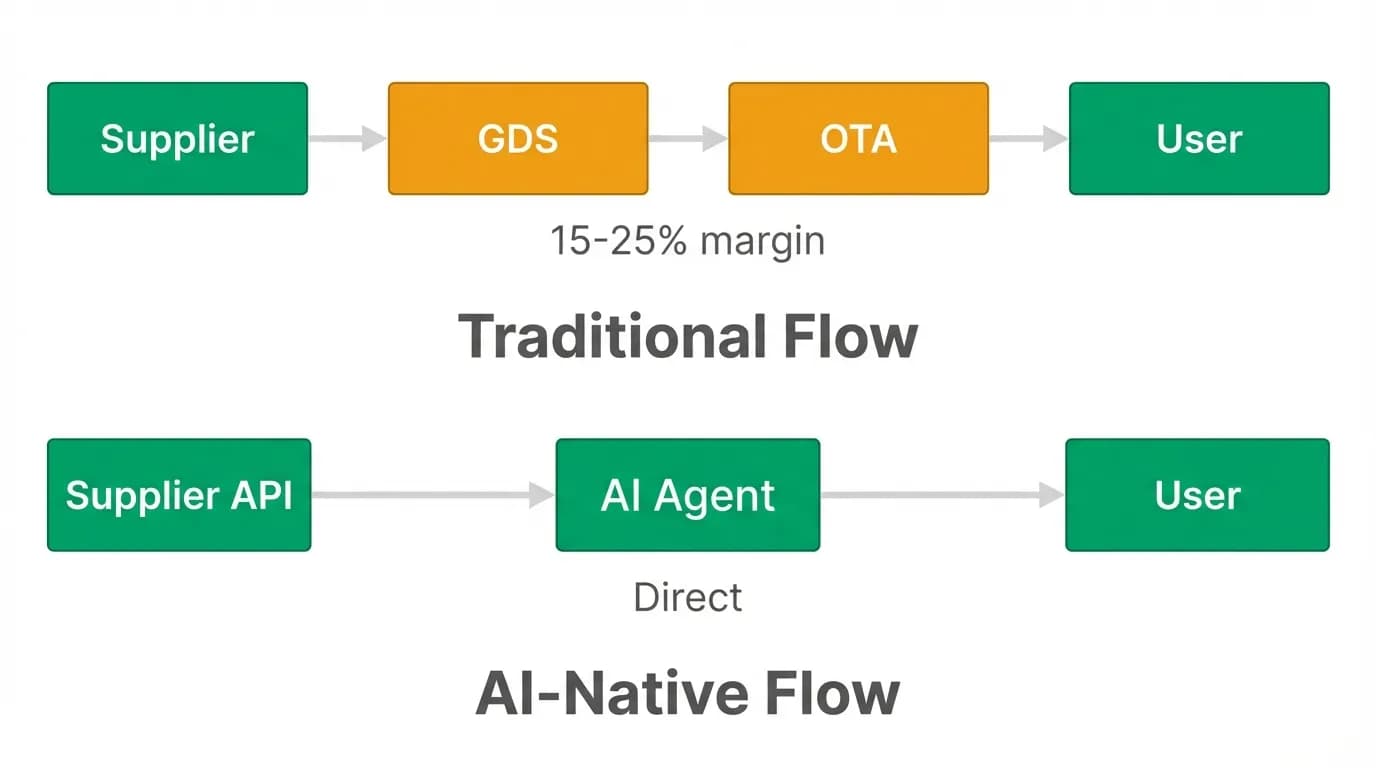
The traditional flow is Supplier > GDS (Global Distribution System) > OTA > User. Each intermediary adds margin. Hotels pay 15-25% commission to OTAs. Airlines pay GDS fees and OTA commissions.
The emerging flow is Supplier API > AI Agent > User. Travel data providers offer direct API access to airline and hotel inventory, bypassing both the GDS and the OTA. An AI agent can search the same flights and hotels that appear on an OTA, at the same or lower prices, without the intermediation cost. This matters economically. A hotel paying 20% commission to an OTA has strong incentives to offer a better rate through a direct API channel. An AI agent that accesses inventory directly can pass some of those savings to the user. Price parity clauses have historically prevented this, but they are weakening under regulatory pressure in many markets.
The price transparency problem
OTAs profit from opacity. Their business model depends on users not knowing whether a better price exists elsewhere. That is why comparison shopping across OTAs is its own industry (metasearch engines like Kayak and Skyscanner exist because OTAs do not show you the full picture).
AI agents profit from clarity. An agent that finds you the genuinely best price builds trust. An agent that hides cheaper options for commercial reasons destroys trust as soon as the user discovers it.
The incentive alignment is fundamentally different. OTAs are incentivized to show you options that maximize their commission revenue. AI agents are incentivized to show you the best options so you keep using the product. This alignment difference is, I believe, the structural advantage that enables AI travel agents to displace OTAs.
Customer acquisition costs tell the story. OTAs spend $40-60 per booking on acquisition because their product does not generate strong organic loyalty. Users shop across OTAs for every trip. AI-native platforms report customer acquisition costs 3-5x lower because users who have built a preference history and trust relationship are less likely to switch.
The attention shift
The behavioral shift from browsing to conversing has already happened in most of digital life. People message more than they email. They use voice assistants. They interact with chatbots. The expectation of conversational interaction is mainstream.
Travel booking is late to this shift because the incumbents have no incentive to enable it. A conversation-first booking interface eliminates the surface area for advertising, comparison grids, and urgency signals ("Only 2 rooms left!") that drive OTA revenue. The incumbents are structurally unable to adopt the interaction model that users increasingly prefer.
New entrants do not have this constraint. An AI-native travel platform can build around conversation from the start, designing the entire experience for the interaction model users already prefer in every other part of their digital life.
What the next generation looks like
The next generation of travel booking is not a better OTA. It is a different product category entirely.
It starts with a conversation, not a search form. The AI agent knows your preferences from past trips and learns new ones as you talk. It searches live inventory across flights, hotels, and activities. It curates three options from hundreds. It explains its reasoning. It books with a single confirmation. It manages the trip after booking with proactive alerts and disruption handling.
The global travel market exceeds $1.8 trillion in transaction volume. The portion flowing through traditional OTAs will shrink as AI agents capture direct-booking relationships with travelers. This will not happen overnight. The OTAs have massive user bases, strong brand recognition, and deep supplier relationships. But the structural advantages are shifting.
The timeline
The unbundling of OTAs will follow the pattern of previous technology disruptions: slow at first, then sudden.
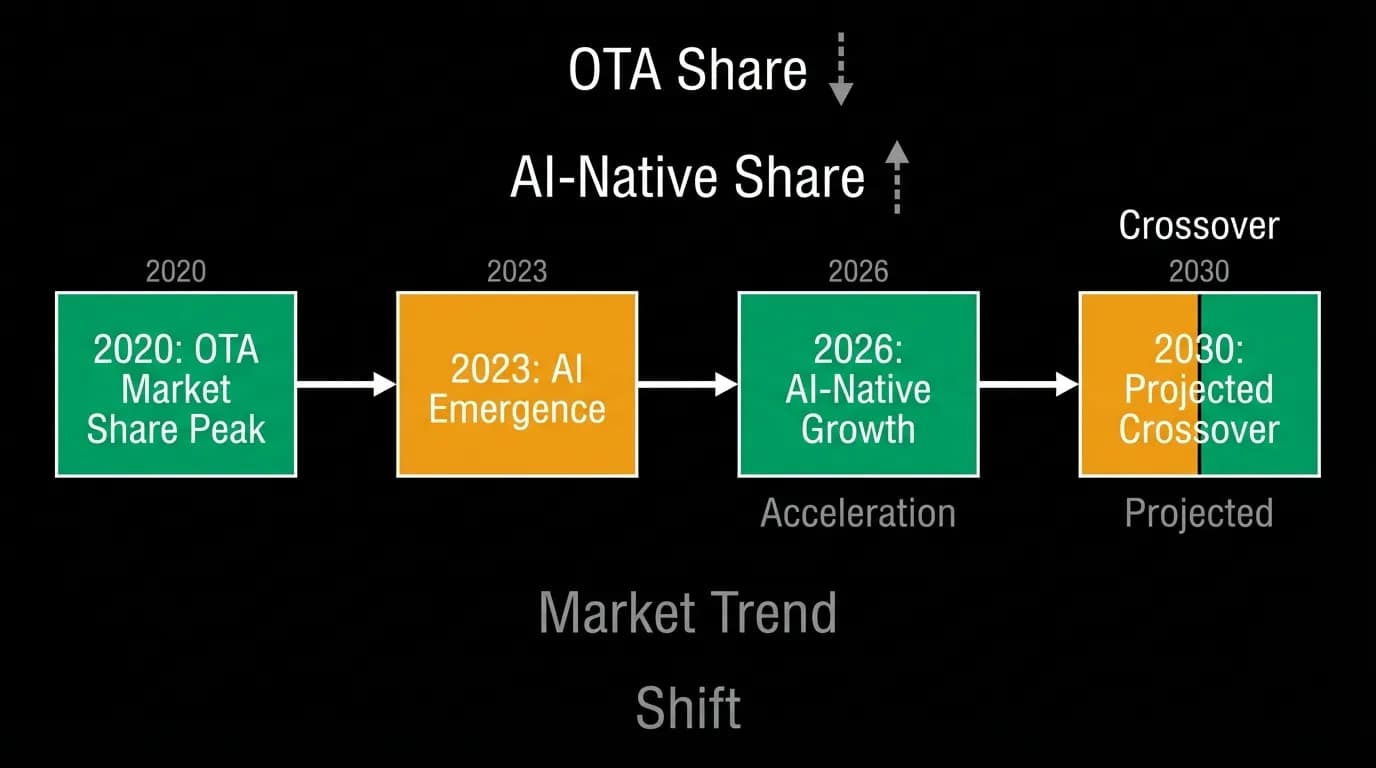
2024-2026 is the experimentation phase. AI travel startups launch. Incumbents add AI features. Early adopters try conversational booking. Most travelers still use OTAs.
2027-2029 is the tipping point. AI agents reach quality parity with human travel agents for most trip types. Consumer trust in AI booking reaches mainstream levels. OTA growth stalls while AI-native platforms grow rapidly.
2030+ is the new normal. Conversational booking is the default for a majority of travelers. OTAs that survived have pivoted to AI-first models or retreated to niche markets.
I do not think OTAs will disappear entirely. Some users will always prefer the browse-and-compare model. But the mass market is moving toward AI curation, and the economics favor the new entrants. The best travel booking experience in 2030 will not look anything like the OTAs of 2020.
Nowah is an AI travel agent that searches and books real flights and hotels through conversation — no filters, no thirty open tabs. Plan your next trip.