The Vertical AI Thesis: Domain-Specific Agents Beat Generalists
You would never ask a GP to perform surgery. A general AI assistant will never book a flight as well as a purpose-built travel agent.

Open ChatGPT right now and ask it to find you a flight from New York to Tokyo in April. It'll give you a thoughtful, well-written response about airlines that fly the route, typical price ranges, and when to book. The information will be generally accurate.
What it won't give you is an actual flight. No real-time prices. No bookable options. No comparison of specific departures. No seat availability. No baggage policies for your fare class. And no way to pay.
Now ask Google's Gemini the same question. Similar result: helpful general information, zero actionable booking capability.
These are the most powerful AI systems in the world, built by the most well-resourced companies on earth, and they cannot do the thing you actually need: book you a flight. They can talk about booking a flight. They just can't do it.
This is the general AI problem, and it's why we believe the next decade belongs to vertical AI agents — purpose-built, domain-specific systems that don't just know about a field but can actually operate within it.
The GP vs. surgeon analogy
When you need heart surgery, you don't go to your general practitioner. Your GP knows a lot about the human body. They can identify that something is wrong with your heart. They can explain what the surgery involves. But they cannot perform the surgery, because surgery requires specialized training, specialized tools, and specialized experience.
General AI assistants are the GPs of the AI world. They know about travel. They know about finance. They know about law. They can discuss any of these topics intelligently. But they can't operate in any of these domains because operating requires more than knowledge — it requires tools, data access, domain-specific interfaces, and the ability to take real actions with real consequences.
A vertical AI agent for travel has direct access to flight inventory APIs. It can search real-time availability. It can compare specific fares with accurate baggage and change policies. It can present options in purpose-built cards with the right information hierarchy. It can process a booking. It can manage changes after the fact. It can remember your seat preference and your passport expiration date.
None of that is possible with a general assistant. The general assistant can summarize travel blog posts. The vertical agent can book your trip.
Domain-specific tool access matters
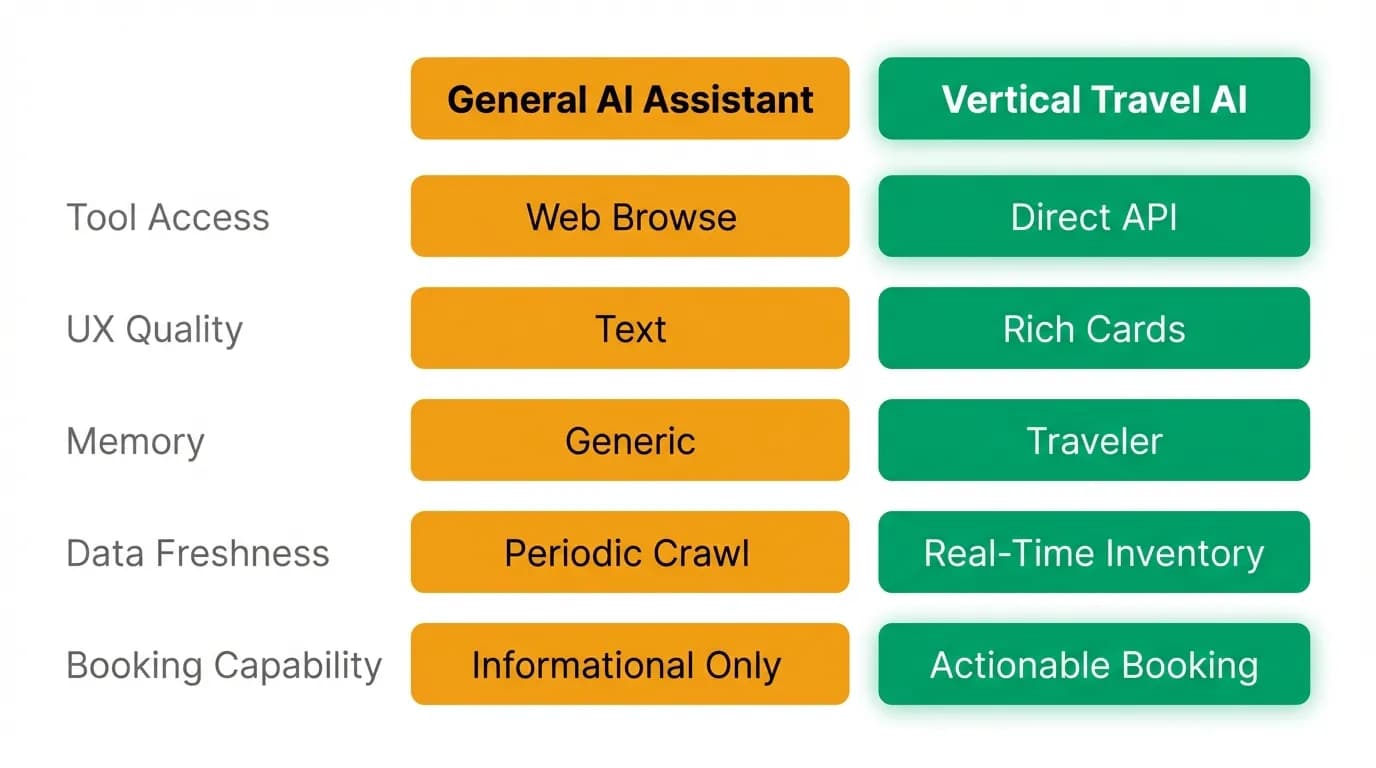
The most obvious advantage of vertical AI is tool access. A general assistant browses the web for travel information. A travel-specific agent queries flight and hotel inventory APIs directly.
The difference is enormous. Web browsing for travel data is slow, unreliable, and incomplete. The assistant might find yesterday's prices on a cached search result page. It might hallucinate flight options that don't exist. It can't guarantee that the price it quotes is the price you'll pay because it doesn't have access to live, authoritative data.
Direct API access means the agent is looking at the same inventory the airlines and hotels see. Real prices, real availability, real-time. When the agent says "this flight is $847 with one stop in Seoul," that's a bookable fare right now, not an estimate scraped from a website.
Tool access also means the agent can take actions. It can hold a booking. It can process a payment. It can send confirmation details to your email. It can check you in when online check-in opens. A general assistant can write you a nice email about your upcoming trip. A vertical agent can change your seat.
This gap won't close easily. General assistants would need partnerships with every airline, every hotel chain, every car rental company, and every travel data provider to match the tool access of a purpose-built travel agent. That's a business development challenge, not a technology challenge, and it's one that general AI companies have shown limited interest in solving.
Domain-specific UX matters
Ask ChatGPT about a flight and you get a text paragraph. It might include the airline, departure time, arrival time, and price. It's accurate-ish. But it's text.
A vertical travel agent shows you a flight card. The card has the airline logo, the departure and arrival cities with airport codes, the times in local time zones, the total duration, the number of stops with layover details, the fare class, the baggage allowance, and the price — all laid out in an information hierarchy that travelers understand at a glance.
This matters more than it might seem. Travel decisions involve comparing multiple options across many dimensions simultaneously. A text paragraph makes this comparison nearly impossible. You'd have to read three paragraphs, hold the details in your head, and mentally compare them. A set of three structured flight cards lets you scan and compare in seconds. The UX extends beyond flight cards. Hotel options need photos, star ratings, location context, and review summaries. Itineraries need timelines with maps. Booking confirmations need structured details with relevant documents attached. All of these are domain-specific interface components that a general assistant doesn't have and can't render.
Domain-specific memory matters
ChatGPT has conversation memory. It remembers what you said in the current thread and, depending on your settings, some things from past conversations. But it's generic memory — it knows you said words, not that you have specific travel preferences.
A travel-specific agent builds a traveler profile. It knows your preferred seat (aisle vs. window). Your typical budget range. Your airline preferences and dislikes. Your dietary restrictions. Your passport details and expiration. Your home airport. Your travel style (adventure vs. relaxation). Your past destinations.
This memory is structured and purposeful. When the agent searches for flights, your seat preference is factored in. When it recommends hotels, your style preference shapes the results. When it plans an itinerary, your pace preference (packed vs. relaxed) guides the schedule.
Generic memory might recall that you mentioned you like aisle seats once. Domain-specific memory treats aisle seats as a persistent preference that applies to every flight search until you change it. The difference between "I remember you said that" and "I apply that to every relevant action" is the difference between memory and a working preference model.
Users who interact with AI assistants during booking show 20-30% higher average order values. That uplift comes from personalized recommendations that match real preferences. Generic AI can't deliver that level of personalization because it doesn't have the structured understanding of what matters in the travel domain.
Why ChatGPT and Gemini fall short for travel
I want to be specific about where general assistants fail, because the failures are instructive.
No live data. ChatGPT's training data has a cutoff. It doesn't know today's flight prices. Gemini can search the web, but web-sourced prices are often inaccurate or outdated. Neither has access to the real-time inventory systems that airlines use.
No booking capability. Even if a general assistant finds the right flight, it can't book it for you. You have to leave the assistant, navigate to an airline or OTA website, find the same flight (which might not exist at the price quoted), and go through their booking flow. The value of the AI recommendation evaporates in the transition.
No post-booking utility. After you book (elsewhere), the general assistant has no connection to your booking. It can't track your flight status. It can't notify you of gate changes. It can't help you change your seat or request a refund. It has no relationship with the actual travel service.
No persistent travel context. Your conversation with ChatGPT about flights to Tokyo exists in isolation. It doesn't connect to your hotel search, your visa requirements, your packing needs, or your in-trip restaurant recommendations. Each conversation is a separate thread. A vertical agent maintains context across the entire trip lifecycle.
AI chatbots handle roughly 30% of travel customer service interactions today. That's a significant number, but customer service — answering questions about existing bookings — is the easiest travel use case for AI. The hard parts — search, comparison, decision support, booking, trip management — require vertical depth that general tools lack.
What Expedia's chatbot and airline direct AI get wrong
Expedia's AI and airline chatbots occupy an awkward middle ground. They're more specialized than ChatGPT but less capable than a true vertical agent.
Expedia's chatbot has access to Expedia's inventory. That's an advantage over general AI. But it can only interact with that inventory in limited ways. It can suggest options but often can't complete the full booking inside the chat. And it only knows about the travel services Expedia sells, which is a wide but not complete inventory.
Airline chatbots (Delta's, United's, etc.) have the opposite problem. They can manage bookings on their airline with real data and real capability. But their scope is narrow — one airline. They can't compare across carriers. They can't book your hotel. They can't help with the non-flight parts of your trip. They're vertical but too narrow.
A well-built vertical travel agent combines the breadth of an OTA (access to many airlines and hotels) with the depth of domain expertise (real booking capability, traveler memory, trip management) and the naturalness of a general assistant (conversational interaction, flexible input, contextual understanding). That combination is what we're building at Nowah.
The vertical AI market map
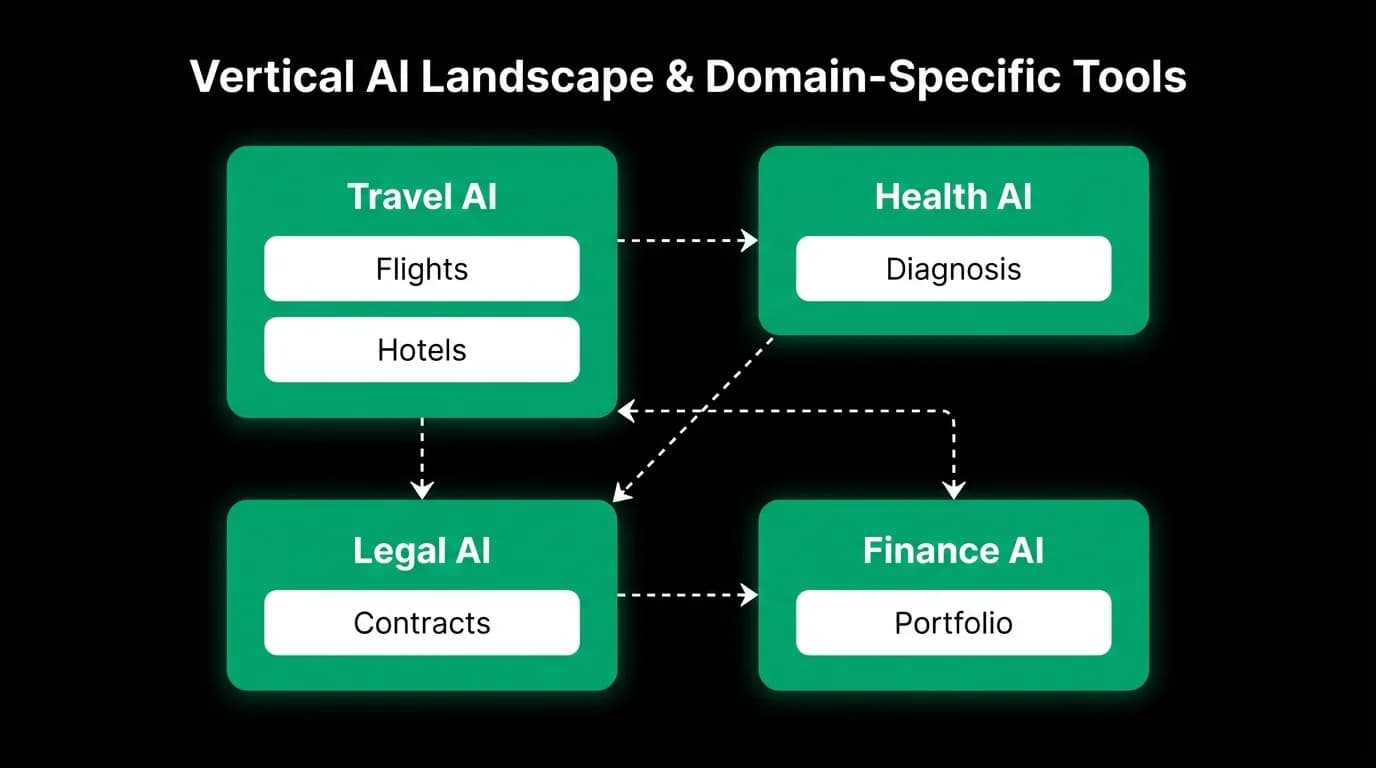
Travel is just one domain where vertical AI will outperform general assistants. The same dynamics play out across industries.
Healthcare: a vertical health AI can access patient records, interpret lab results in clinical context, check drug interactions, and schedule appointments. A general AI can discuss symptoms and suggest you see a doctor.
Legal: a vertical legal AI can review contracts against specific jurisdictions, flag compliance issues, and draft provisions. A general AI can explain what a non-compete clause is.
Finance: a vertical finance AI can analyze your specific portfolio, execute trades, and optimize tax implications. A general AI can explain what index funds are. In each case, the vertical agent wins because it can do, not just know. It has tools, data access, domain-specific interfaces, and the ability to take real actions. The general assistant wins at breadth — it can switch from discussing your vacation to reviewing a legal document to explaining a medical condition. But for any individual task, the specialist beats the generalist.
The venture capital market has recognized this. The majority of AI startup funding in 2025 and 2026 has gone to vertical applications, not general-purpose assistants. The general-purpose assistants are being built by a handful of well-capitalized companies (OpenAI, Google, the model provider). The vertical applications are being built by hundreds of startups in every industry.
We believe this is the right structure for the market. General AI is infrastructure. Vertical AI is product. And products are where the value accrues to users. Nobody wants a slightly better general assistant. Everyone wants an agent that actually does the specific thing they need done — and does it well.
Nowah is an AI travel agent that searches and books real flights and hotels through conversation — no filters, no thirty open tabs. Plan your next trip.