What Travel AI Gets Wrong (And How We Design to Fix It)
Our AI is not perfect. Here are its real failure modes, how we detect them, and why admitting imperfection builds more trust than claiming perfection.

Our AI is not perfect. It gets things wrong. I am going to tell you exactly how, because I believe admitting imperfection earns more trust than claiming perfection.
The error categories
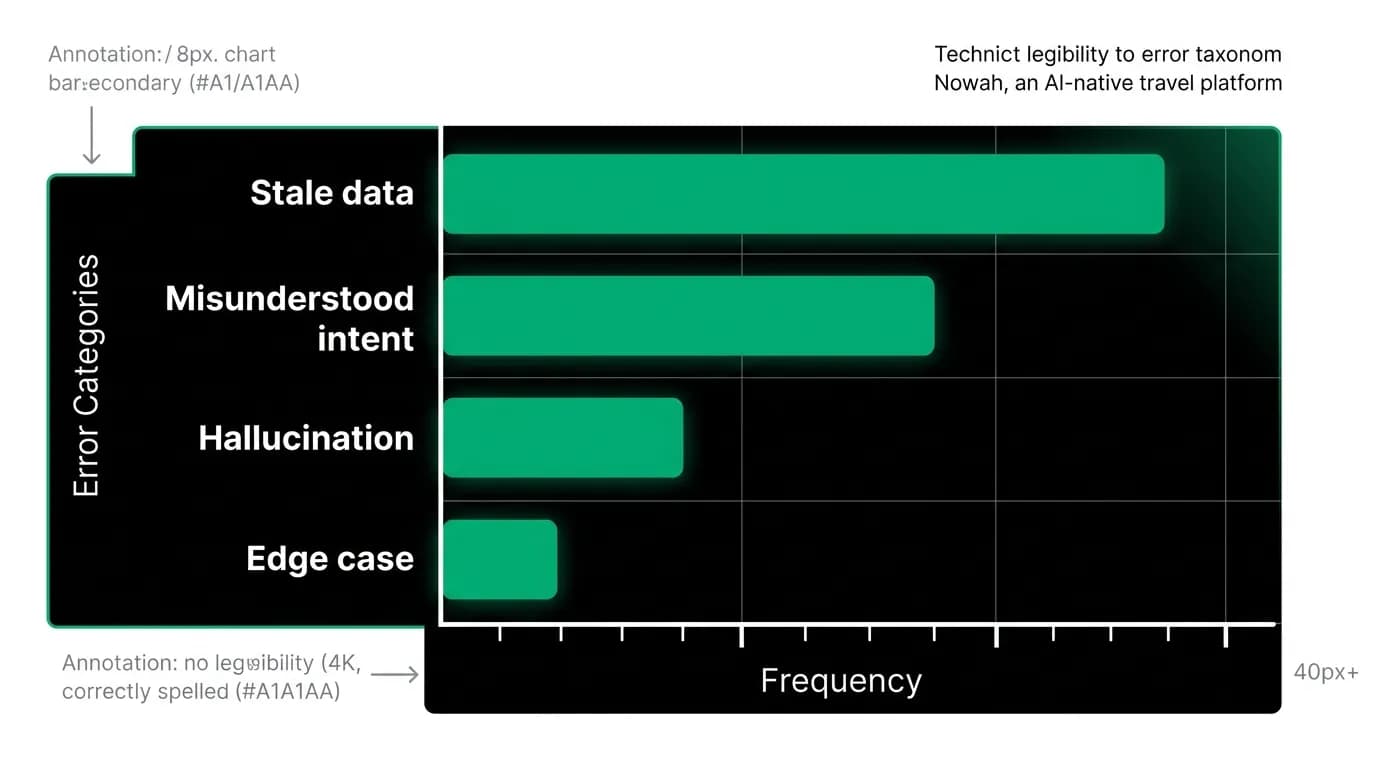
Our agent makes mistakes in four main categories.
Stale pricing. This is the most common error class. Travel data changes constantly. A flight that costs four hundred dollars when the agent searches might cost four-twenty by the time you decide to book. We have added price verification immediately before booking confirmation, but the lag between search and decision is a fundamental challenge of real-time travel data.
Misunderstood preferences. Sometimes the agent interprets a vague request differently than the user intended. "Something not too touristy" means different things to different people. The agent makes its best inference, but that inference is sometimes wrong. Over time, as memory accumulates, these misunderstandings decrease because the agent learns what you specifically mean by "not too touristy."
Hallucinated details. Like all AI systems, ours occasionally generates details that sound plausible but are not accurate. A hotel amenity that does not exist. A restaurant recommendation that has since closed. We have significantly reduced these through grounding the agent in real-time data rather than general knowledge, but edge cases persist.
Edge cases. Unusual routing, obscure airports, complex multi-leg itineraries with tight connections, travel with unusual requirements. These are the long tail of travel complexity, and some of them push the agent beyond its reliable performance range. We are constantly expanding coverage, but the edge cases are, by definition, the last ones to be solved.
How we detect failures
Detection happens through three channels.
Automated evaluations run continuously. Our test framework includes hundreds of travel-specific scenarios that the agent must handle correctly. These scenarios cover common trips, edge cases, and safety-critical situations. The framework accounts for non-determinism, using retries and range-based evaluation rather than exact matching.
User feedback is the most valuable signal. When someone tells us the agent made a mistake, that error gets categorized, analyzed, and added to our evaluation dataset. Every user-reported error makes the system better for every future user.
Conversation analysis reveals patterns that individual reports might miss. We look at aggregates: which types of requests have the highest error rates, which conversation patterns lead to misunderstandings, and where the agent's confidence is miscalibrated.
The feedback-to-fix pipeline
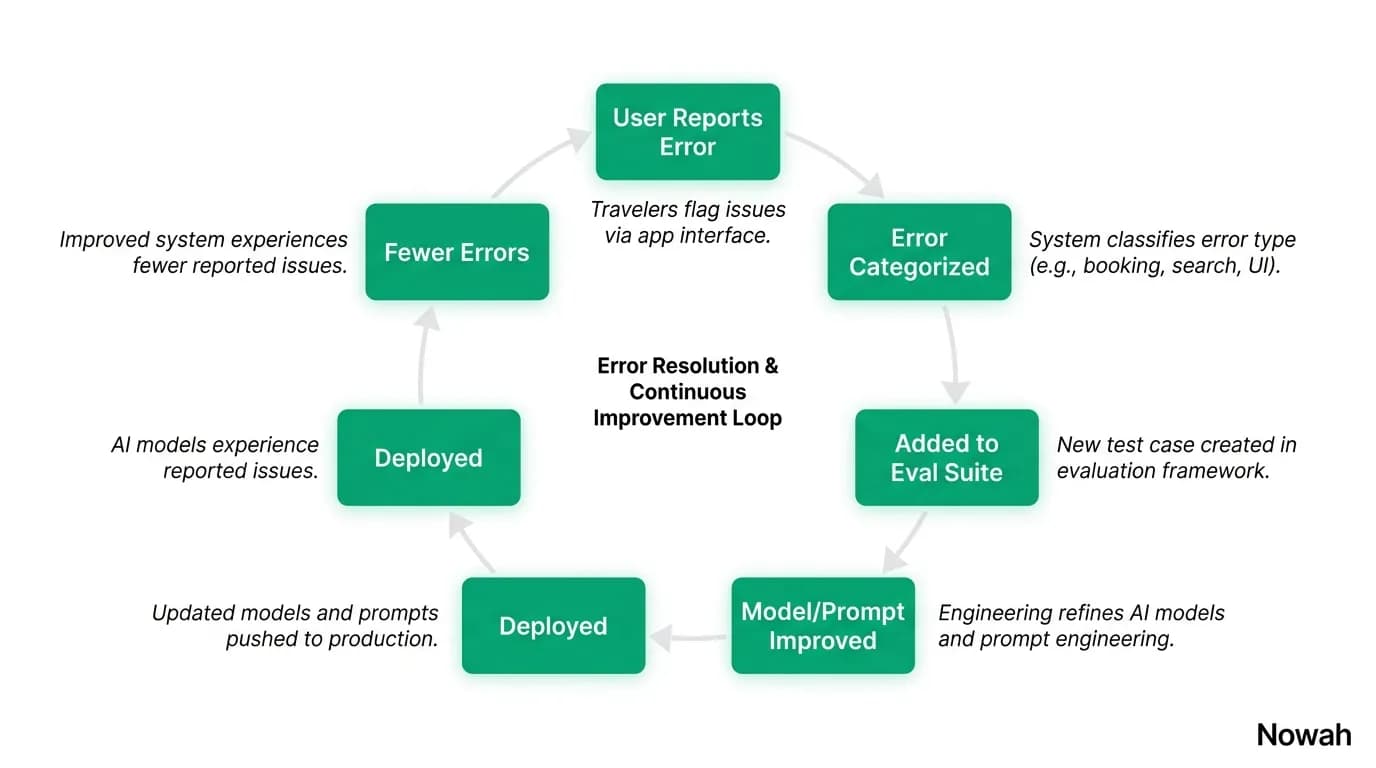
When an error is detected, it enters a structured pipeline. First, it is categorized by type and severity. Then the root cause is analyzed. A fix is developed, whether that is a prompt adjustment, a tool improvement, or a data source update. The fix is tested against the existing evaluation suite. And finally, the original error becomes a new test case, ensuring it never regresses.
This pipeline means the system is genuinely self-improving. Not in a magical, autonomous way. Through disciplined engineering practice that turns every failure into a permanent test.
Why honesty beats perfection
Some AI companies present their products as infallible. The marketing implies the AI always gets it right. When it inevitably does not, user trust drops sharply because the gap between expectation and reality is wide.
We take a different approach. We tell you upfront: the agent is very good, getting better every week, and not perfect. When the agent is uncertain about something, it says so. When data might be stale, it flags the risk. When it cannot find a good option, it says "I could not find anything that matches all your criteria" rather than fabricating something.
This honest approach sets realistic expectations. Users who know the agent is imperfect but improving are far more forgiving of occasional errors than users who were promised perfection.
The trajectory
The error rate has been declining consistently since launch. The agent today is substantially more accurate than it was three months ago, which was more accurate than three months before that. The trajectory matters more than any single data point.
Found a mistake? We genuinely want to hear about it. Every error you report becomes a test case that prevents the same mistake from happening again. You are not just reporting a bug. You are making the agent smarter for everyone.
Nowah is an AI travel agent that searches and books real flights and hotels through conversation — no filters, no thirty open tabs. Plan your next trip.