Why Travel Is the Perfect Domain for AI Agents
High complexity, high stakes, massive personalization potential, fragmented supply. Travel was built for AI agent disruption.

Not every industry is equally ready for AI agents. Some domains have clean, structured data and simple decision-making. AI agents there are nice-to-have but not transformative. Other domains have messy, multi-variable problems with high personalization needs. AI agents there are game-changing.
Travel is the second kind. I believe it is the single best domain for AI agents in 2026, and I want to lay out the structural argument for why.
Five characteristics that matter
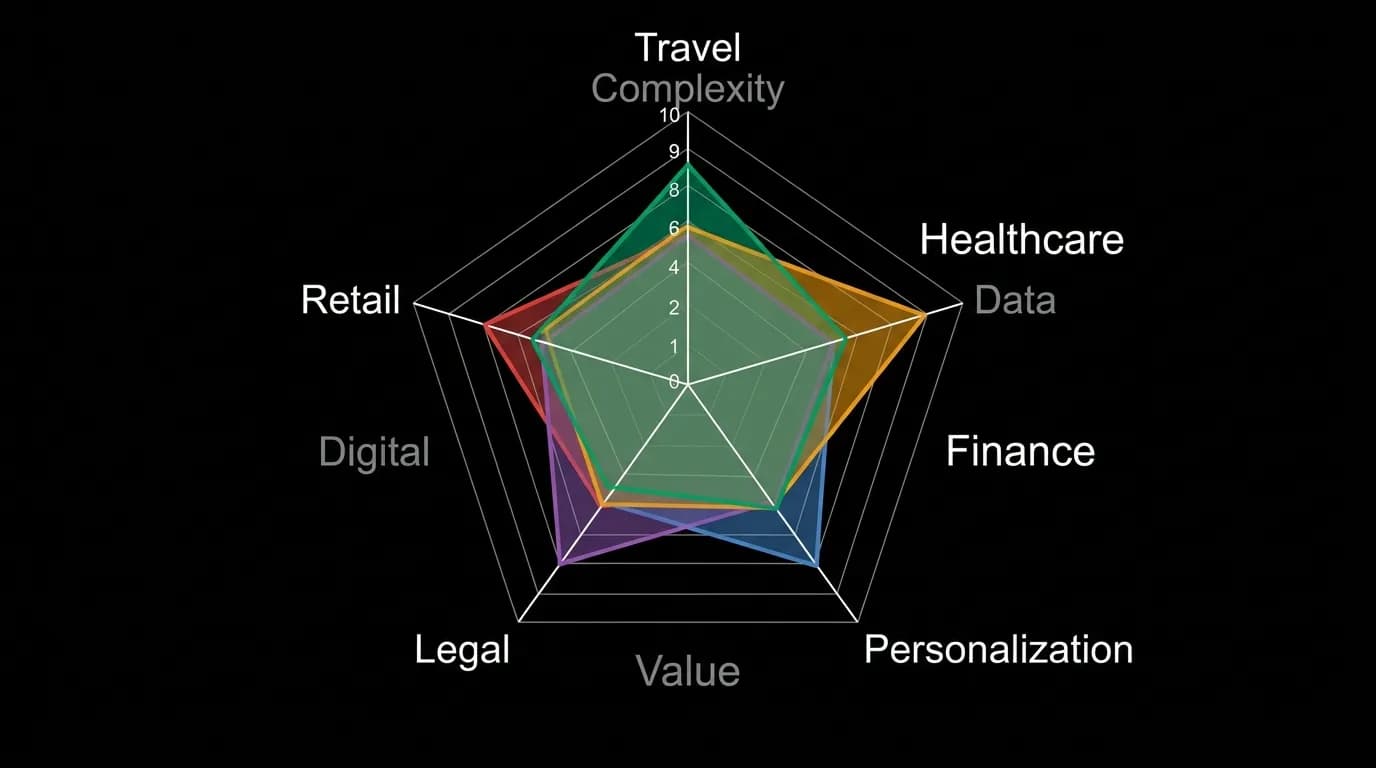
The domains where AI agents add the most value share specific structural characteristics. Travel scores high on all five.
1. Complexity
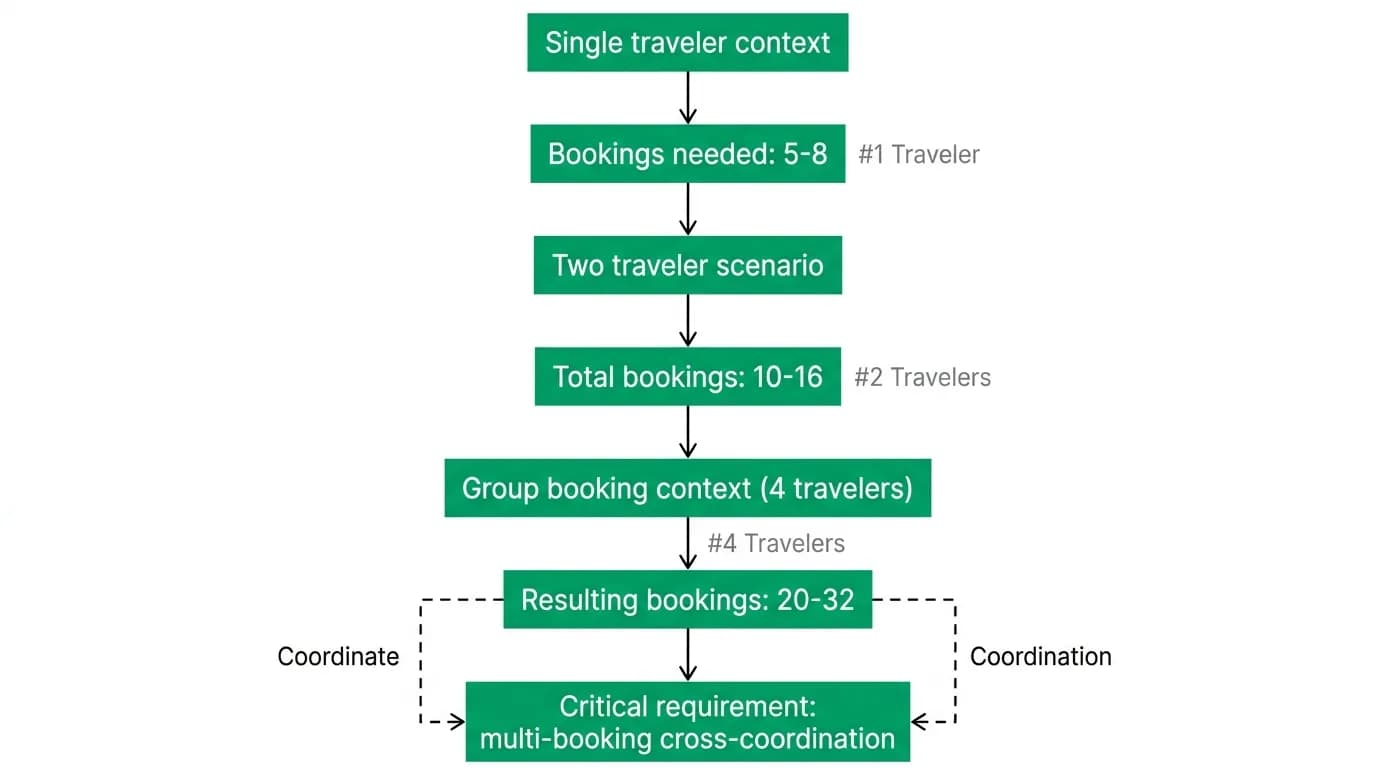
The average international trip requires coordinating 5 to 8 separate bookings: outbound flight, return flight (or multiple segments for multi-city), hotel (possibly multiple), ground transport, activities, insurance. Each booking has its own set of variables: dates, prices, availability, policies, preferences.
The interaction between these bookings adds another layer. Your hotel check-in time depends on your flight arrival. Your ground transport depends on your hotel location. Your activity schedule depends on your energy level, which depends on how many time zones you crossed.
A single traveler making a single round-trip flight has a manageable optimization problem. A family of four planning a two-week multi-city trip is solving a problem with hundreds of interdependent variables. No human can efficiently evaluate all options across all variables simultaneously.
An AI agent can. It queries multiple data sources in parallel, applies constraints across all variables, and presents optimized options. The more complex the trip, the more valuable the agent becomes.
2. Stakes
Travel is expensive. A typical international trip costs $2,000-5,000 per person. Mistakes are costly. Booking the wrong dates costs rebooking fees. Missing a visa requirement costs a canceled trip. Choosing the wrong hotel costs a diminished experience.
High stakes mean users care about quality. They are willing to invest time (and potentially money) in getting it right. An AI agent that reliably improves outcomes is worth paying for. Compare this to, say, restaurant recommendations, where the stakes of a bad choice are a mediocre dinner, not a ruined $5,000 vacation.
The global travel market exceeds $1.8 trillion in annual transaction volume. This is not a niche application. The total addressable market for AI travel tools is massive.
3. Information asymmetry
Airlines and hotels know their pricing algorithms, inventory levels, competitive dynamics, and seasonal patterns. Travelers do not. This asymmetry means travelers regularly make suboptimal decisions: booking at the wrong time, paying more than necessary, missing better options.
AI agents level this playing field. An agent with access to historical pricing data, route-level patterns, and demand signals can tell you whether $450 for SFO-NRT in April is a good deal. It can advise you to wait or book now based on price trajectory analysis. It has access to information that individual travelers cannot practically gather.
The average traveler visits many websites across 45 sessions before booking. Most of that effort is attempting to overcome information asymmetry through manual research. An AI agent with the right data sources makes most of that research unnecessary.
4. Personalization potential
Everyone travels differently. Business travelers want efficiency: direct flights, convenient hotels, fast check-in. Leisure travelers want experience: interesting neighborhoods, local restaurants, walkable areas. Budget travelers optimize for price. Luxury travelers optimize for comfort.
Beyond these broad categories, individual preferences are deeply personal. You hate layovers in Miami because the airport is stressful. You love boutique hotels with character. You always want an aisle seat because of your knee. You prefer morning departures because afternoon flights make you anxious.
A one-size-fits-all search engine cannot accommodate this. It gives everyone the same results, sorted by the same criteria. An AI agent that knows your specific preferences, learned over multiple trips, can personalize every recommendation.
Sixty-seven percent of travelers find booking stressful due to information overload. Personalization is the antidote. Instead of drowning in 500 options, you see 3 options selected for you.
5. Fragmented supply
Travel inventory is spread across thousands of suppliers. Airlines, hotels, car rental companies, activity providers, rail operators, ferry lines. No single supplier covers the full trip.
Traditional platforms partially aggregate this supply, but the aggregation is incomplete. You might search for flights on one platform, hotels on another, and activities on a third. Coordinating across them is your responsibility.
An AI agent can aggregate and coordinate across all supply sources within a single conversation. Book a flight, find a hotel near your arrival airport, schedule a car rental for the next morning, add a museum visit for the afternoon. One agent, one conversation, one trip.
Why other domains are harder
To sharpen the argument, let me compare travel's AI-readiness to a few other domains.
Healthcare. High complexity, high stakes, high personalization. But the data is fragmented across providers with strong privacy restrictions, the regulatory environment is orders of magnitude more complex, and errors can be life-threatening rather than just expensive. AI in healthcare will be transformative but moves more slowly due to these constraints.
Finance. High personalization potential and high data availability. But financial products are more commoditized than travel (a savings account is a savings account), the regulatory landscape is intense, and the emotional engagement is lower. Nobody gets excited about optimizing their portfolio the way they get excited about planning a vacation.
Legal. High complexity and high stakes. But legal reasoning requires understanding precedent, jurisdiction-specific rules, and adversarial dynamics that current AI handles unevenly. The tolerance for error is near zero. A bad legal recommendation can have permanent consequences.
Retail. Low complexity, low stakes, already digitized. AI in retail is helpful for recommendation and personalization, but the problems are less severe. Nobody visits many websites to buy a pair of shoes.
Travel hits the sweet spot: complex enough that AI adds massive value, high-stakes enough that users care, data-rich enough that AI can work effectively, and personalization-heavy enough that generic search is inadequate.
The structural opportunity
The structural case for AI in travel is not just about technology readiness. It is about market dynamics.
Incumbents are constrained. The major travel platforms built their businesses on search-and-filter interfaces monetized through advertising and commission. AI agents that curate 3 options instead of displaying 300 eliminate the surface area for advertising. Incumbents cannot fully embrace AI without cannibalizing their revenue model.
Consumers are ready. Willingness to use AI for travel has more than doubled in two years. The behavioral shift to conversational interfaces (messaging, voice assistants) aligns perfectly with AI travel agents. People are comfortable talking to AI. They do this daily.
Technology has crossed the threshold. Function calling is reliable enough for real booking transactions. Context windows are large enough for complete trip histories. Streaming makes the experience feel responsive. The infrastructure exists.
The combination of incumbent vulnerability, consumer readiness, and technology maturity creates a window.
The timing argument
Even within travel, the timing matters. Ten years ago, the technology was not ready. LLMs could not understand natural language well enough. Function calling did not exist. Real-time APIs were less reliable. Mobile was not yet dominant.
Five years from now, the opportunity may be captured. The companies that establish AI-native travel products in the current window will have accumulated user data, preference models, and brand trust that late entrants cannot easily replicate.
The current moment has a specific combination of conditions: capable models, reliable tool use, affordable inference, consumer readiness, and incumbent vulnerability. Each has been building independently for years. They converged in 2025-2026.
This convergence is why we are building now, not two years ago (technology was not ready) and not two years from now (window may have closed). The global travel market exceeds $1.8 trillion in annual transactions, and the share that will shift to AI-native platforms in the next five years is the prize.
Why vertical beats horizontal for travel
General-purpose AI assistants can answer travel questions. They can even search for flights if connected to the right APIs. But they cannot match a vertical travel agent for depth.
A general assistant optimizes for breadth: it needs to handle weather questions, recipe requests, calendar management, and flight searches with equal competence. A vertical travel agent optimizes for depth: it has specialized tools for fare analysis, hotel neighborhood scoring, connection quality evaluation, and loyalty program optimization.
The depth advantage manifests in specific scenarios. A general assistant might find flights. A vertical agent finds flights, evaluates whether the price is good historically, considers your connection comfort, checks visa requirements, and coordinates the hotel booking with your arrival time. The difference is not in any single capability but in the integration across dozens of travel-specific capabilities.
Users trust specialists over generalists for high-stakes decisions. You would not ask a general-purpose assistant to manage your investment portfolio. You should not ask one to manage your $5,000 vacation. The stakes justify a specialist.
Travel is not just a good domain for AI agents. It might be the best domain. The structural characteristics align perfectly with what AI agents are good at, and the market conditions favor new entrants who can build AI-native rather than retrofitting AI onto legacy platforms.
The data advantage
Travel generates rich, structured data that AI agents can learn from. Every booking is a training signal. Every preference stated in conversation is a labeled data point. Every user choice (accepting or rejecting a recommendation) is implicit feedback.
This data density is higher in travel than in most other domains. A single trip generates data about destination preferences, price sensitivity, timing preferences, accommodation style, airline preferences, seat preferences, and activity interests. One trip can produce dozens of preference signals.
Compare this to, say, a finance AI that manages your investments. The data signals are sparse: a few transactions per month, limited preference dimensions (risk tolerance, time horizon), and long feedback loops (you don't know if an investment was good for years).
Travel's data richness means AI agents improve faster. The preference model converges more quickly. The recommendations get better with fewer interactions. The user sees value sooner, which drives retention, which generates more data. It is a virtuous cycle that is structurally enabled by the domain.
The incumbent vulnerability
The structural case for AI in travel extends to the competitive landscape. The incumbents are structurally disadvantaged in adopting AI-native approaches.
The major online travel agencies built their businesses on a specific model: aggregate inventory, display it in a searchable interface, and monetize through advertising and commission. Their revenue depends on page views. More results displayed means more opportunities for sponsored listings, banner ads, and affiliate clicks.
An AI agent that curates 3 options instead of displaying 300 eliminates most of that advertising surface area. The incumbents cannot fully embrace AI curation without cannibalizing the revenue model that funds their operations. This is the classic innovator's dilemma applied to travel.
They also have technical debt. Decades of investment in search-and-filter interfaces, recommendation engines tuned for grid displays, and mobile apps built around navigation-heavy workflows. Rebuilding all of this around a conversational agent is not a feature update. It is a product rebuild.
New entrants building AI-native from day one do not have this constraint. The entire product is designed around the agent. The interface is a conversation. The revenue model does not depend on displaying hundreds of results. The technical architecture assumes tool-calling and memory from the start.
This does not mean incumbents cannot adapt. They have brand recognition, supply relationships, and massive user bases. But their structural position makes rapid adaptation difficult, and the window for AI-native entrants to establish themselves is open.
The consumer readiness signal
Technology readiness is necessary but not sufficient. Consumer readiness matters equally.
Willingness to use AI for travel planning and booking has more than doubled in the past two years. This is not hypothetical survey data about future intent. It is reflected in actual adoption of AI-powered travel tools, growth in conversational booking, and declining loyalty to traditional search-and-filter platforms.
The behavioral shift is driven by several factors. People are already comfortable talking to AI through daily interactions with voice assistants and messaging-based AI. The quality of AI responses has crossed the threshold from "interesting toy" to "genuinely useful." And the pain of traditional booking, those many websites and 45 sessions, creates strong motivation to try alternatives.
Younger travelers are especially receptive. They grew up with messaging as the primary communication mode. A conversational travel agent feels natural to them in a way that a complex search interface does not. As this cohort becomes the dominant travel spending demographic, the market pull toward conversational interfaces strengthens.
The emotional dimension
Travel is one of the few consumer purchases where the buying process has high emotional stakes. People look forward to vacations for months. A bad booking can ruin an anticipated experience. A great booking can exceed expectations.
This emotional dimension matters for AI agents because it means users care about the quality of the interaction. They are not indifferent. A good recommendation generates genuine gratitude. A bad one generates genuine frustration.
Emotional engagement drives word-of-mouth. Travelers who have a great AI booking experience tell their friends. The "my AI agent rebooked me in 2 minutes when everyone else was on hold for 2 hours" story is one people share.
The emotional stakes also mean users are willing to invest in the relationship with the agent. They will answer preference questions. They will provide feedback. They will give the agent more information than they would give a generic web form. This investment feeds the data advantage described above.
The network effects
As more users adopt AI travel agents, network effects emerge.
More users generate more data about routes, hotels, and timing patterns. The agent's price intelligence improves because it has seen more pricing scenarios. Its hotel recommendations improve because it has more user feedback on properties. Its route knowledge deepens because more users have traveled more routes.
These network effects do not require users to interact with each other. They emerge from the aggregation of individual booking data into better models. A user in New York benefits from the thousands of bookings by other users on the same routes, even though they never interact directly.
Travel's network effects are not as strong as social media's, but they are meaningful. And they compound over time, creating a moat that grows as the user base grows.
The network effects also have a geographic dimension. As more users in a particular region use the platform, the agent's knowledge of that region deepens. A user planning a trip to Lisbon benefits from the accumulated booking data, hotel reviews, and neighborhood insights from every previous user who visited Lisbon. The agent knows which areas are walkable, which hotels have noise issues, and which restaurants deliver on their ratings. This localized knowledge is hard to replicate without the user base that generates it.
The global travel market exceeds $1.8 trillion in annual transactions. Even capturing a small fraction of that market generates enough data to build significant network effects. The compounding advantage makes early entry valuable because data advantages grow over time and become increasingly difficult for later entrants to match.
The compounding advantage
The structural characteristics I have described do not just make travel a good domain for AI agents. They make it a domain where AI agents improve faster than in other domains.
Complexity means each interaction generates multiple data points. A single trip booking produces signals about flight preferences, hotel preferences, price sensitivity, timing preferences, destination interests, and travel style. In a simpler domain like grocery delivery, each interaction produces a single signal: what item did you buy?
High stakes mean users provide more detailed input. When $3,000 is on the line, people specify their preferences carefully. "I want a direct morning flight, window seat, and I am loyal to one particular alliance so I can earn miles." Each specification is a labeled data point that the agent can learn from.
Personalization potential means the data is useful. In a domain where everyone wants the same thing (fastest shipping, lowest price), user data does not differentiate. In travel, where everyone wants something different, user data is the key to unlocking value.
Fragmented supply means the agent handles a wide range of tool calls, which generates more behavioral data about how users interact with different types of travel products. This behavioral data feeds back into better tool selection and better result ranking.
The combination creates a data flywheel. More users generate more travel data. Better data produces better recommendations. Better recommendations drive higher retention. Higher retention generates more data. This flywheel spins faster in travel than in most other domains because of the structural characteristics described above.
We picked travel because we love travel and because the problem of booking a trip is unreasonably hard for how common it is. The structural analysis confirmed our intuition: this is where AI agents will prove their value first. And the best travel app will be the one that embraces the full potential of what agents can do. The domain is ready. The technology is ready. The consumers are ready. The only question is who builds the product that brings it all together. We intend for that to be Nowah, and the structural case laid out in this article is why we believe we are right about the domain, even if execution is everything. The domain fit gives us a structural tailwind. The rest is up to us, and we are building as fast as we can. The $1.8 trillion market is not going to disrupt itself.
Nowah is an AI travel agent that searches and books real flights and hotels through conversation — no filters, no thirty open tabs. Plan your next trip.