The Innovator's Dilemma in Travel: Why Expedia Cannot Beat AI-Native Startups
Clayton Christensen's framework explains exactly why Expedia and Booking.com will optimize their search model while AI-native platforms capture the future.

Clayton Christensen's The Innovator's Dilemma describes a pattern that has repeated across every technology-driven industry: the most successful companies are the most vulnerable to disruption. Not because they are incompetent, but because their success creates structural incentives to optimize the existing model rather than cannibalize it for something new.
The travel industry in 2026 is a textbook case.
The framework applied to travel
Christensen's framework identifies two types of innovation: sustaining and disruptive.
Sustaining innovation improves the existing product for existing customers. Better search algorithms, faster loading times, more filters, loyalty programs, mobile apps. The major OTAs have been pursuing sustaining innovation for two decades, and they have gotten very good at it. Their search engines are fast. Their inventory is comprehensive. Their mobile apps are polished.
Disruptive innovation creates a new product category that initially serves the market's edges — underserved segments or use cases the incumbent ignores — and then improves until it captures the mainstream. The product starts as "worse" on the dimensions the incumbent measures (inventory breadth, brand recognition, raw search speed) but "better" on dimensions the incumbent undervalues (personalization, simplicity, speed-to-book, trust).
AI-native travel platforms are textbook disruptors. They started with smaller inventory, no brand recognition, and less feature completeness. But they offered something the incumbents could not: a fundamentally different interaction model that most travelers prefer.
The rational choice that leads to decline
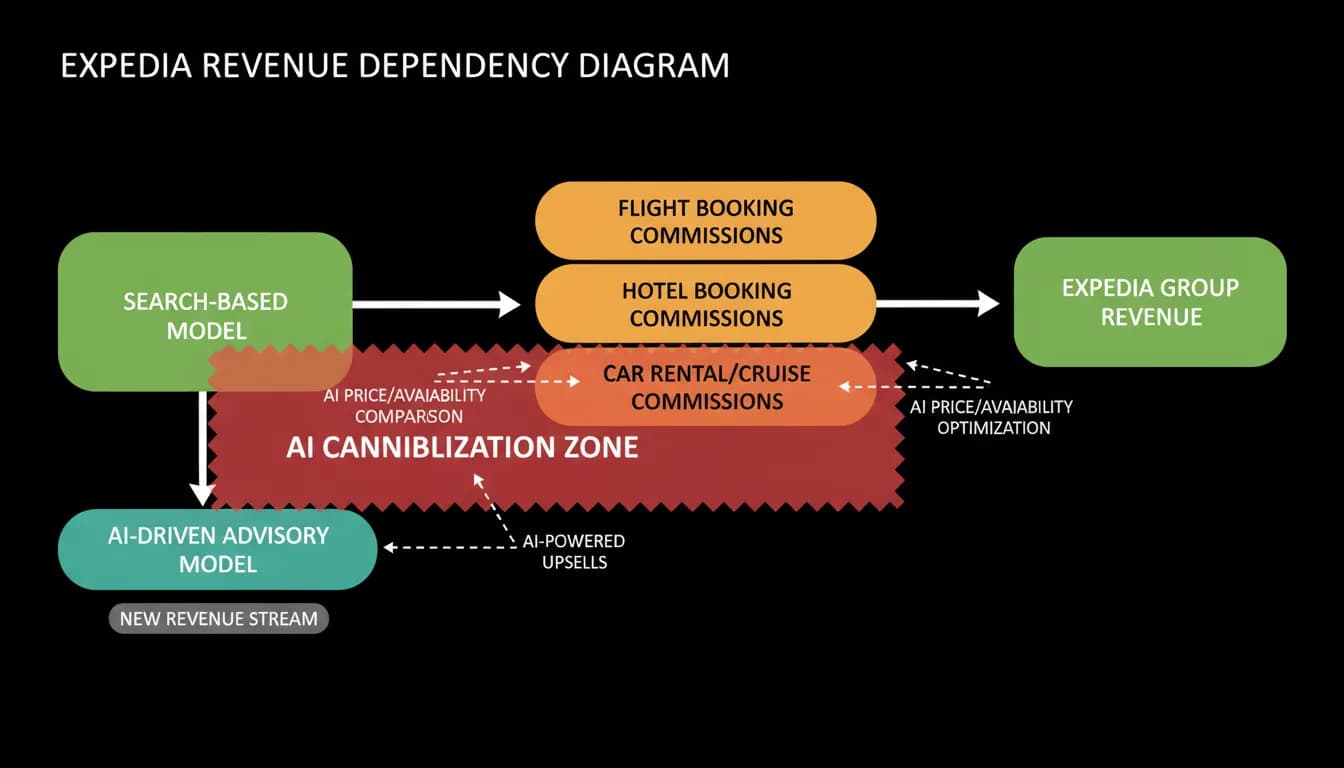
Here is what makes the innovator's dilemma so pernicious: the incumbent's decisions are rational at every step.
A $13 billion company built on advertising-funded search results has a rational reason to invest in better search rather than conversational AI that eliminates search. Better search improves the existing revenue stream. Conversational AI threatens it. Every quarterly earnings report reinforces the logic of optimizing the current model.
The AI features these companies do ship are carefully constrained. Chatbots that supplement search rather than replace it. Trip planners that inspire but redirect to the booking funnel. Price alerts that are features within the existing product rather than alternatives to it.
This is not cowardice or stupidity. It is the rational behavior of an organization optimized for its current business model. Christensen's insight is that this rationality is the trap.
The billion-dollar inertia
The larger the incumbent, the stronger the inertia. When your revenue model generates well over ten billion dollars a year from a specific product architecture — Expedia Group's annual revenue sits in that range, and Booking Holdings' is larger still — every dollar invested in changing that architecture is a dollar at risk of destabilizing the revenue engine.
Incumbent R&D goes overwhelmingly into defending and incrementally improving the existing funnel. An AI-native startup has no legacy revenue to protect, so effectively all of its build effort goes into the new model. Every dollar goes toward building the future product. For incumbents, every dollar is weighed against the risk to the existing product.
The result is predictable: incumbents add AI features cautiously. Startups build AI products aggressively. The feature gap widens over time.
The crossover point
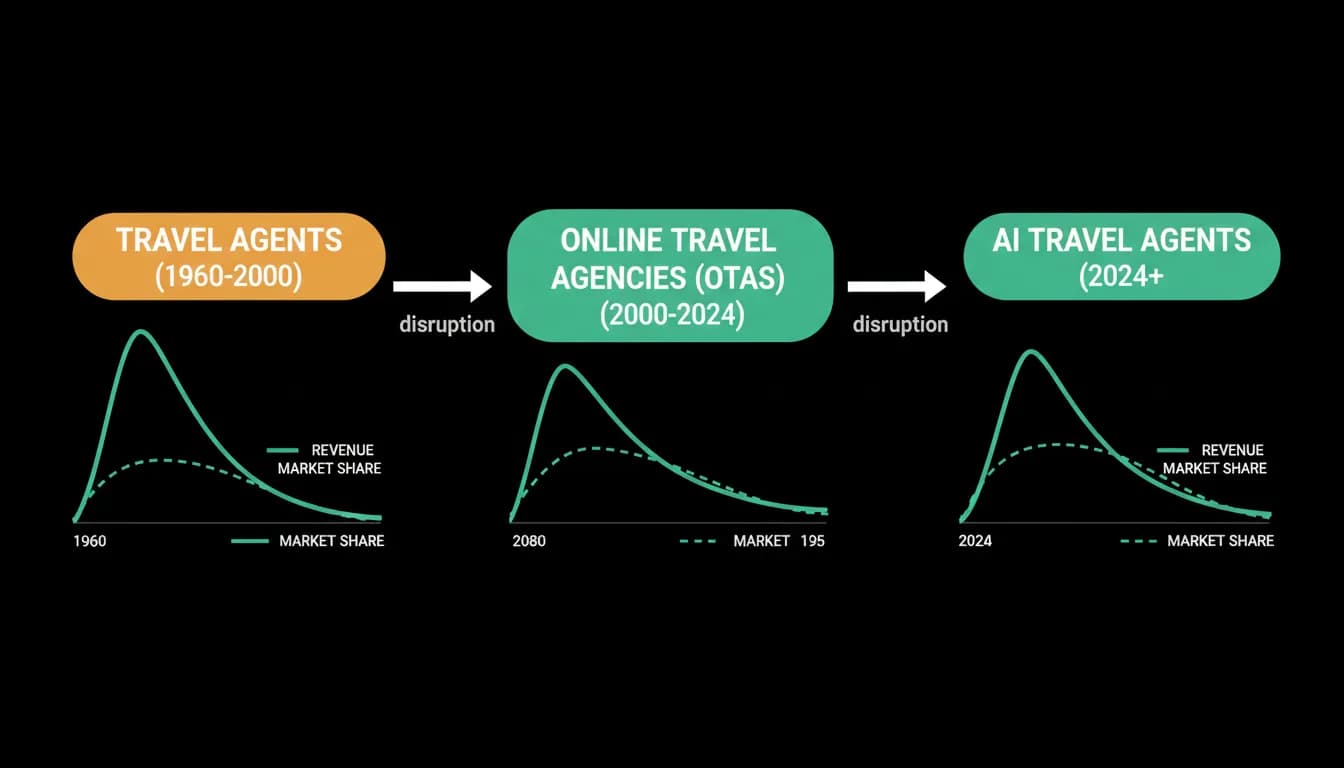
Christensen's framework predicts a crossover point where the disruptor's product quality exceeds the incumbent's for mainstream use cases. Before the crossover, the disruptor serves niche segments. After the crossover, the mainstream shifts.
For AI travel agents, the crossover is approaching or has already occurred for several use cases. For complex trips (multi-city, group travel, special occasions), AI agents already deliver a better experience than any OTA. For simple bookings, the gap is narrowing as AI agents match incumbents on inventory breadth and surpass them on speed and personalization.
The historical pattern from the last disruption cycle is instructive. Travel agents held 75 percent of bookings in the 1990s. OTAs disrupted them over approximately 15 years, reducing agent share to 25 percent by 2015. The OTA-to-AI agent transition may be faster — perhaps 5 to 7 years — because the technology improvement cycle is shorter and consumer adoption of AI is faster than consumer adoption of the internet was.
Assess your current platform
The practical implication for travelers is simple: is your current booking platform innovating or optimizing?
Innovating means building a fundamentally new product that changes how you interact with the platform. Optimizing means making the existing product incrementally better — faster searches, more filters, prettier results pages.
If your platform's biggest recent improvement is a redesigned filter sidebar or a chatbot that answers FAQ questions, it is optimizing. If it has shifted from a search-based interface to a conversational agent that handles end-to-end booking, it is innovating.
The optimizers will continue to serve the market well for years. But the trajectory is clear: the future belongs to platforms that built for the new paradigm, not those that are retrofitting the old one.
Nowah is an AI travel agent that searches and books real flights and hotels through conversation — no filters, no thirty open tabs. Plan your next trip.