The AI Feedback Loop: How User Interactions Make the Agent Smarter
Implicit signals — which options users select, when they rephrase, what they ignore — feed back into the system. More users mean better AI for everyone.

Every time you use Nowah, you make it better. Not just for yourself, through the agentic memory that learns your preferences. For everyone. Every conversation, every selection, every ignored option generates signals that feed back into the system and improve the AI for the next user.
This is not accidental. We designed the product around a feedback loop that turns usage into intelligence. And understanding how this loop works explains why AI products with more users are not just more popular, they are genuinely better products.
Implicit feedback: the signals you send without trying
The most valuable feedback is the feedback users never consciously give.
When the agent presents three flight options and you select Option B, that is a signal. It tells us that for this route, at this price point, with your preference profile, the mid-tier option was more attractive than the cheapest or the most premium. Over thousands of similar selections, patterns emerge. Users on this route consistently prefer direct flights even when they cost more. Users in this budget range prioritize departure time over price. Users who have traveled to Asia before care more about airline reputation than users booking their first Asian trip.
When you rephrase a question, that is a stronger signal. It means the agent's response to your first phrasing was not useful. If you say "find me a hotel in Paris" and the agent returns options near the Eiffel Tower, and then you say "no, I want something in the Marais," we learn that "in Paris" without further specification should probably not default to the most touristy area. Over hundreds of similar rephrasing patterns, we calibrate the agent's default assumptions for city neighborhoods.
When you ignore a response entirely, neither selecting an option nor asking a follow-up, that is a signal too. Something about the response was off enough that you disengaged. Maybe the options were too expensive. Maybe they did not match your unstated preference for boutique hotels. Maybe the response was too long and you lost patience.
Time spent is another implicit signal. If a user reads a hotel description for 30 seconds before selecting it, they were genuinely evaluating. If they select in 2 seconds, they might have just picked the first option without comparing. If they spend 45 seconds on one option and then select a different one, the first option almost won, which tells us something about which features attract attention versus which drive decisions.
None of these signals require the user to do anything special. They are byproducts of normal interaction. And collectively, they are worth more than any amount of explicit feedback.
Explicit feedback: when users tell us directly
We also collect explicit feedback, but we are deliberate about when and how.
After a completed booking, we show a simple satisfaction indicator. Not a five-star rating (which suffers from J-curve distribution problems where everyone rates 1 or 5). Not a lengthy survey (which nobody completes). A quick reaction paired with an optional text field.
The text field responses are gold. "The hotel options were all chains and I wanted something independent." "The agent recommended a flight with a 6-hour layover, which I would never want." "Loved that it remembered I need an aisle seat." These are specific, actionable, and directly tied to a particular interaction that we can examine in detail.
We also capture explicit preference updates. When a user tells the agent "I always want direct flights" or "I prefer hotels under $200 per night," those are explicit signals that feed into both the individual user's memory and our understanding of common preferences.
The ratio of implicit to explicit signals is roughly 100:1. For every piece of explicit feedback we receive, there are a hundred implicit signals we capture. This is why designing for implicit signal capture matters so much. If you rely on explicit feedback alone, you are working with 1% of the available information.
The learning loop
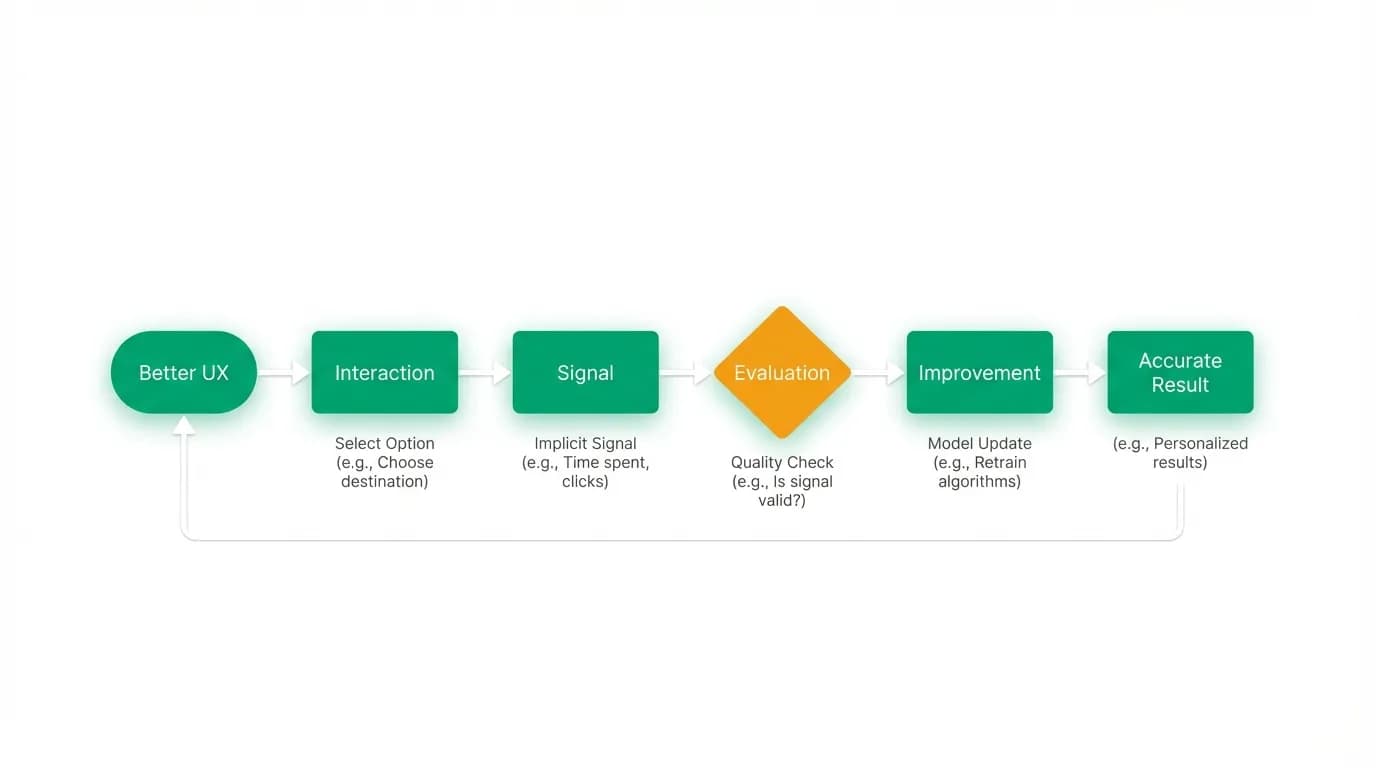
Here is how the feedback loop works as a system:
Stage 1: Interaction. A user has a conversation with the agent. They search for flights, compare hotels, ask about destinations. Normal usage.
Stage 2: Signal extraction. Every interaction generates signals. Selections, rejections, rephrases, timing, abandonment, follow-up depth. These are captured and tagged with context: the user's preferences, the route, the price range, the time of year.
Stage 3: Aggregation. Individual signals are noisy. But aggregated across hundreds or thousands of similar interactions, clear patterns emerge. "Users searching for flights from New York to London in summer prefer departure times before 10am by a 3:1 ratio." "When presented with three hotel options, users select the one with the best review score 55% of the time, regardless of price position."
Stage 4: Evaluation. Aggregated patterns are evaluated against our quality metrics. Do the patterns suggest the agent is making good recommendations? Where is the agent consistently wrong? Which types of queries have the highest rephrasing rates (indicating poor initial understanding)?
Stage 5: Improvement. Insights from evaluation feed into the agent's behavior. This happens through multiple channels: adjustments to how the agent ranks options, changes to default assumptions, refinements in how the agent interprets ambiguous requests, and updates to the presentation of results.
Stage 6: Better interaction. The improved agent delivers a better experience to the next user, who generates new signals that start the loop again.
The cycle time varies. Some improvements are immediate: a prompt adjustment that takes effect within hours. Others are weekly: aggregated curation signals that refine ranking weights. A few are quarterly: structural changes to how the agent handles certain types of queries.
The point is that the loop never stops. Every day, the product gets slightly better because of the conversations that happened yesterday.
Privacy-first learning
This section matters, and I want to be direct about it.
We can build a feedback loop that improves the AI without compromising individual privacy. Here is how.
First, aggregation is the default. We learn from patterns across users, not from individual users. "Users prefer direct flights on transatlantic routes" is a population-level insight. It does not require identifying which specific user told us that.
Second, individual memory is opt-in and user-controlled. The agentic memory that remembers your personal preferences (seat choice, airline loyalty, budget range) is yours. You can view it, edit it, and delete it. It is not shared with other users or used for aggregate learning without anonymization.
Third, we separate the individual model from the population model. Your personal preferences improve your experience. Population-level patterns improve everyone's experience. These are different systems. Your preference for window seats feeds your personal memory. The aggregate finding that 60% of users prefer window seats feeds the population model that sets default assumptions for new users.
Fourth, we do not train on personally identifiable information. Conversation content that includes names, passport numbers, or other PII is stripped before any aggregate analysis. The learning system sees "a user searched for flights from [origin] to [destination] on [date range] and selected option B." It does not see who that user is.
Privacy and learning are not in tension if you design the system correctly from the start. The mistake most companies make is collecting everything, learning from everything, and then trying to bolt on privacy controls after the fact. We went the other direction: privacy constraints are built into the data pipeline, and the learning system operates within those constraints.
The compounding advantage
Here is where the feedback loop becomes a strategic moat.
A new AI travel product launching today starts with zero signals. Its agent has no data about which flight options users prefer, which hotel descriptions lead to bookings, or which conversational patterns indicate satisfaction. It relies entirely on the base AI model's general knowledge.
A product with a million conversations in its history has aggregated thousands of signals per route, per destination, per preference combination. Its agent knows that users searching for Tokyo flights in April care about cherry blossom season and should be warned about peak pricing. It knows that budget hotels in Barcelona with ratings below 7.5 have a high abandonment rate. It knows that users who mention "anniversary" in their search tend to spend 40% more on hotels.
This knowledge is not in the AI model. It is product-level intelligence built from actual user behavior. And it compounds. Each month of operation adds another layer of signal that makes the product better. A competitor cannot buy this. They can match the technology stack. They can use the same AI model. But they cannot replicate the accumulated intelligence of millions of travel conversations.
This is the AI equivalent of Amazon's flywheel. More users generate more signals. More signals create better AI. Better AI attracts more users. The cycle is self-reinforcing, and the gap between early movers and late entrants widens over time.
What Spotify and Netflix perfected
This feedback loop is not new to AI travel. It is the same mechanism that made Spotify's Discover Weekly and Netflix's recommendation engine industry-leading.
Spotify does not just recommend songs you might like based on genre tags. It learns from billions of listening patterns: when people skip, when they replay, when they add to a playlist, when they listen to something once and never return. Every interaction refines the recommendation model, not just for you but for everyone whose listening patterns resemble yours.
Netflix famously offered a $1 million prize to improve its recommendation algorithm by 10%. The winning insight was that collaborative filtering, learning from what similar users watch, outperforms content-based filtering, recommending based on genre and actor. The feedback loop of user behavior was more valuable than any amount of content metadata.
We are applying the same principle to travel. Collaborative patterns across users ("travelers who booked this hotel in Barcelona also loved this restaurant") combined with individual preferences ("you prefer boutique hotels in walkable neighborhoods") create a recommendation quality that neither approach achieves alone.
The difference is that travel decisions are higher-stakes than song or movie choices. Nobody loses $2,000 on a bad Spotify recommendation. So the feedback loop has to produce reliable quality faster, and the consequences of getting it wrong are more severe. This actually makes the loop more valuable, because users who have a great AI travel experience become loyal in a way that Spotify users, with a dozen competing music apps, typically are not.
The network effect of AI quality
Traditional network effects are about users: the product is more valuable because more people use it. Facebook is useful because your friends are on it. Airbnb is useful because lots of hosts list properties.
AI products have a different kind of network effect: the product is more valuable because more people have used it. Past usage improves the product for future users. This is a temporal network effect rather than a social one.
The practical implication is that early users of an AI product are not just early customers. They are contributors to the product's quality. Every conversation they have, every flight they book, every correction they make when the agent gets something wrong, contributes to the aggregate intelligence that makes the product better for everyone who comes after them.
This creates an interesting growth dynamic. The first 1,000 users get a good product. The next 10,000 get a better product, because the first 1,000 generated signals that improved the AI. The next 100,000 get an even better product. And so on.
For competitors, this means the window to enter the market narrows over time. An AI travel product with two years of conversation data and a million users has a quality advantage that is increasingly difficult to close. The technology can be copied. The data cannot.
We think about this every day. Not just because it is good for our business (it is), but because it means every user interaction carries weight. Every conversation matters. Every signal counts. The product we ship tomorrow is built on the conversations we had today. That is a responsibility we take seriously, both in terms of privacy and in terms of making sure every interaction contributes to a genuinely better product for the next person who opens the app.
Nowah is an AI travel agent that searches and books real flights and hotels through conversation — no filters, no thirty open tabs. Plan your next trip.