The AI Travel Ecosystem: When Agents Talk to Agents
Your travel AI negotiating hotel rates with the hotel's AI. Automatic rebooking before you notice a delay. Agent-to-agent commerce is the next frontier.
Right now, AI travel agents have one conversation partner: you. You tell the agent what you want. The agent searches, reasons, and responds. The agent-human loop is the entire product.
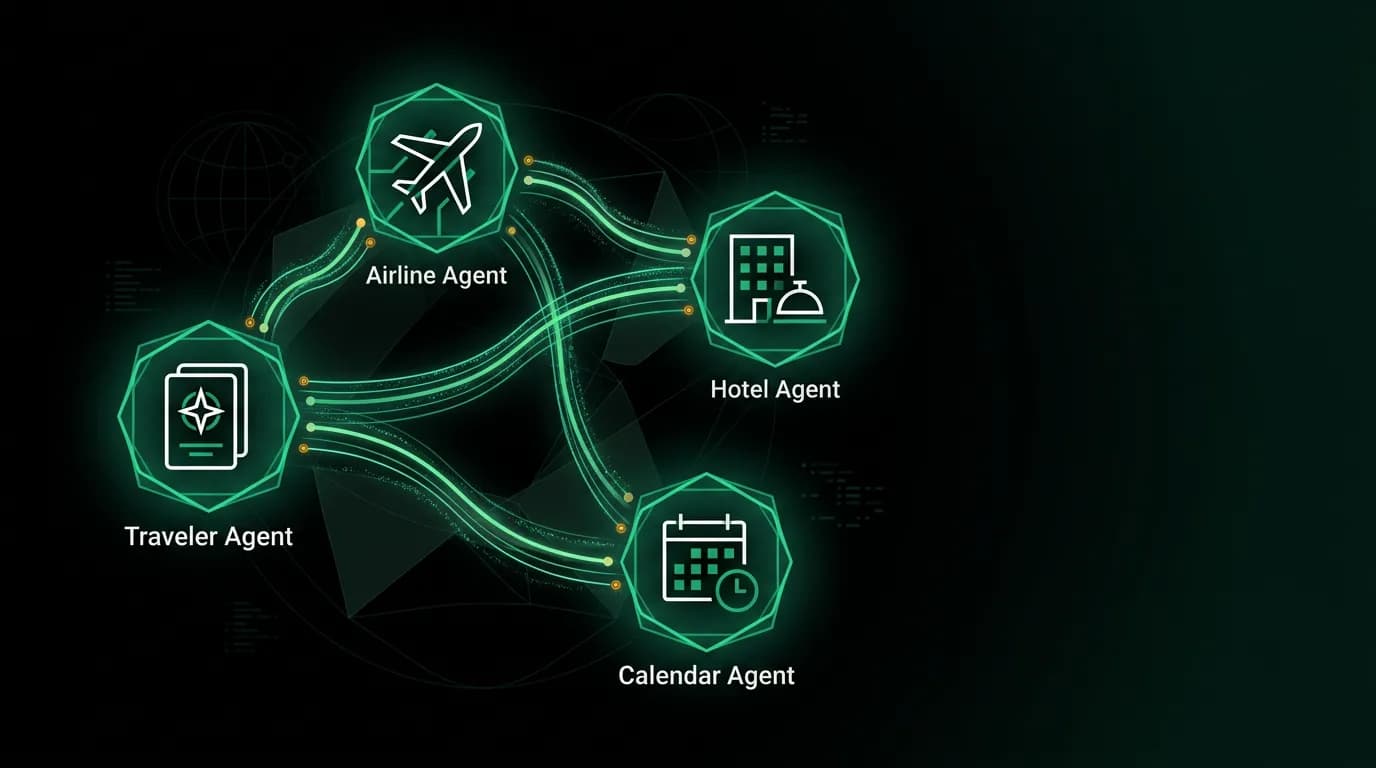
But this is an interim state. The next frontier is agent-to-agent communication. Your travel AI talking to the airline's AI. Your AI negotiating rates with the hotel's AI. Your AI coordinating with your calendar AI, your budget AI, your health AI to plan travel that fits your entire life context.
This sounds futuristic, but the pieces are assembling faster than most people realize. Agent communication protocols are emerging. Companies are building AI agents for their own operations. The technical infrastructure for agent-to-agent commerce is being laid right now.
When it clicks into place, the travel experience changes fundamentally. From something you actively manage to something that manages itself.
Agent-to-agent commerce: how it works
Let me paint a concrete scenario.
You tell your travel AI you want to visit Barcelona in September. Your agent knows your preferences: boutique hotels, walkable neighborhoods, $150-200/night budget, quiet room, preferably with a balcony.
Today, your agent searches a hotel inventory API, gets results, and filters them based on your preferences. This works, but it is limited by what the API returns. Standard hotel APIs surface price, availability, room type, and basic amenities. They do not negotiate. They do not offer personalized deals. They do not understand context.
In an agent-to-agent world, your agent contacts the hotel's AI directly. The conversation might look something like this (in protocol terms, not literally):
Your agent: "I have a guest seeking a boutique hotel in the Gothic Quarter for September 12-17. They prefer quiet rooms with a balcony. Their budget is $150-200/night. They are a frequent traveler with a history of positive reviews. Can you offer a rate?"
Hotel agent: "We have a balcony room on the courtyard side, which is our quietest wing. Standard rate is $210/night. For a five-night stay, I can offer $185/night. If your guest books directly through our AI channel, I can include complimentary breakfast, bringing the effective rate to approximately $165/night equivalent."
Your agent: "That works within the budget. My guest also prefers late check-out. Is that available for the September dates?"
Hotel agent: "Late check-out until 2 PM is available for September 17th. Confirmed."
Your agent presents this to you: "I found a hotel in the Gothic Quarter with a balcony overlooking the courtyard, which is the quiet side. $185/night with free breakfast, and I negotiated late check-out on your departure day. Total: $925 for five nights. Book it?"
This interaction is richer than anything a standard API search can produce. The hotel's agent offered a rate that does not appear in the general listing. It understood the context (frequent traveler, positive reviews) and made a tailored offer. Your agent negotiated a perk (late check-out) that would not have been surfaced through a standard booking flow.
Automated rebooking: agents acting in real time
The scenario I am most excited about, and the one that will sell agent-to-agent communication to skeptics, is automated disruption handling.
Here is the current experience when your flight gets delayed:
- The airline sends you a push notification: "Your flight AA234 is delayed 3 hours."
- You panic.
- You open the airline app to check options.
- The app shows rebooking options, all of which are worse than what you wanted.
- You call the airline. You wait on hold for 45 minutes.
- The agent rebooks you on a different flight.
- You realize the new flight arrives too late for your hotel check-in.
- You call the hotel. More hold time.
- You update your airport transfer.
- Two hours of stress for a problem that should have taken two minutes.
Here is the agent-to-agent experience:
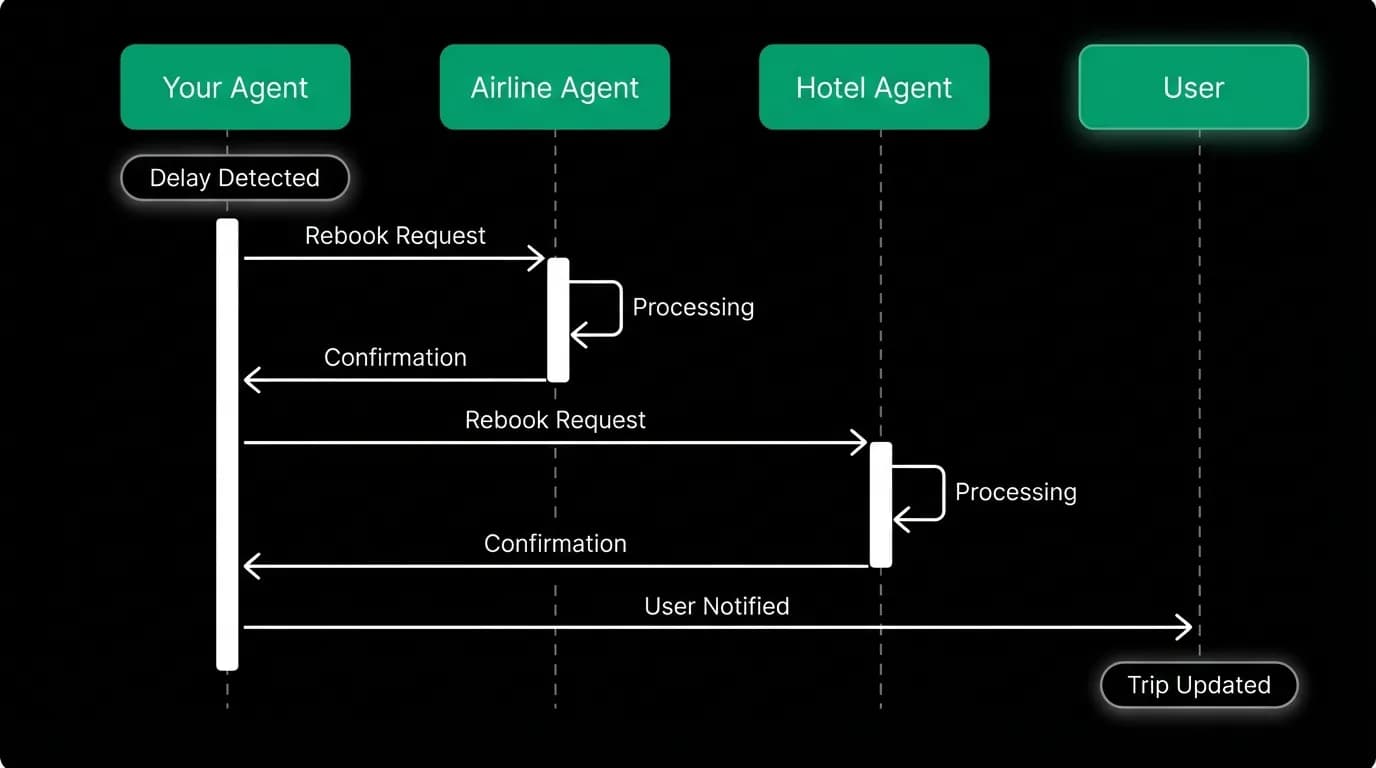
- Your travel agent detects the delay through the airline's status feed.
- Your agent contacts the airline's agent: "My passenger was on AA234. What rebooking options are available?"
- Airline agent: "I can rebook on AA456 departing two hours later, or UA789 departing in one hour."
- Your agent evaluates both options against your preferences and downstream itinerary. UA789 arrives 30 minutes later than the original. AA456 arrives 4 hours later and would miss your dinner reservation.
- Your agent books UA789 automatically.
- Your agent contacts the hotel's agent: "Check-in will be 30 minutes later than originally planned. Please adjust."
- Your agent contacts the restaurant's agent: "Please move the reservation from 8 PM to 8:30 PM."
- You get a notification: "Your original flight was delayed. I have rebooked you on United flight 789, arriving at 7:30 PM. Your hotel and dinner reservation have been adjusted. No action needed."
Total user effort: reading one notification. Total time: 30 seconds. The agents handled everything in the background, communicating with each other to resolve the cascade of changes that a single flight delay triggers.
This is not a convenience feature. For frequent business travelers, this is a productivity tool. For anxious travelers, this is stress elimination. For families traveling with kids, this is the difference between a calm adjustment and a chaotic airport scramble.
Cross-platform intelligence coordination
Travel does not exist in a vacuum. A trip interacts with your calendar, your budget, your health, your work schedule, your family's plans. Today, the traveler is the integration layer connecting all of these systems. You check your calendar manually. You calculate the budget yourself. You coordinate with your family through text messages.
Agent-to-agent communication can automate these integrations.
Calendar coordination. Your travel agent talks to your calendar AI. "Is there a free week in October?" Calendar agent: "October 14-20 is clear, but there is a mandatory meeting on October 17th that could potentially be moved." Travel agent: "The meeting would need to be moved to October 12th for the trip to work. Should I request the change?" This kind of cross-system reasoning is beyond what any single app can do today.
Budget integration. Your travel agent talks to your financial AI. "The user is considering a $4,500 trip to Japan. Does this fit their current financial situation?" Financial agent: "Based on their savings goals and current discretionary budget, $3,500-4,000 is more comfortable. They also have $800 in airline credit that could be applied." Travel agent adjusts the search parameters accordingly.
Health awareness. Your travel agent talks to your health AI. "The user is planning a trip to a high-altitude destination." Health agent: "The user has a respiratory condition. Altitude above 3,000 meters may require medical preparation. Recommend consulting their doctor and considering altitude sickness medication." Travel agent surfaces this information proactively.
Each of these integrations requires trust, permission, and robust data protocols. But the value is clear: a travel agent that understands your full life context makes dramatically better recommendations than one that only knows your travel preferences.
The protocol question
For agent-to-agent communication to work at scale, there need to be standards. How do agents discover each other? How do they establish trust? How do they communicate? How do they handle disputes?
This is an active area of development in the AI industry. The an open agent-tool protocol is one emerging standard for agent communication. It defines how AI agents can discover capabilities, exchange structured data, and coordinate actions. Other protocols are emerging from different communities with different approaches.
The travel industry has some existing infrastructure to build on. The airline industry has had machine-to-machine communication standards for decades (EDIFACT, NDC). Hotel distribution has its own protocols (HTNG, OTA specifications). These were designed for system-to-system communication, not agent-to-agent communication, but they provide a foundation.
The gap is in the intelligence layer. Existing travel protocols handle structured transactions: book this room, confirm this flight. Agent-to-agent protocols need to handle negotiation, context exchange, preference communication, and conditional logic. "My passenger prefers a quiet room. What is your best quiet room rate given a five-night stay from a frequent traveler?" This is a different kind of interaction than "book room type A for dates X to Y."
I expect the protocol landscape to be messy for the next two to three years. Multiple competing standards. Proprietary implementations. Compatibility issues. This is normal for emerging technology. Eventually, a few standards will win and agent communication will become as standardized as web APIs are today.
What this means for consumers
The consumer promise of agent-to-agent commerce is straightforward: zero-effort travel management.
You express a desire. "I want to go to Japan in the spring." Your agent handles everything: researching destinations, negotiating rates, checking your calendar, coordinating with your travel companion's agent, booking flights and hotels, arranging transfers, making restaurant reservations, monitoring for disruptions, and managing changes.
You review and approve. The agent presents a plan. You say yes or request changes. The agent handles the changes. When the plan is right, you confirm and the agent executes.
You travel. During the trip, agents handle logistics in the background. Flight change? Handled. Weather disruption? Adjusted. Restaurant closed? Alternative booked.
You remember. After the trip, the agent creates the summary, organizes the photos, updates your travel profile.
This is not travel planning. This is travel happening. The distinction is profound. Planning implies effort. Happening implies automation. We are moving from a world where you plan travel to a world where travel happens for you.
The infrastructure being built today
This future is not hypothetical. The infrastructure is being built right now.
Airlines are building AI systems for customer service, operations, and revenue management. These systems are early but evolving rapidly. When an airline's revenue management AI can communicate with a consumer's travel AI, dynamic personalized pricing becomes possible at a scale that human-mediated booking could never achieve.
Hotels are building AI for pricing, guest communication, and operations. Some hotel chains already use AI for dynamic pricing that adjusts based on demand patterns, events, and competitive positioning. Connecting this intelligence to a traveler's agent enables real-time negotiation.
Payment systems are evolving to support agent-initiated transactions. Pre-authorized spending limits, category-based approvals, and agent authentication are all being developed. The mechanics of an AI agent spending money on your behalf, with your permission and within defined boundaries, are being figured out.
Trust and verification systems are emerging. How does a hotel's AI know that your AI is legitimate? Digital signatures, agent credentials, and reputation systems are all in development. These are necessary for agent-to-agent transactions to be secure and trustworthy.
Timeline and milestones
2026 (now): Agent-to-human is the primary interaction model. Your AI talks to you. Your AI accesses inventory through standard APIs. No meaningful agent-to-agent communication in production.
2027: Early agent-to-agent interactions emerge. Likely starting with simple use cases: automated rebooking during disruptions, price alert coordination, basic negotiation for corporate travel contracts. These will be bilateral agreements between specific companies, not open protocols.
2028: Agent communication standards mature. A handful of major airlines, hotel chains, and travel platforms adopt interoperable protocols. Consumer travel agents can negotiate rates and handle disruptions across a meaningful portion of travel inventory.
2029: Agent-to-agent commerce reaches critical mass. The majority of major travel suppliers have AI agents that can communicate with consumer agents. Automated booking, negotiation, and disruption management become standard for users with AI travel agents.
2030+: Full ecosystem intelligence. Travel agents coordinate across suppliers, calendar systems, financial tools, and other personal AI agents. The vision of zero-effort travel management becomes reality for early adopters.
These timelines assume continued progress in AI capabilities, protocol development, and industry adoption. Any one of these could slow down. But the direction is clear, and the economic incentives (reduced operational costs for suppliers, better experience for consumers) are strong.
Our position
We are building Nowah to be a leading participant in this ecosystem. Today, our agent talks to you and accesses inventory through APIs. Tomorrow, it will negotiate with hotel agents, coordinate with airline agents, and integrate with your broader AI ecosystem.
The decisions we make today about agent architecture, protocol support, and data structures are informed by this future. We are building an agent that can participate in a multi-agent ecosystem, not just a chatbot that searches databases.
This is the most exciting product direction in travel technology. The shift from apps that you operate to agents that operate on your behalf, coordinating with other agents to create seamless travel experiences. It is the logical conclusion of everything the AI travel industry is building toward.
And it starts with conversations. First agent-to-human. Then agent-to-agent. Then a whole ecosystem of intelligence working together so you can focus on the part of travel that actually matters: the experience.
Nowah is an AI travel agent that searches and books real flights and hotels through conversation — no filters, no thirty open tabs. Plan your next trip.