AI Ranking Intelligence — Beyond Price Sorting
Sorting by price is lazy and wrong. AI ranking scores 20+ factors — layover quality, neighborhood fit, time preferences — to find your actual best option.

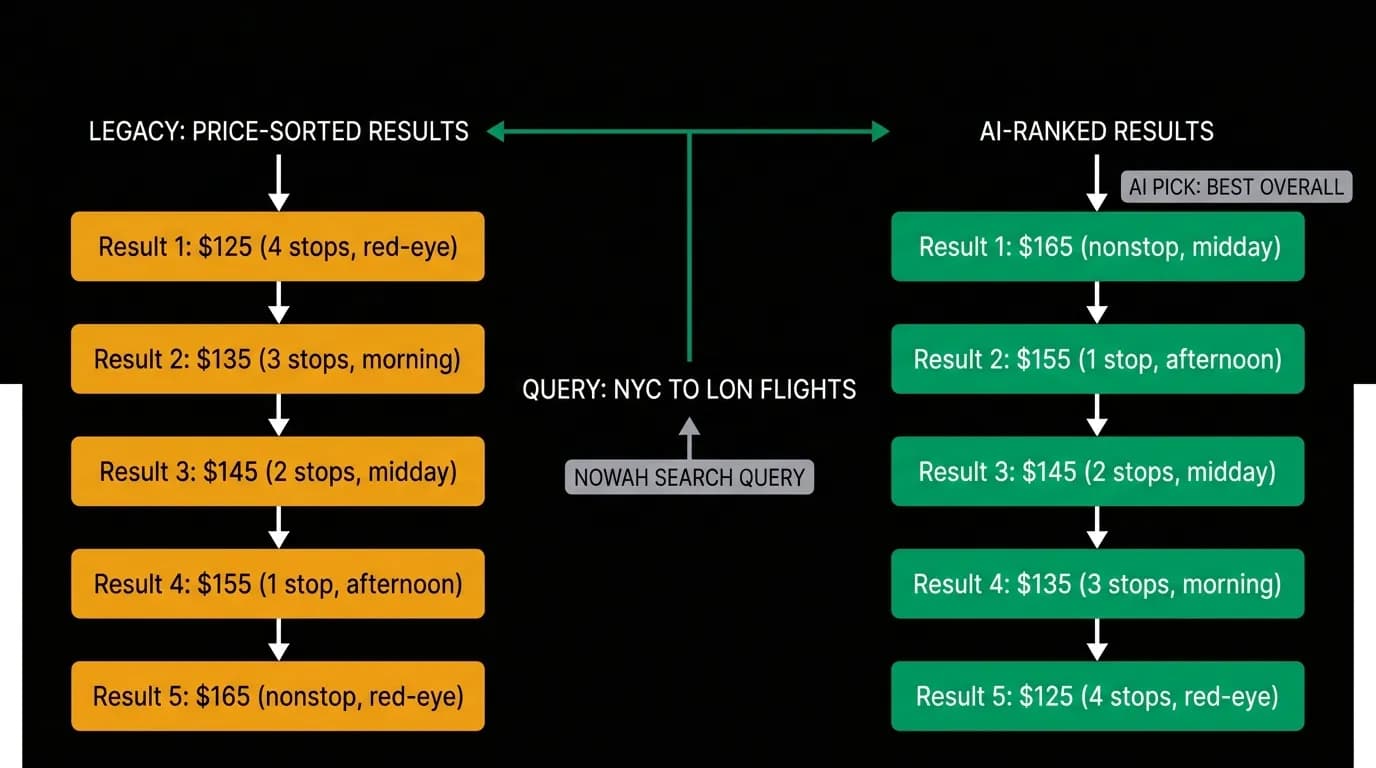
Every major travel platform defaults to sorting by price. It is the laziest possible ranking strategy. And it is wrong for the vast majority of travelers.
The cheapest flight from SFO to NRT in April might be a $380 red-eye with two stops and a 7-hour layover in a cramped terminal. The "best" flight for most travelers is the $520 direct on a good airline with morning arrival. Sorting by price puts the objectively worse option first.
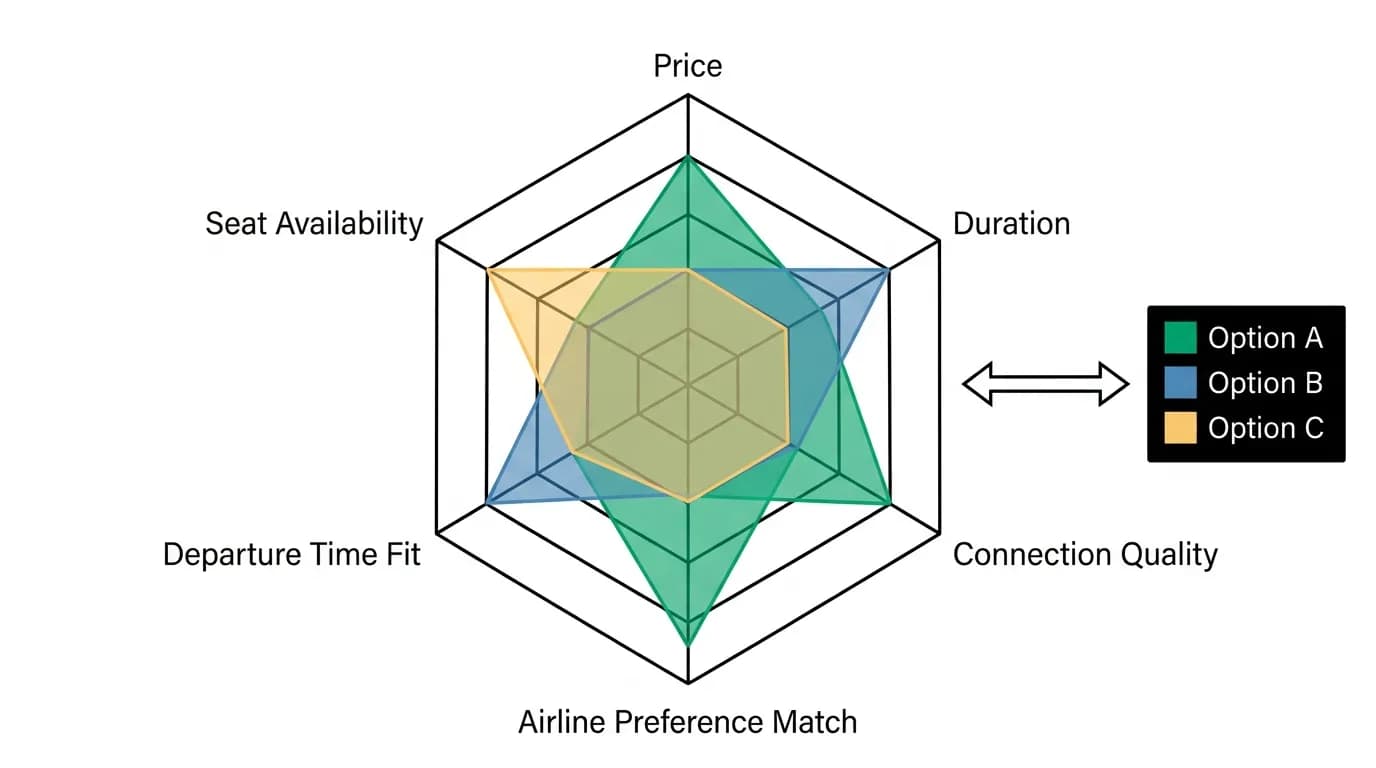
Price is one of at least 20 factors that determine whether a travel option is actually good for a specific person. AI ranking considers all of them. I want to show what that looks like.
The price-sort trap
Price sorting persists because it is simple to implement and simple to understand. Users can see that the list goes from cheap to expensive. It feels objective. But it creates several problems.
It ignores quality entirely. A $380 flight with two stops, no baggage, a middle seat, and departure at 1 AM is not comparable to a $520 direct flight with included baggage, an aisle seat, and a 10 AM departure. Yet price sort puts the $380 option first.
It biases toward false economy. The cheapest option often has hidden costs: baggage fees, seat selection fees, change fees, lost time, discomfort. The total cost of the cheap option frequently exceeds the sticker price of a better one.
It creates regret. Users who book the cheapest option often discover they should have paid more for the better experience. Forty percent of travelers report post-booking regret, and price-driven decisions are a major contributor.
It serves the platform, not the user. Some platforms bias their default sort toward options with higher commissions, disguised as "recommended" or "best value." Users trust the default sort without realizing it may not reflect their interests.
The 20+ factor challenge
What makes a flight or hotel "good" is a multi-dimensional question. Here are the factors our ranking system evaluates.
For flights:
- Total price including all fees
- Number of stops
- Total travel duration
- Connection quality (terminal, minimum time, airport comfort)
- Departure time alignment with user preferences
- Arrival time (red-eye vs. daytime, arrival time at destination)
- Airline quality and user's history with that carrier
- Aircraft type and seat configuration
- Baggage policy
- Fare flexibility (change and cancellation policies)
- Loyalty program alignment
- Seat availability in preferred position (aisle/window)
For hotels:
- Price per night
- Location relative to user's planned activities
- Neighborhood character (quiet, lively, walkable, local, touristy)
- Hotel style (boutique, chain, resort, apartment)
- Room type and size
- Guest reviews weighted by relevance (recent, similar traveler profile)
- Amenities that match user needs (gym, pool, restaurant, workspace)
- Cancellation policy
- Check-in/check-out flexibility
- Transportation access
Each factor gets a weight. Some weights are universal: almost everyone prefers shorter travel time, all else being equal. Some are personal: you prefer morning departures while someone else prefers evenings. Some are contextual: business trips weight hotel proximity to meeting locations; leisure trips weight neighborhood character.
Connection quality: not all layovers are equal
This is one of my favorite examples of why AI ranking beats price sorting.
A 2-hour layover at Singapore Changi Airport is comfortable. The airport has lounges, gardens, a swimming pool, and efficient transfer processes. A 2-hour layover at a congested hub during peak hours is stressful. You might have to change terminals, clear security again, and sprint to your gate.
Traditional platforms show "1 stop, 2h layover" for both. They look identical. An AI ranking system that understands airport quality, transfer logistics, and terminal configurations can score these layovers differently.
We evaluate connection quality based on:
- Minimum connection time at that specific airport
- Terminal transfer requirements (same terminal vs. different terminals, airside vs. landside)
- Airport comfort score (facilities, dining, rest areas)
- Historical on-time performance for the connecting flights
- Buffer time beyond the minimum (a 90-minute connection with a 60-minute minimum is tighter than a 90-minute connection with a 45-minute minimum)
A user who sorts by price would never see this analysis. They would just see the layover duration and assume all 2-hour layovers are the same.
Hotel neighborhood intelligence
Traditional hotel ranking uses star ratings and review scores. Both are deeply flawed.
Star ratings are assigned by the hotel, not by a neutral evaluator. A "4-star" hotel in one country might be a "3-star" in another. The criteria are inconsistent and often meaningless.
Review scores are aggregated across all guests. An 8.5/10 might mean the hotel is great for business travelers (who value fast wifi and a desk) but mediocre for families (who value pool and kid-friendliness). The score tells you nothing about whether the hotel is right for you specifically.
AI ranking incorporates neighborhood intelligence. For a food-focused traveler, hotels near interesting restaurants, markets, and food streets rank higher. For a business traveler, proximity to the convention center and airport transit matters more. For a family, safety, park access, and kid-friendly dining dominate.
The same city, the same dates, the same budget can produce completely different hotel recommendations for different travelers. That is the point. One-size-fits-all ranking fails because travelers are not one-size-fits-all.
Transparent ranking
Average booking value for AI-assisted trips is 15-20% higher than for traditional price-sorted bookings. That is not because AI pushes users toward more expensive options. It is because AI helps users book better options that they are more satisfied with and that happen to cost slightly more than the cheapest alternative.
But this only works if users trust the ranking. And trust requires transparency.
When our agent recommends option B over cheaper option A, it explains why: "Option B is $80 more but it is a direct morning flight (you prefer those), includes checked baggage (Option A charges $60 for bags), and arrives early enough for your hotel check-in. The effective price difference is $20, not $80."
Trust in AI recommendations jumps from roughly 30% to roughly 65% when the AI explains its reasoning. For ranking, that means showing users why the AI thinks a $520 flight is a better choice than a $380 flight. When the reasoning is sound and transparent, users accept the recommendation. When it is hidden, they default to price sort because it is the only metric they can evaluate independently.
The future of ranking
We are moving toward fully personalized ranking where the weights on every factor are calibrated to each individual user.
A first-time user gets general-population weights: most people prefer direct flights, reasonable departure times, and good airlines. A returning user gets personalized weights derived from their booking history, stated preferences, and behavioral patterns.
After 10 trips, the ranking is uniquely yours. No two users see the same ranked results for the same query. Because no two users have the same combination of preferences, history, and priorities.
Sorting by price was never the right answer. It was the only answer traditional platforms could implement because they did not know enough about the user to do better. AI agents know enough. The best travel app ranks by what matters to you, not by what is cheapest.
Nowah is an AI travel agent that searches and books real flights and hotels through conversation — no filters, no thirty open tabs. Plan your next trip.