Best Travel App in 2026: What AI-Native Looks Like
Chat-first, memory-powered, voice-enabled, and end-to-end booking in conversation. Here is what the best AI travel booking experience delivers today.
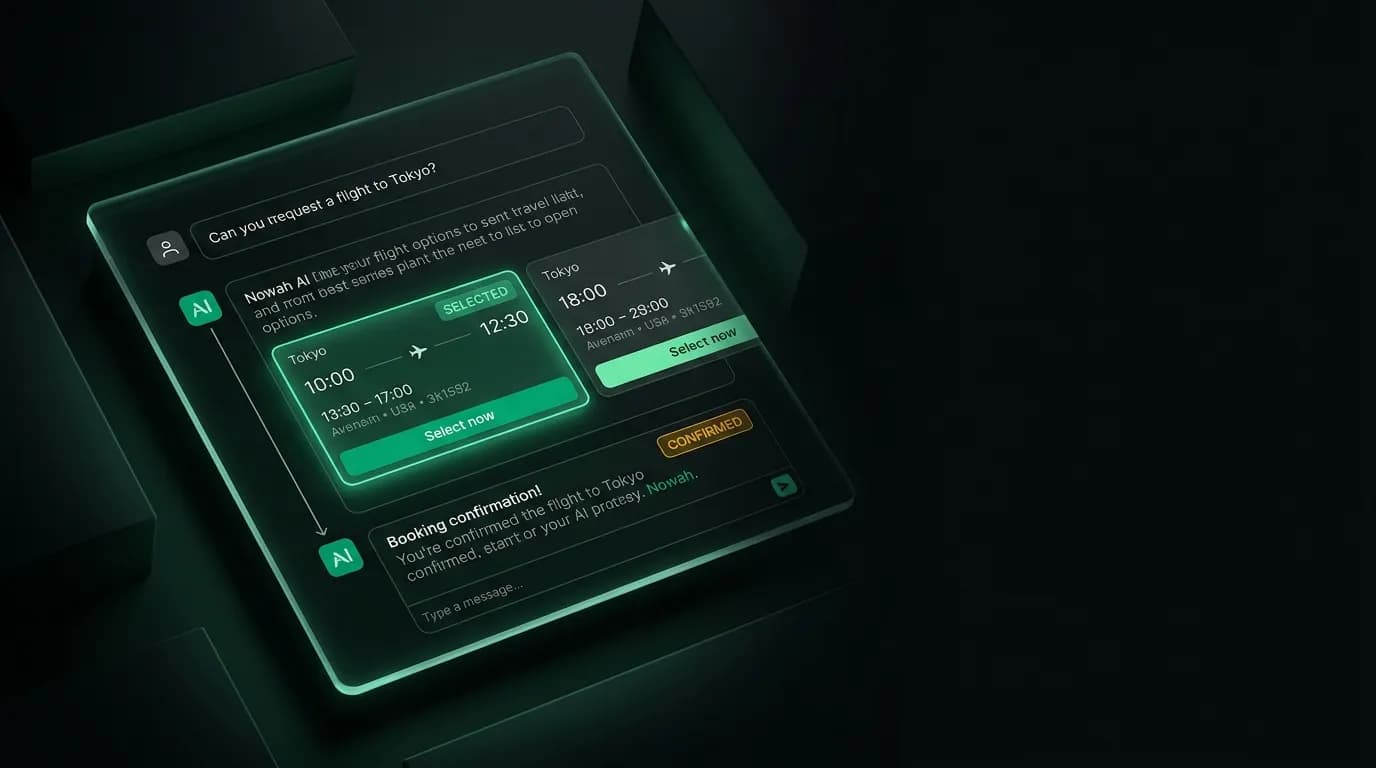
The bar for what a travel app should be has shifted. Two years ago, the best travel apps were the ones with the cleanest search interfaces and the broadest inventory. Today, the best travel apps do not have search interfaces at all. They have conversations.
Here is what an AI-native travel booking experience looks like in 2026, and why the gap between AI-native and traditional apps is growing, not shrinking.
Chat-first, not form-first
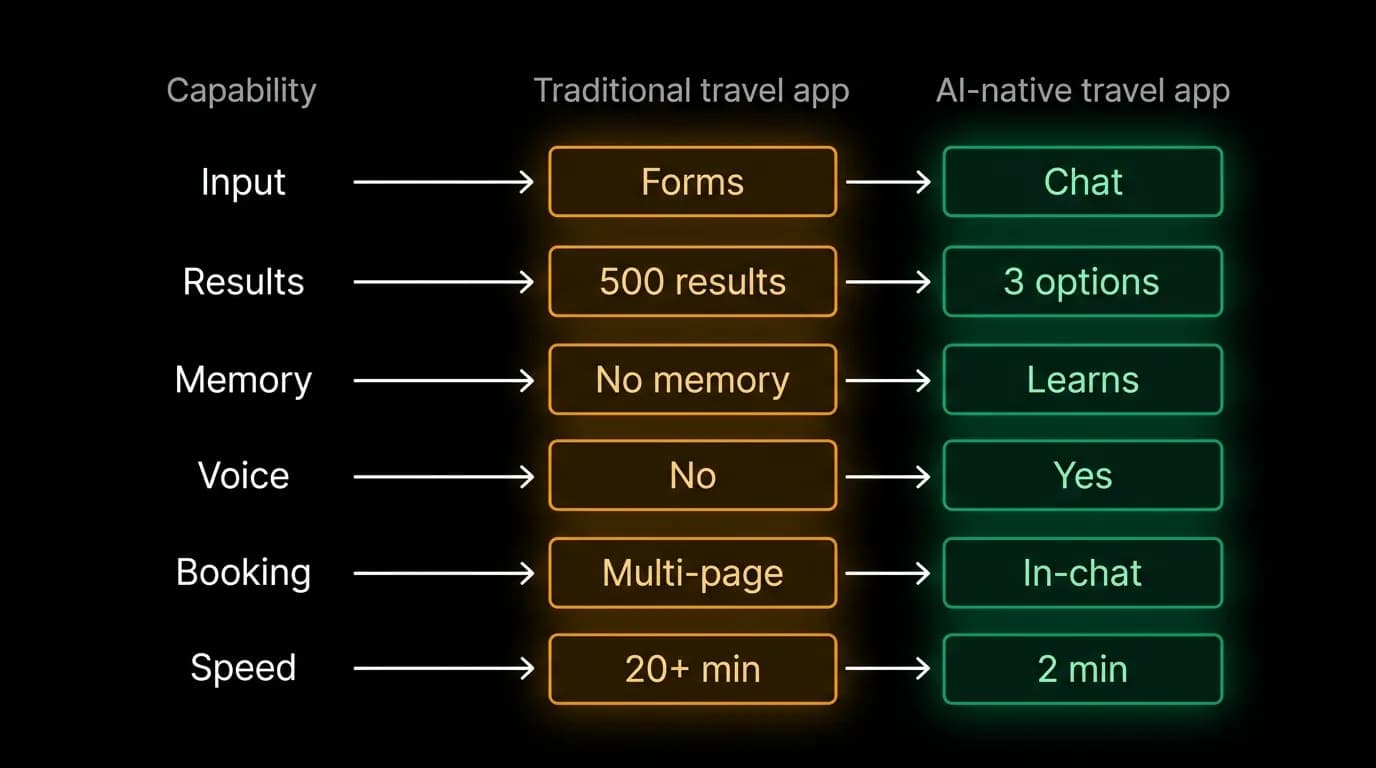
Open a traditional travel app and you see a search form. Airport codes. Date pickers. Passenger counters. Cabin class dropdowns. Five screens of structured input before you see a single result.
Open an AI-native travel app and you see a chat. Type one sentence: "I need flights to Tokyo for a week in April, flexible on dates." That sentence contains more information than a five-screen form, and it took five seconds instead of two minutes to input.
The chat-first model is not just faster. It handles complexity that forms cannot. "I want to fly into Rome and out of Barcelona, spending three days in each plus two days in the countryside between them" is a sentence. On a traditional app, that is a multi-city search with separate hotel bookings and a car rental, requiring multiple form submissions and manual coordination.
Conversational AI reduces booking time by 3-5x compared to form-based search. Not because the AI is faster at processing. Because the input method is faster and more expressive. A single natural language statement captures nuance that would require dozens of form field selections.
An AI agent that remembers you
This is the feature that changes the relationship between user and product.
Traditional travel apps are stateless. Every search starts from zero. You have to re-enter your home airport, your seat preference, your loyalty program numbers, your budget range, every single time. The app you have used for five years knows no more about you than the app you downloaded five minutes ago.
An AI-native app with agentic memory gets better with use. After your first booking, it knows your home airport. After your second, it knows your seat preference. By your fifth, it knows your budget range, your preferred airlines, your hotel style, your dietary restrictions, and your tolerance for layovers.
The tenth time you book should feel effortless because the agent already knows most of what it needs to know. "Book me something like my Portugal trip but in Greece" becomes a viable request because the agent remembers your Portugal trip in detail.
Three curated options, not 500 results
Traditional OTAs compete on inventory display. More results is better. Filters and sorts are the user's tools for navigating the deluge. This made sense when access to inventory was the value proposition. It makes no sense when everyone has the same inventory.
An AI-native app presents three options. The best match for your stated criteria. The best value alternative. And a wild card that you might not have considered but that fits your profile.
Three options versus 500 is not a limitation. It is a feature. The AI did the filtering, sorting, ranking, and preference matching before the results reached you. If none of the three options work, you say why, and the agent adjusts. "These are all too expensive" or "I'd prefer a direct flight" triggers a refined search. This iterative refinement through conversation is faster than adjusting 15 filter sliders on a results page.
Over 70% of travelers say they are open to AI-assisted trip planning. The appetite for someone (or something) to do the sorting for them has always been there. The technology just was not ready.
End-to-end booking in conversation
Search is only half the problem. On a traditional app, finding the right flight is step one. Then you fill out passenger details. Select seats. Add bags. Enter payment information. Review the booking. Confirm. Each step is a separate screen with its own loading time and its own potential for confusion.
In an AI-native app, the entire flow happens in the chat. "Book the second option" leads to a confirmation summary. "Use the card ending in 4242" completes payment. "Add a checked bag" happens in one message. The conversation thread is your booking receipt, your modification history, and your support channel all in one place.
This is not about removing screens for the sake of minimalism. It is about keeping the user in a single interaction context. When you switch between screens, you lose mental context. When you scroll through a conversation, the full context is visible. You can see exactly what you asked for, what the agent found, and what you booked.
Voice-first input
Voice search in travel is growing at over 20% year over year, and the reasons are obvious on mobile. Describing a complex trip is easier by talking than by typing, especially on a phone screen.
"I need to fly from JFK to Heathrow on December 15th, business class, and I need a hotel near Covent Garden for four nights, something boutique with a gym" is 10 seconds of speech and would take two minutes of form-filling.
Voice input is particularly powerful for the iterative refinement that makes AI travel search work. After seeing initial results, saying "can you find something cheaper" or "what about flying the day before" is instantaneous. On a traditional app, each refinement requires navigating back to the search form, changing parameters, and waiting for new results.
Why traditional OTAs cannot replicate this quickly
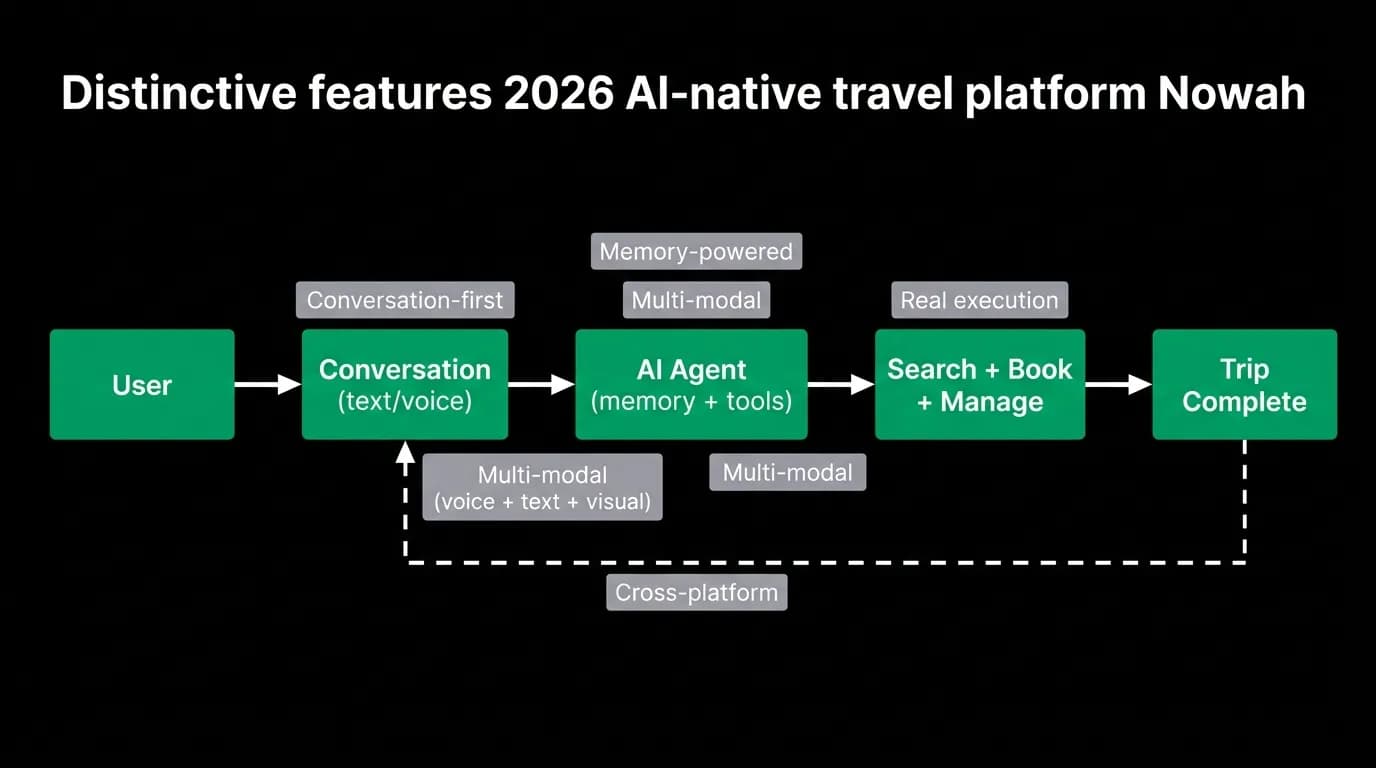
Every capability I described requires AI to be the core of the product architecture, not an add-on. Memory requires a data model designed for persistent user understanding. Conversational booking requires a transaction pipeline driven by AI agent decisions, not form submissions. Voice input requires speech processing integrated into the agent workflow, not bolted onto a search form.
These are architectural requirements, not feature requirements. You cannot achieve them by adding a chat window to an existing OTA. You achieve them by designing every system, from database schema to API layer to frontend rendering, around the assumption that an AI agent is the primary interaction mechanism.
That is what AI-native means. And that is why the best travel app in 2026 looks nothing like the best travel app in 2020.
Nowah is an AI travel agent that searches and books real flights and hotels through conversation — no filters, no thirty open tabs. Plan your next trip.