The Best Travel Booking Apps in 2026: Why AI Changes Everything
How Expedia, Booking.com, Google and Hopper compare on AI capability, personalization depth and booking speed — and why architecture decides the winner.
Every year, someone publishes a "best travel apps" list that ranks platforms on inventory size, price, and interface polish. In 2026, those criteria are necessary but insufficient. The single most important dimension in travel booking has become AI capability — not as a marketing checkbox, but as the core interaction model that determines whether you spend 45 minutes searching or 3 minutes conversing.
This is the year the travel booking app landscape split into two distinct categories: platforms that added AI features to their existing search-based product, and platforms built from the ground up around an AI agent. The difference between these two architectures is not cosmetic. It changes what the app can do, how fast it does it, and whether the recommendations actually serve your interests or the platform's advertising revenue.
The evaluation framework
Rating travel apps on star counts and feature lists misses the point. We evaluated the 2026 landscape across eight dimensions that reflect how travelers actually experience these products.
AI depth measures whether the platform has a genuine AI agent that can search, rank, book, and manage — or just a chatbot that answers questions and sends you back to the search form. This is the most important dimension and the one with the widest variance across platforms.
Personalization evaluates whether the platform remembers your preferences across sessions and trips, or resets every time you open the app. The gap between cookie-based personalization and agentic memory is enormous.
Speed measures time from intent to booked confirmation for varying trip complexities.
Inventory assesses the breadth and quality of flight, hotel, and experience options available.
[Price intelligence](/blog/real-time-price-intelligence-ai) goes beyond showing you a price to telling you whether it is a good price, whether you should book now or wait, and what the true total cost is after fees and ancillary charges.
Mobile UX evaluates the experience on the device where most travel research and increasingly most booking happens.
Post-booking support measures what happens after you pay — can the platform help with changes, disruptions, and trip management, or does it abandon you after checkout?
Trust assesses whether recommendations serve the traveler or the advertiser. This is the dimension most travelers do not think about but should.
The incumbents: strong inventory, bolted-on AI
The platforms that dominated the last decade brought real innovation to travel. They aggregated global inventory, built powerful search engines, and made it possible to comparison-shop from your couch. Their limitation in 2026 is structural, not a lack of effort.
The major OTAs generated combined revenue exceeding $34 billion in 2024, with the vast majority coming from advertising commissions and merchant margins. Hotels and airlines pay for placement in search results. This creates a fundamental conflict: the platform's financial incentive is to show you what pays them the most, not what is best for you.
When these platforms launched AI chatbots in 2023 and 2024, the chatbots were constrained by this business model. A chatbot that genuinely recommends the best option would cannibalize the advertising revenue that pays for the platform's existence. So the chatbots plan but often do not book, suggest but hedge, and ultimately funnel you back to the search results page where the money is made.
The AI features are real and sometimes useful. Trip planning assistance, destination suggestions, and FAQ responses have improved. But the core booking flow remains search-filter-sort-compare, and the AI sits alongside that flow rather than replacing it.
On our eight dimensions, these platforms score highest on inventory and reasonably well on mobile UX. They score lowest on AI depth, personalization, and trust.
The data players: powerful but transactional
Search and prediction platforms bring enormous data advantages to travel. Price prediction algorithms trained on billions of data points can tell you with roughly 70 percent accuracy whether a fare will go up or down. Flight tracking is excellent. The user interfaces are among the cleanest in the industry.
The limitation is transactional. These platforms are built for search, not for booking. The ones that aggregate prices send you elsewhere to complete the purchase — adding friction and losing context. The ones with price prediction are useful for a single dimension (timing) but cannot help you navigate the other nine things that matter about your trip.
The younger price-focused platforms skew heavily toward under-35 travellers, which suggests the market is ready for mobile-first, AI-forward booking. But prediction alone is not an agent. Knowing when to book is helpful. Having someone book for you, manage the trip, and handle disruptions is transformative.
These platforms score well on price intelligence and mobile UX but fall short on AI depth, personalization, and post-booking support.
AI-native platforms: architecture-first
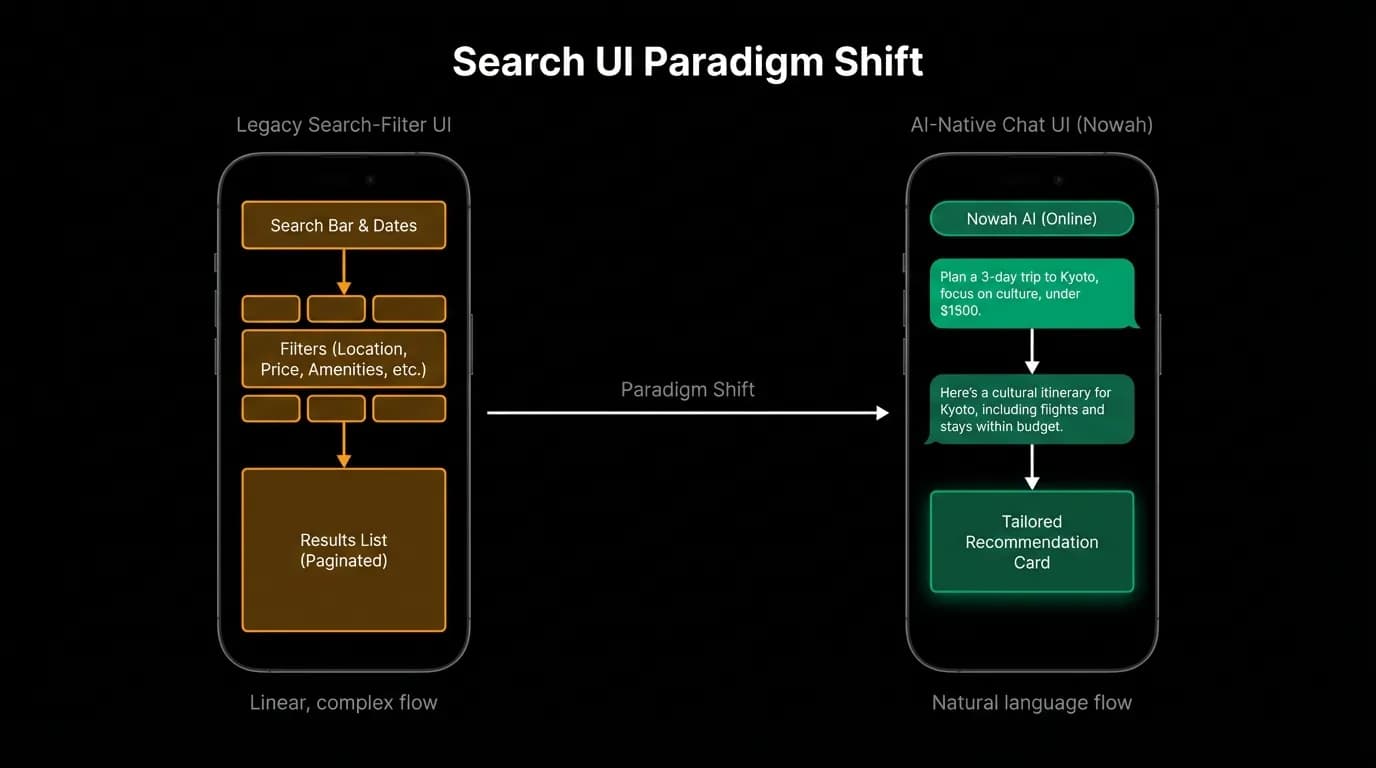
The defining characteristic of an AI-native travel platform is that the conversation is the product. There is no search form to fill out. There is no results page to scroll through. You describe what you want, the AI agent processes it, and you receive curated options you can book without leaving the conversation.
This is not a UI preference. It is an architectural distinction that determines the ceiling of what the product can do. When the agent is the primary interface, every feature — search, ranking, booking, payment, trip management, disruption handling — flows through the conversation. When the agent is a sidebar next to a search form, it can only do what the search form's database supports.
AI-native platforms typically score highest on AI depth, personalization, speed, and trust. They score competitively on inventory (modern APIs provide access to the same carriers and properties) and mobile UX (conversational interfaces are inherently mobile-friendly). Where they lag is in raw inventory breadth for niche accommodation types — though this gap is closing as API ecosystems mature.
The speed difference is the most immediately noticeable. An eight-step OTA booking flow compresses to three steps: conversation, curated options, confirm. Average booking time drops from 20 to 45 minutes to 2 to 5 minutes. This is not an incremental improvement. It is a category change.
The feature matrix
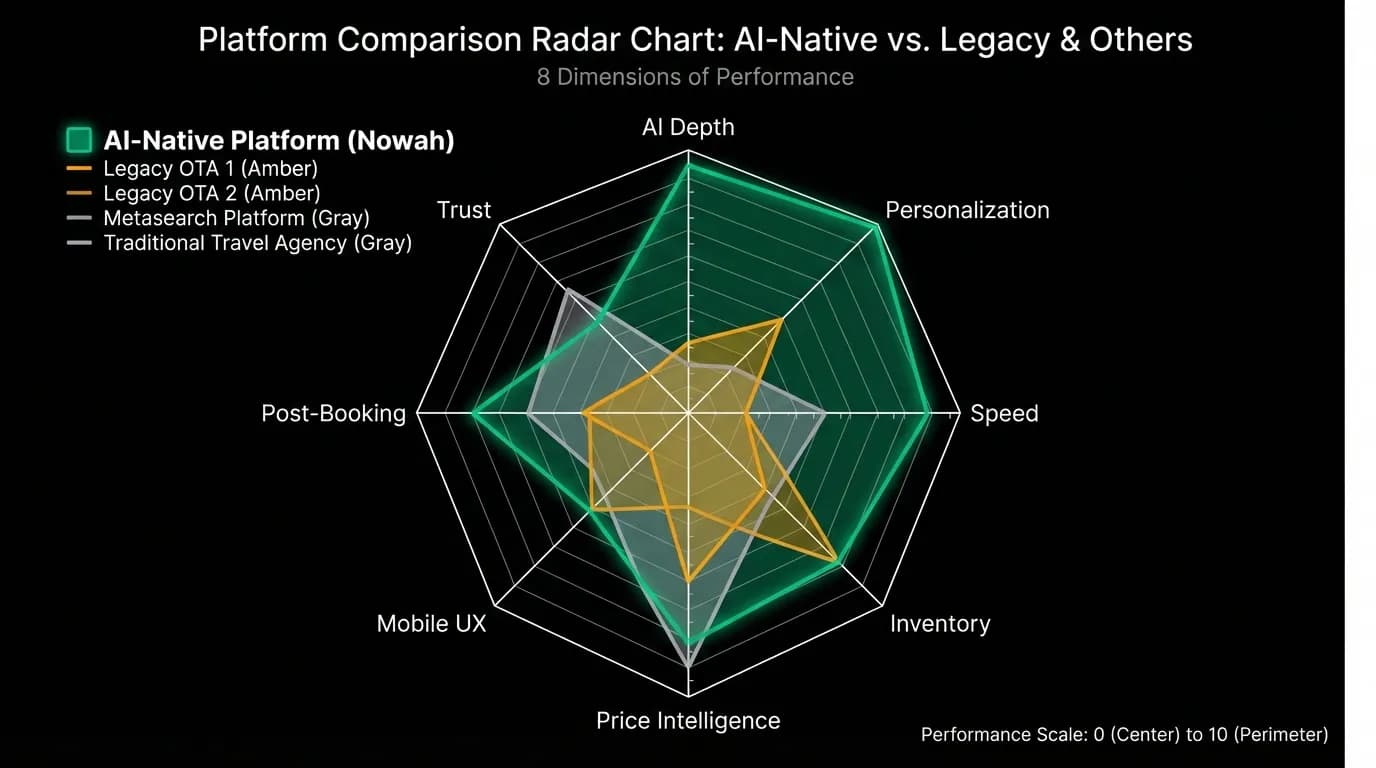
Across all eight evaluation dimensions, a clear pattern emerges. Legacy OTAs lead on inventory breadth because they have had two decades to build supplier relationships. Data-focused platforms lead on price intelligence for the same reason — years of data accumulation. AI-native platforms lead on everything related to the actual experience of booking and managing a trip.
The scoring gap is widest on AI depth. The difference between a chatbot that answers destination questions and a full agent that searches across hundreds of carriers, ranks by your personal preferences, executes bookings, processes payments, and remembers everything about your travel history is not a matter of degree. It is a different product category.
The trust dimension deserves particular attention. Platforms funded by advertising revenue have a structural incentive to recommend what pays them, not what serves you. AI-native platforms that charge through transaction fees or subscriptions align their incentive with your satisfaction. You cannot fake this alignment. It shows up in every recommendation the platform makes.
How to pick the right booking app for your travel style
The honest answer is that different travelers need different tools at this stage of the industry's evolution.
If you fly one airline exclusively and your only goal is maximizing loyalty points, the airline's own app serves that narrow use case well, though it cannot help you when another carrier has a better option.
If your primary concern is seeing every available option on the market regardless of AI capability, the large OTAs still aggregate the broadest inventory.
If you want someone to handle the work — find the right flights, match hotels to your actual needs, manage the booking end to end, and improve with every trip — the choice is an AI-native platform. The technology has reached the point where the agent experience is not just faster but fundamentally better than the search-and-scroll alternative.
The trajectory is clear. Every platform is moving toward AI, but the ones that started there have a structural lead that bolted-on features cannot close. Architecture matters. In 2026, it matters more than any other dimension on the scorecard.
Nowah is an AI travel agent that searches and books real flights and hotels through conversation — no filters, no thirty open tabs. Plan your next trip.