How Your Booking History Makes Your Next Trip Better
Every booking teaches the AI something new about how you travel. See how recommendations evolve from your first trip to your tenth.

Your first Nowah search is good. Your tenth is uncanny. That gap is not magic. It is data. Every trip you book teaches the AI something about how you travel, and those lessons compound in ways that make each subsequent search faster, more accurate, and more personal.
I want to show you exactly how that works by walking through the journey from trip one to trip ten.
What each booking teaches
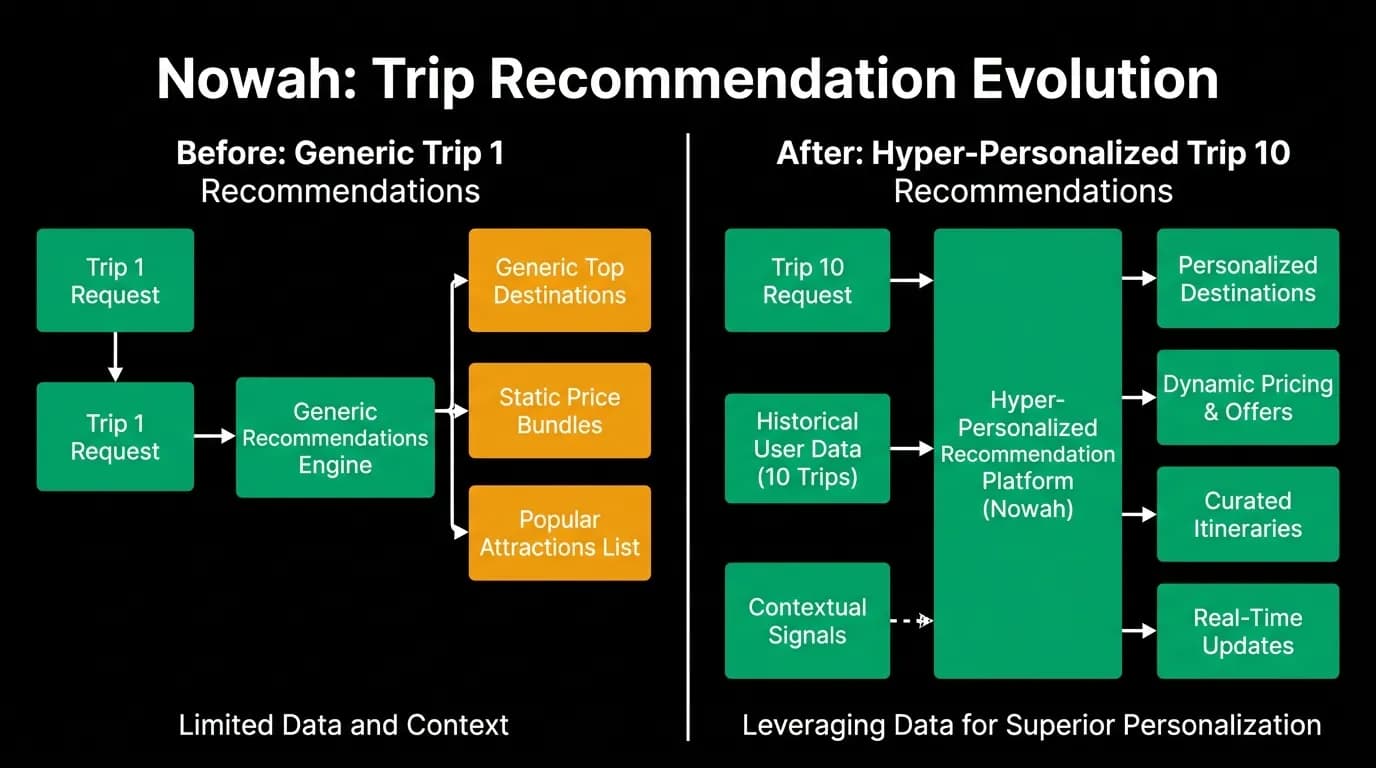
When you book a flight, the AI does not just file it away as a transaction. It extracts preference signals from the choice you made.
You picked an aisle seat? That is a seat preference data point. You chose the mid-priced option over the cheapest? That tells the AI your comfort threshold relative to savings. You booked premium economy on a seven-hour flight but standard economy on a three-hour domestic hop? Now the AI knows your cabin class preferences are duration-dependent. You picked a boutique hotel over a chain despite a higher price? That is a lodging style signal.
These signals come from what you chose and what you did not choose. If you consistently scroll past red-eye flights, the AI learns that even without you saying "no red-eyes." If you always book hotels with free cancellation even when non-refundable rates are cheaper, the AI learns your risk tolerance.
Trip 1 through trip 10: a hypothetical journey
Trip 1. You share a few preferences during onboarding: aisle seats, morning flights, budget around $1,200 for international. The AI uses these explicit signals plus population-level defaults. Recommendations are solid but generic.
Trip 2. You book a flight to Barcelona. You pick premium economy, a boutique hotel in the Gothic Quarter, and you mention in conversation that you love walkable neighborhoods. The AI stores all of this.
Trip 3. You search for flights to Tokyo. The AI already knows you prefer aisle seats, morning arrivals, premium economy on long-haul, and walkable hotel locations. It prioritizes these automatically. You do not have to re-state any of it.
Trip 5. A pattern emerges. You tend to travel in shoulder season (September-October, April-May). You pick hotels rated above 8.5. You favor airlines in a specific alliance. The AI shifts its scoring weights to match.
Trip 8. You mention that your last hotel was too noisy. That negative signal gets stored with high weight. Future hotel recommendations deprioritize properties where noise is a common complaint in reviews.
Trip 10. You say "plan a long weekend in October." That is it. Seven words. The AI knows your departure city, your budget range, your preferred season, your flight and hotel preferences, your activity style, and your aversion to noise and crowded tourist areas. It comes back with three complete trip proposals without asking a single clarifying question.
Explicit vs. implicit preference learning
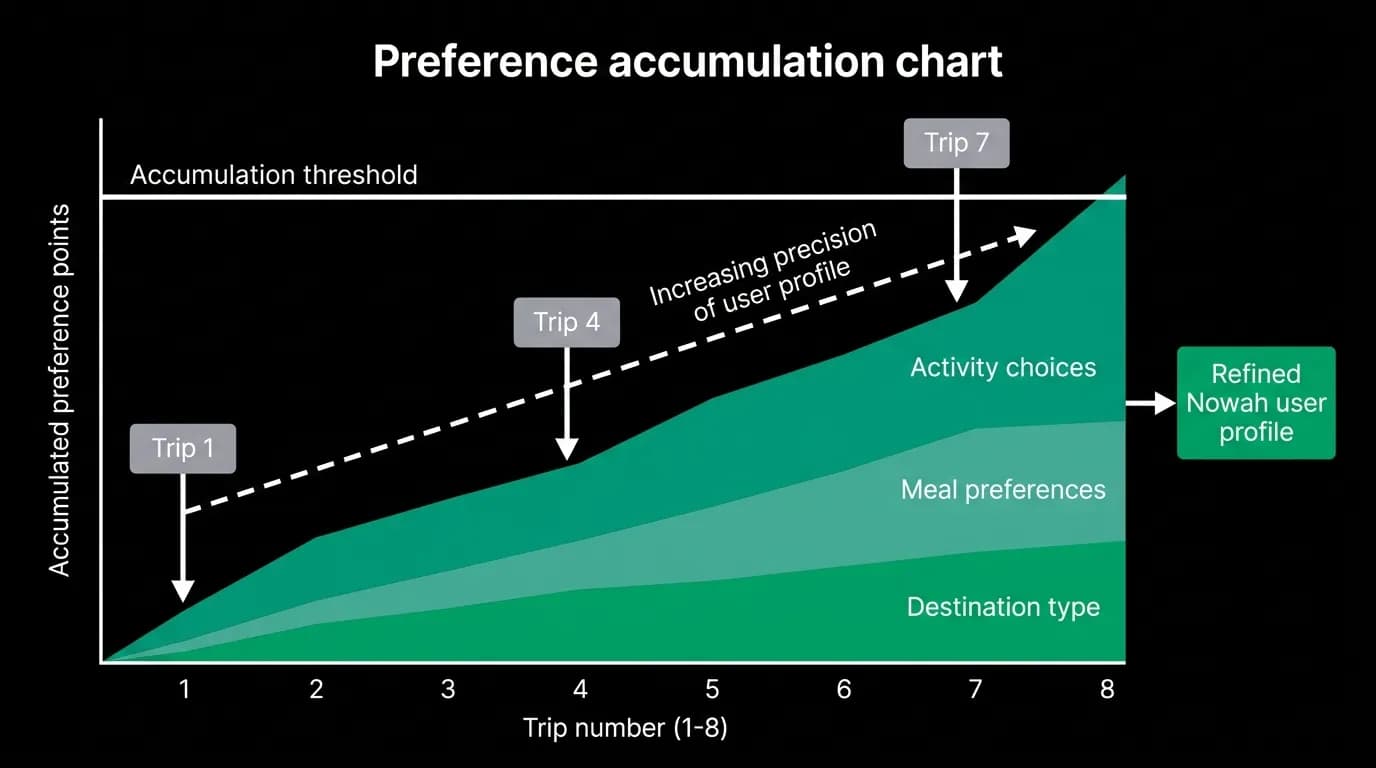
Not all preference data comes from what you say. A lot of it comes from what you do.
Explicit preferences are stated: "I prefer window seats." Implicit preferences are inferred from patterns: you have never booked a window seat in six trips, so the AI infers you do not prefer them even if you never said so explicitly.
Both types feed the same personalization engine, but they carry different confidence weights. An explicit statement is strong and immediate. An implicit pattern needs several data points before the AI acts on it. This prevents the system from over-fitting to a single booking that might have been an exception.
The compound personalization effect
Personalized recommendations drive 2-3x higher booking completion rates compared to generic results. That multiplier grows with the depth of the personalization.
Early on, the AI can personalize the basics: seat type, cabin class, price range. By trip five, it can personalize the nuances: airline preferences, layover tolerance, hotel style, location priorities. By trip ten, it can predict what you want before you finish asking.
The diminishing questions effect is one of my favorite metrics. On trip one, the AI might ask 4-5 clarifying questions. By trip five, it asks 1-2. By trip ten, it often asks none. Your preference profile has grown rich enough that the conversation can go straight from request to recommendation.
Surveys often show strong interest among younger travelers in AI trip planning, and I think the compound effect is a big part of why. The more you use it, the better it gets. That is not true of traditional search, where your fiftieth search is identical to your first.
When the AI knows enough
There is a threshold where the AI has enough data to plan a trip with minimal input. It varies by person. Some travelers have very consistent preferences and reach the threshold after 3-4 trips. Others have diverse travel styles and take longer.
The memory system stores profiles, satisfaction signals, patterns, and negative preferences. All of these compound. The AI does not just remember what you like. It remembers what you disliked, what surprised you, and what you changed your mind about.
Book your next trip on Nowah and watch the AI learn from it. Each booking makes the next one better.
Nowah is an AI travel agent that searches and books real flights and hotels through conversation — no filters, no thirty open tabs. Plan your next trip.