The Booking Window Sweet Spot: Route by Route
The \\\"book 6-8 weeks ahead\\\" rule is an oversimplification. Detailed analysis of 25 major routes shows how sweet spots vary by route, season, and fare class.

"Book six to eight weeks in advance." It is the most widely repeated piece of flight booking advice, and it is right for some routes and dead wrong for others. The six-to-eight-week rule is an average, and averages mask enormous variation. On some domestic routes, the sweet spot is three weeks. On some international routes, it is five months. Using a single rule for all routes leaves money on the table.
We analyzed optimal booking windows across 25 major routes to show how much the sweet spot varies and what drives the differences.
How optimal booking windows are calculated
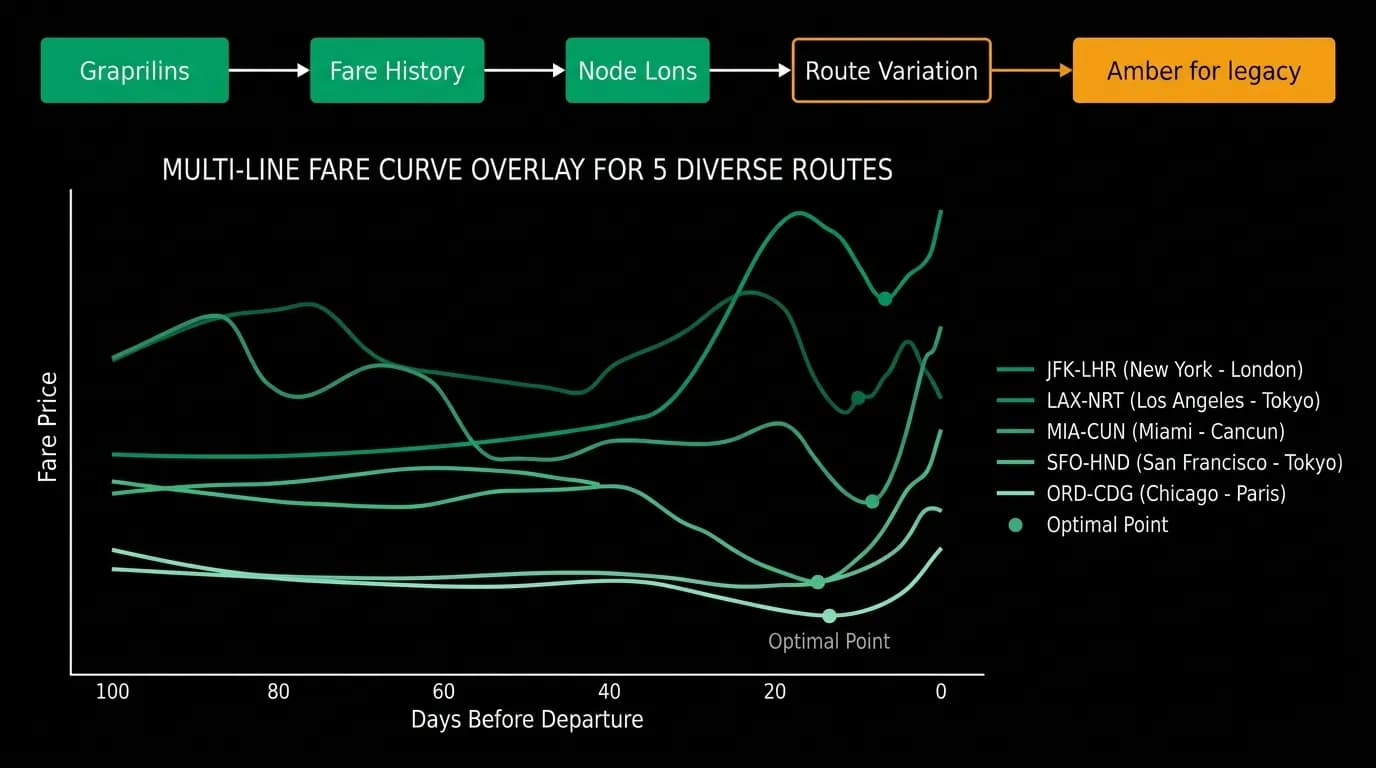
An optimal booking window is the advance purchase timeframe where fares are statistically lowest for a given route. It is calculated by examining fare data over an extended period — typically 12 to 18 months — and identifying the booking lead time that most frequently coincides with the lowest available fares.
The window is not a single day but a range. For most routes, there is a period of two to four weeks where fares cluster near their minimum. Before that window, fares are moderate because the airline has not yet started aggressively managing fare classes for the departure date. After that window, fares climb as departure approaches and the airline closes cheaper fare buckets.
Importantly, the optimal window shifts with season, fare class, and demand conditions. The same route might have a three-week sweet spot for summer travel and a six-week sweet spot for winter travel because seasonal demand patterns change how aggressively airlines manage inventory.
Domestic routes: 10 routes and their sweet spots
Domestic routes in competitive markets generally have shorter booking windows because the airline pricing cycle is faster on shorter routes with higher frequency.
High-competition transcontinental routes (think major coastal city pairs) show optimal windows of three to five weeks. These routes have so many carriers and so many daily flights that fare competition keeps prices volatile but ultimately drives them down as departure approaches — until the final two weeks, when last-minute pricing kicks in.
Regional routes between mid-size cities tend to have slightly longer windows, four to six weeks, because competition is thinner and airlines manage inventory more carefully. Routes with only one or two carriers often have the longest domestic windows — up to eight weeks — because without competition, the airline has less incentive to drop fares as departure approaches.
Hub-to-hub routes are an exception. Even though they are domestic, their role as connecting-traffic feeders means the pricing dynamics resemble international routes in complexity. Sweet spots for these routes are often in the four-to-six-week range.
Transatlantic routes: 8 routes with wide variance
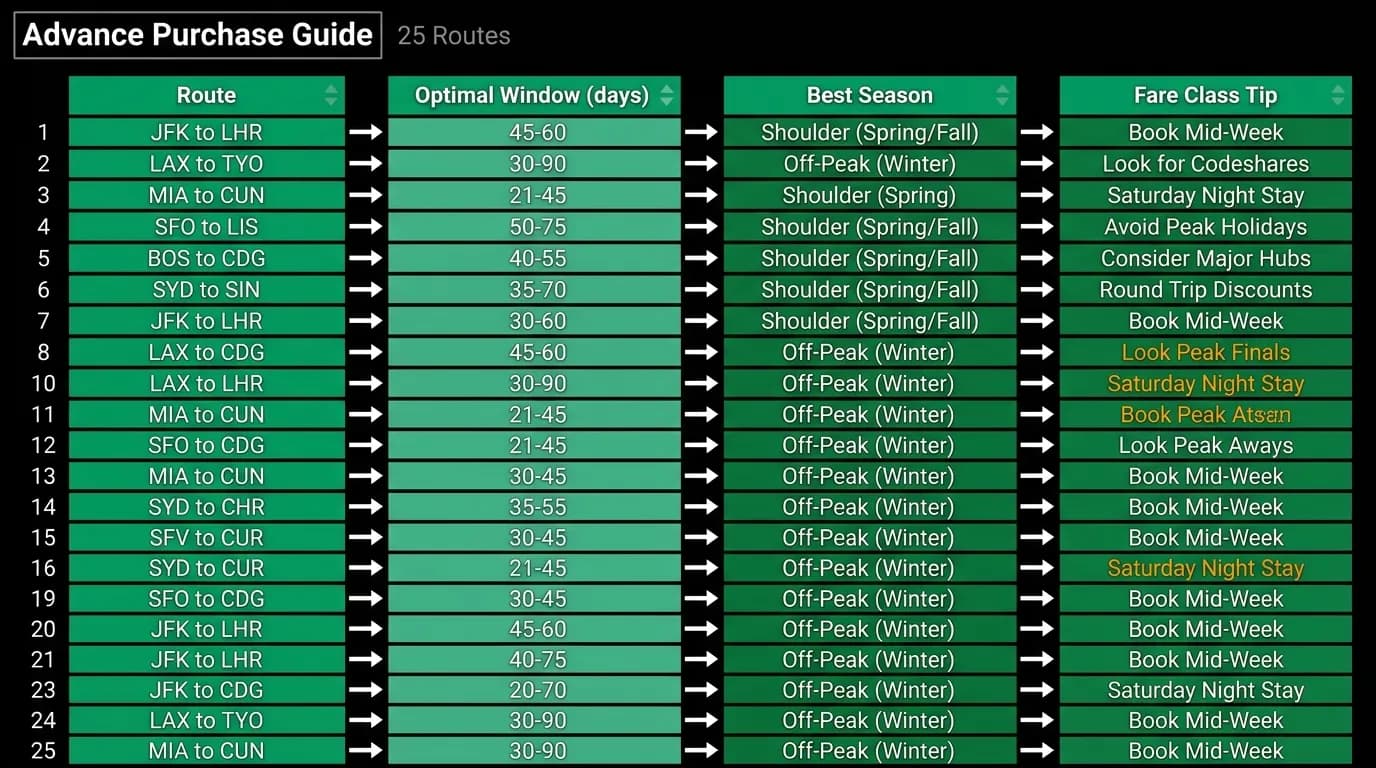
Transatlantic routes show the most dramatic variation in optimal booking windows. Major US-to-London routes, which are among the most competitive international routes in the world, have relatively short sweet spots of six to ten weeks. Competition from multiple carriers keeps the pricing cycle compressed.
US-to-continental-Europe routes vary more widely. Routes to popular destinations like Paris and Rome have windows of two to four months, while routes to secondary European cities might have sweet spots of three to five months because demand is less predictable and airlines set their pricing strategies earlier.
Seasonal variation is strongest on transatlantic routes. Summer travel (June through August) sees the shortest optimal windows because demand is high and airlines have less incentive to discount. Winter travel (excluding holidays) sees longer windows because softer demand means cheap fare classes stay open longer.
Asia-Pacific and long-haul routes
Transpacific and other long-haul routes tend to have the longest optimal booking windows, often three to six months in advance. The longer booking windows reflect the longer lead time travelers need to plan international trips, the higher absolute prices (which make travelers more deliberate), and the more complex fare class structures that airlines use on premium long-haul routes.
Routes to popular destinations in Japan, Thailand, and Australia show sweet spots in the three-to-four-month range for economy and four-to-six-month range for premium classes. Less competitive routes — particularly those with limited direct service — can have optimal windows extending to six months or more.
Business class booking windows are consistently longer than economy across all route types. Airlines release premium cabin inventory strategically, and the best business class fares often appear further in advance than economy. Travelers who wait to book business class often find the cheapest fare classes already closed.
The seasonal and fare class overlay
The same route can have different sweet spots in different seasons. The shift is typically two to four weeks between peak season (shorter window, higher baseline prices) and off-peak (longer window, lower baseline). This makes generic advice like "book two months ahead" particularly unhelpful, because the optimal lead time changes with when you are traveling, not just where.
Airlines manage 12 to 26 fare classes per route, and each fare class has its own inventory release timing. The cheapest fare classes open first and close as demand builds. The most expensive ones stay open until departure. This fare class cascade is what creates the sweet spot — the window where the cheapest classes are available but have not yet been sold through.
Check your specific route's optimal booking window on Nowah. The AI knows the sweet spot for your route, your season, and your fare class, so you are not relying on a one-size-fits-all rule that might not fit your trip at all.
Nowah is an AI travel agent that searches and books real flights and hotels through conversation — no filters, no thirty open tabs. Plan your next trip.