What Conversion Data Tells Us About Travel Decisions
What makes travelers book vs. abandon? Price confidence, recommendation quality, and transparency are the signals that drive decisions.
Industry research often finds that unexpected price changes are a top reason travelers abandon bookings. That number should bother every company in the travel industry, and it should especially bother the ones who have been staring at stubbornly low conversion rates for a decade without solving the underlying problem.
The underlying problem is not UI design or checkout friction, though those matter. It is that travelers lack confidence in their decision. They are not sure the price is good. They are not sure the option is right. They are not sure they have looked hard enough. So they do what any rational person does when uncertain: they stall, compare more, and eventually abandon.
Here is what the data tells us about what actually drives travel decisions from browsing to booking.
The decision funnel
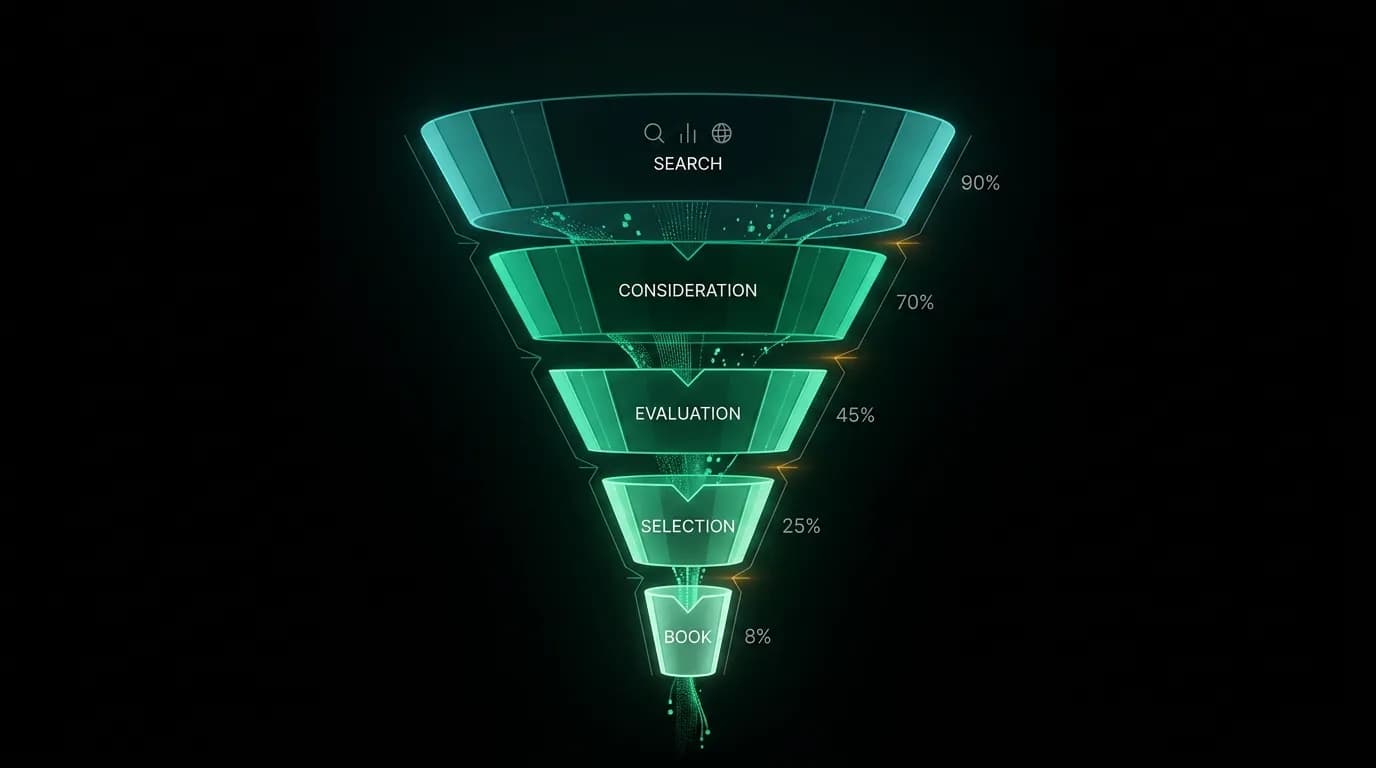
The traditional travel purchase funnel looks roughly like this: awareness (I want to go somewhere), research (where and when), search (find flights and hotels), comparison (evaluate options), and booking (commit and pay).
The dropout rates at each stage tell a story. Most people make it from awareness to research easily. Research to search has moderate friction. But search to comparison is where the funnel bleeds. People run the same search across multiple sites, open dozens of tabs, and enter a comparison loop that can last weeks. The 38-site, 45-session average is the data's way of saying this stage is broken.
From comparison to booking, the funnel bleeds again. After all that research, many travelers still do not book. Price uncertainty, option fatigue, and the nagging "what if there is something better" feeling create abandonment rates that would be unacceptable in any other e-commerce category.
Price confidence is the number one driver
Travelers book faster when they believe the price is at or near its floor. That belief does not come from the price itself. It comes from context.
When the AI tells you "this fare is below the recent average and historically, prices on this route start climbing from here," it gives you a reason to act. You are not guessing. You have data-backed confidence that waiting is unlikely to save you money and might cost you more.
Transparent price explanations measurably increase conversion. The mechanism is simple: uncertainty creates inaction, and context resolves uncertainty. The less a traveler has to wonder whether they are making a mistake, the more likely they are to book.
Recommendation quality matters more than option quantity
Conversion spikes when the top recommendation closely matches stated preferences. This is the data-backed case for curation over aggregation.
When you search on a traditional OTA and get 200 results sorted by price, the "best" option for you might be on page three. You might never find it. Even if you do, you have no confidence that it is actually the best because you cannot evaluate all 200.
When the AI presents three picks that each match your stated preferences, with explanations of why each was chosen, the decision burden drops dramatically. Industry UX research consistently finds that small, well-explained choice sets convert better than long uncurated result lists. That is not a marginal improvement. That is a structural shift.
Decision fatigue is real and measurable
Many travelers report that booking is the most stressful part of trip planning. Stress comes from cognitive load, and cognitive load comes from too many decisions with too little guidance.
Every additional option you evaluate costs mental energy. By the time you have looked at your twentieth flight option, your ability to distinguish between them has degraded. You start making worse decisions or no decision at all. This is well-documented in behavioral economics, and it plays out clearly in travel conversion data.
The solution is not to hide options. It is to do the evaluation work so the traveler does not have to. When the AI has already scored 180 candidates and selected the best three for you, the cognitive load drops from "evaluate everything" to "choose among three well-explained options."
Transparency as a conversion tool
I want to make a claim that might sound counterintuitive: showing travelers why a recommendation was made increases booking rates more than showing them a lower price.
The mechanism is trust. When you explain the reasoning behind a recommendation, you give the traveler a basis for confidence. "This is the cheapest non-stop on your preferred alliance with a morning arrival that matches your history" is a more compelling pitch than a bare price tag, even if the price tag is lower elsewhere.
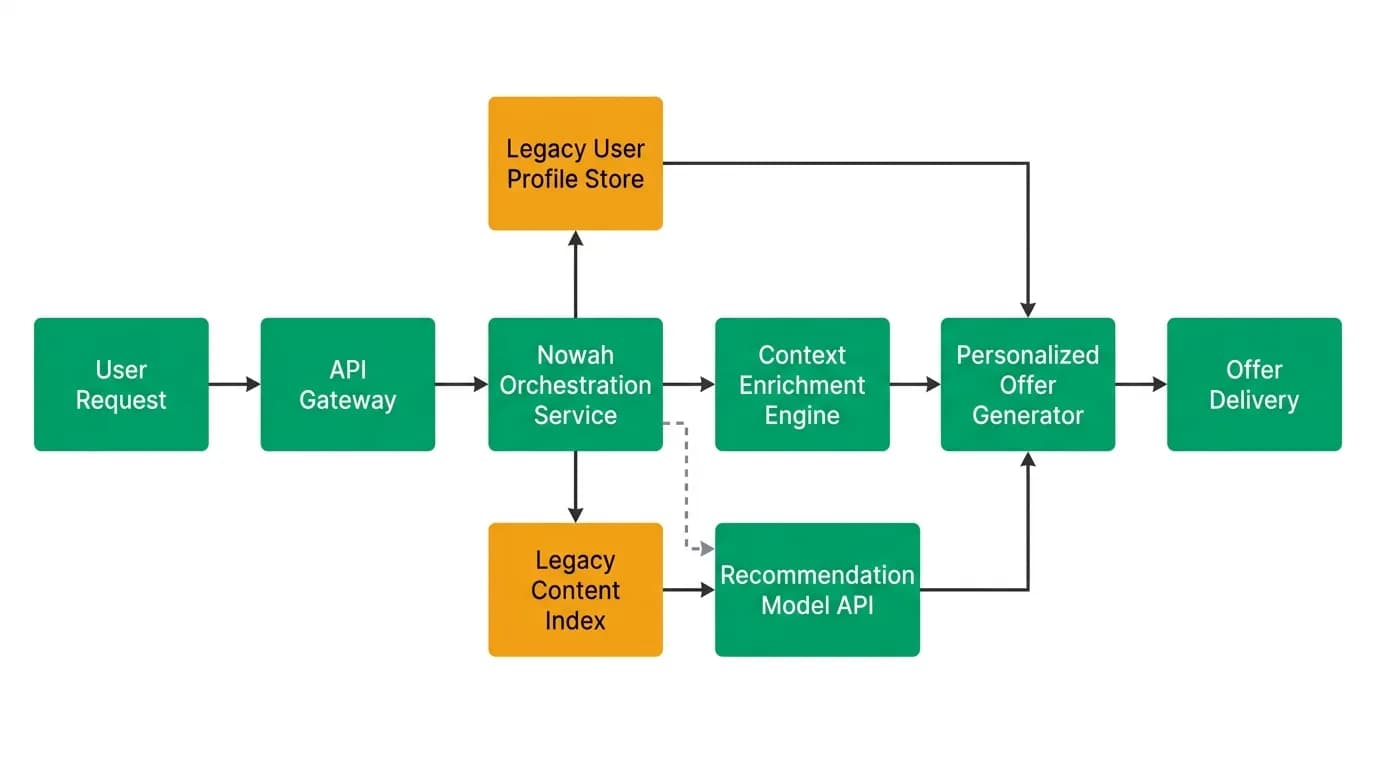
This is why every Nowah recommendation ships with an explanation. Explanations are not a feature. They are the conversion engine.
Friction reduction: the last mile
Saved traveler details, remembered payment methods, and pre-filled forms reduce drop-off at the final booking step. This sounds obvious, but the gap between obvious and implemented is wide. Many OTAs still ask you to re-enter passport details for every booking. The AI agent remembers everything you have shared and pre-fills what it can, reducing the checkout to a confirmation rather than a data entry exercise.
The average journey from first search to booking takes 30-45 days for international flights using traditional methods. AI-native booking compresses that timeline dramatically because the decision bottleneck is removed. When you trust the recommendation, the time between "this looks good" and "book it" shrinks from days to seconds.
Nowah is an AI travel agent that searches and books real flights and hotels through conversation — no filters, no thirty open tabs. Plan your next trip.