Nowah Commission Example: $60 in Net Revenue Produces a $21 Partner Share
Follow Nowah's illustrative $60 net-revenue example to calculate a $21 partner share while keeping booking spend and payout eligibility separate.
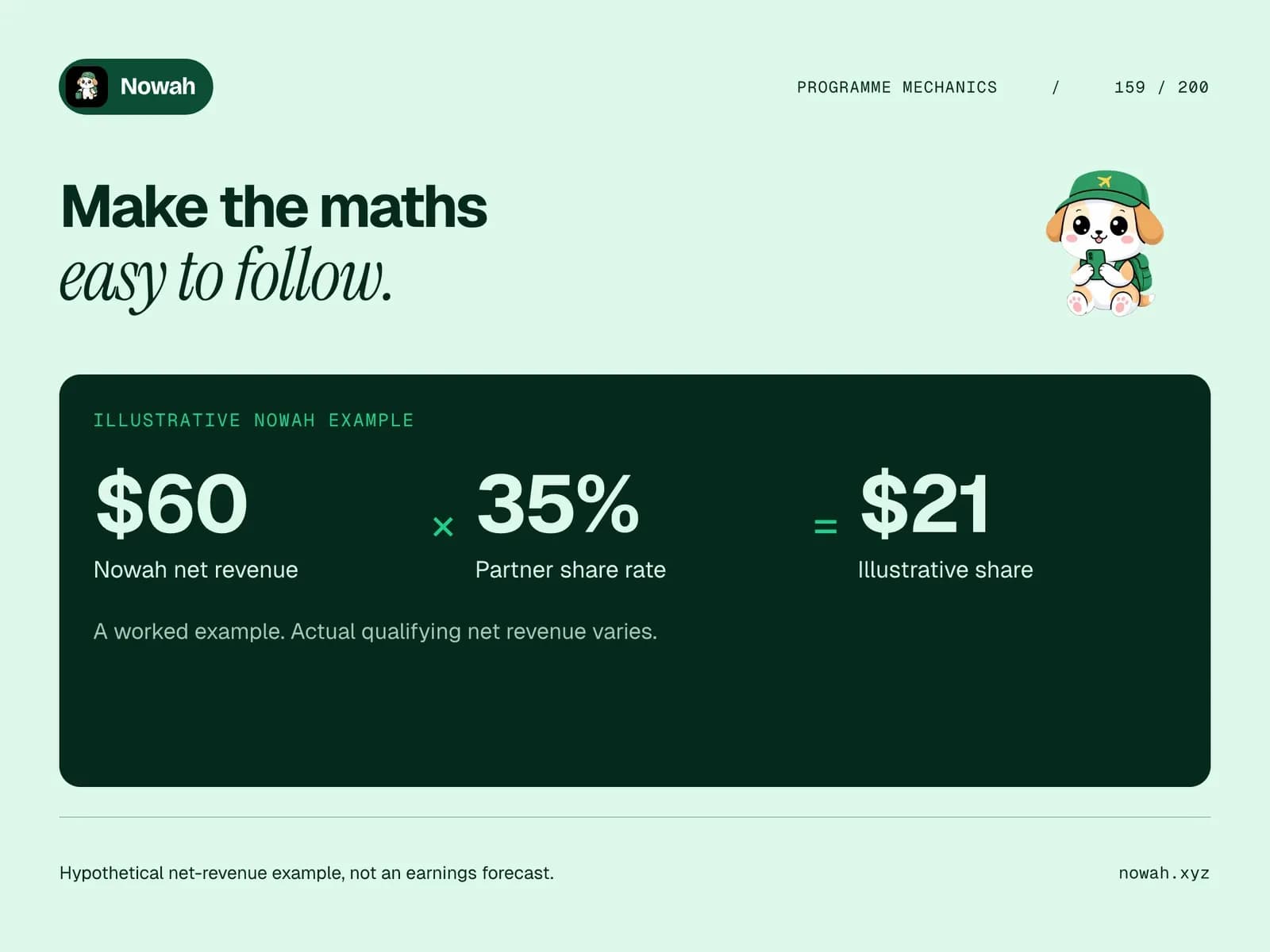
The clearest way to understand Nowah's partner calculation is to keep the input and rate together. If a qualifying booking produces $60 in Nowah net revenue, a 35% share gives an illustrative partner amount of $21.
The Nowah program overview uses that example to explain the model. It does not say that every booking produces $60 in net revenue, that every referral earns $21 or that a creator receives immediate cash after a link click.
This guide walks through the arithmetic and the checks around it. All monetary examples here are illustrative assumptions, not real creator results or predictions.
Identify the correct input
The $60 input is Nowah net revenue from a qualifying booking. It is not the traveller's full booking price.
The program terms define the base using revenue actually received by Nowah for the booking, less the permitted direct deductions. A booking total alone does not establish that number.
Before calculating, ask what the figure represents. Is it the traveller's spend, Nowah booking revenue before deductions or the defined net-revenue amount? Those are different inputs.
For a real earning question, use the actual records for what they document. Do not infer a company margin from the appearance of a hotel or the price of a flight.
The net-revenue definition guide explains the revenue and deduction distinction in more detail.
Convert the percentage into a multiplier
Thirty-five percent means 35 out of 100, or 0.35. For the public illustration, the calculation is:
Illustrative Nowah net revenue: $60
Partner share: $60 × 0.35 = $21
The multiplication answers one narrow question: what is 35% of the stated net-revenue input? It does not prove that a real booking qualifies, that attribution exists or that the amount is ready for payout.
Keep the currency with the figure. The terms calculate amounts in the settlement currency and round once to the nearest minor unit. Do not mix amounts from different currencies to make an apparent total.
For the simple $60 illustration, the result is already a whole-dollar amount, so the arithmetic does not require a fractional-cent adjustment.
State the qualifying assumptions
The example assumes the relevant program conditions can be satisfied. An eligible traveller follows an active partner link and creates a new account within 30 days of introduction, with successful tracking.
Existing accounts and self-referrals do not qualify. The first valid recorded introduction determines account attribution.
Once valid attribution exists, later qualifying bookings may generate earnings for the account's lifetime. That rule does not guarantee that the traveller will make another booking.
The eligible categories include hotels, flights and paid eSIMs under the terms. A restaurant bill, event ticket or unsupported purchase should not be placed into the calculation merely because it appeared in the creator's travel content.
These assumptions should remain clear when you reuse the example in a video or graphic. A correct multiplication does not replace eligibility checks.
Keep booking spend outside the formula
Suppose you know only that a traveller paid $60 for something. You cannot conclude that the Nowah partner share is $21, because you have not established that the $60 is qualifying Nowah net revenue.
Likewise, a much larger holiday bill does not allow you to apply 35% to the total and label the result a commission.
The mistake is not in multiplication; it is in choosing the wrong base. A calculator can produce a precise number from an input that does not belong in the formula.
For creator content, name the base beside the rate and amount. “Illustrative net revenue” and “illustrative partner share” are more accurate labels than an unexplained screenshot claiming what a booking will earn.
The commission-base visibility guide develops this communication task for promotional content.
Use a calculation worksheet
Create an ordinary worksheet with these fields:
- The purpose of the example: hypothetical teaching or an actual record query.
- The currency.
- The net-revenue input and what establishes it.
- The 35% rate.
- The multiplication and rounding step.
- The qualifying-account and booking checks.
- The earning stage being described.
- The remaining hold, threshold or verification conditions.
This is a creator-maintained review tool, not a claim that Nowah provides a particular calculation screen.
Fill the source field before the formula. If the input is assumed for teaching, label it. If it comes from a real record, do not claim more than that record establishes.
The stage field is important because a calculated share and an eligible transfer answer different questions.
A fictional creator teaching example
Imagine a creator explaining the program in a blog article about monetising useful travel recommendations. This is a hypothetical editorial scenario, not a real campaign result.
The article describes a fictional Nowah planning demonstration that helps a traveller investigate a hotel-area question. The creator then introduces the public $60 net-revenue assumption to explain the commission base.
The worksheet shows the $21 result and lists the qualifying conditions separately. The creator does not say that the fictional demonstration produced a booking or that a reader can expect $21 from every introduction.
The graphic retains the words “illustrative” and “Nowah net revenue.” The partner relationship is disclosed with the recommendation.
The useful outcome is an understandable calculation. It does not require a fabricated testimonial, earnings notification or forecast of future volume.
Understand how a correction changes arithmetic
A hypothetical correction can illustrate why a previously calculated amount may change. Assume, solely for teaching, that the relevant net-revenue base is later corrected from $60 to $50.
At 35%, the revised illustrative share would be $17.50 rather than $21. The difference is $3.50. These are assumed figures demonstrating the formula, not a statement about any real refund or booking.
Nowah's terms allow documented corrections for refunds, disputes and supplier revisions, including effects on earnings related to earlier payouts. The actual program records and terms govern a real case.
Do not treat the example as permission to guess the amount of a real adjustment. Identify the statement entry and ask the precise question through the official support route when needed.
The refund-corrections guide explains that separate process.
Separate the $21 share from a payout
Even if an actual qualifying calculation established $21, payout eligibility would still need its own checks.
Earnings require completion and verified supplier settlement. The 30-day hold starts after whichever of those events occurs later.
Monthly processing also depends on the separate per-currency threshold and the other conditions, including relevant verification and available settlement funds. A hypothetical $21 USDamount by itself would not meet a US $50 minimum if it were the only eligible balance being considered.
Do not combine another currency's balance with it to reach a threshold. The terms assess settlement currencies separately.
A transfer to the connected Stripe account is also distinct from the bank payout and its arrival timing. The arithmetic does not establish that money has reached a bank account.
Review examples before publishing them
Check the text, graphic and spoken explanation together. Does every percentage have its base? Are assumed inputs labelled? Does a screenshot imply a real creator result where the article describes only arithmetic?
Remove any promise that viewers will earn the illustrated amount. No particular booking volume or income is guaranteed.
Nowah's article about what “best” means in travel comparisons offers background for examining apparently simple numbers. A clear calculation should not become an unsupported claim that one offer always pays more.
If you compare programs, verify each base and condition separately. Do not place different assumed inputs side by side and treat the resulting figures as a reliable payout ranking.
Check the result in two ways
For the assumed $60 input, you can check the $21 result by splitting the rate into simpler parts. Thirty percent of $60 is $18, and five percent is $3. Together they make $21. This is an arithmetic cross-check, not a second earning event.
You can also divide the illustrative $21 share by the assumed $60 base. The result is 0.35, confirming the stated rate. That check is meaningful because both figures belong to the same assumed calculation and currency.
Do not use the reverse calculation to invent a missing real-world base from an unrelated balance or transfer. A payout can involve eligibility, timing, corrections and other entries. Use actual records for their documented purpose rather than assuming that every visible amount represents one booking's share.
These checks make the teaching example easier to understand while preserving its limits: it explains the rate, not a forecast or proof of payment.
Connect the calculation to useful recommendations
The program's commercial value comes from relevant introductions, not from repeatedly displaying a percentage. A hotel-area explanation, arrival worksheet or trip-structure demonstration gives the recommendation a practical task.
Verify product behaviour, keep supplier questions visible and explain that you are a Nowah partner who may earn commission from qualifying referrals.
Prospective creators can apply through the official partner portal. Traveller recommendations need the active route supplied after approval and onboarding.
Understand the $60-to-$21 example as a formula with a clearly named input. Then build content that helps someone investigate a real travel decision, while keeping attribution and payout conditions separate from the arithmetic.




