Build a Travel-Creator Learning Path Around Nowah Partners
Connect travel-creator articles into a useful Nowah learning path, from audience questions and workflows to program mechanics and application.
A creator reading about travel monetisation may not be ready to apply after the first paragraph. They may first need to understand whether their audience fits, what useful content to produce and how the earning conditions work.
A thoughtful article path helps them answer those questions in order. Nowah has a clear offer to explain: approved partners can earn 35% of Nowah net revenue from qualifying bookings by eligible newly attributed accounts. The program overview introduces that opportunity, while practical guides can show how a relevant recommendation might work.
The purpose of the learning path is clarity. It is not a promise that adding internal links will produce rankings, applications or settled earnings. Each article should help the reader make a distinct decision and identify a sensible next question.
Begin with the reader's starting point
List the questions a creator may bring to your site. Someone exploring family travel content may first ask whether their everyday planning explanations fit a partner program. A publisher already making videos may need help with a specific linking or disclosure task.
These starting points call for different pages. Do not assume that every visitor needs the same general introduction before they can use a practical guide.
Describe the reader's current task without inventing demographic or income data. “A creator who explains family rooming questions” is a useful editorial audience. It does not require an unsupported claim about that audience's buying power.
A starting page should answer its own question properly. Internal links are a way to continue the learning, not a substitute for providing the answer promised by the page title.
The audience-fit worksheet can help define that first task before you plan the rest of the sequence.
Separate four learning jobs
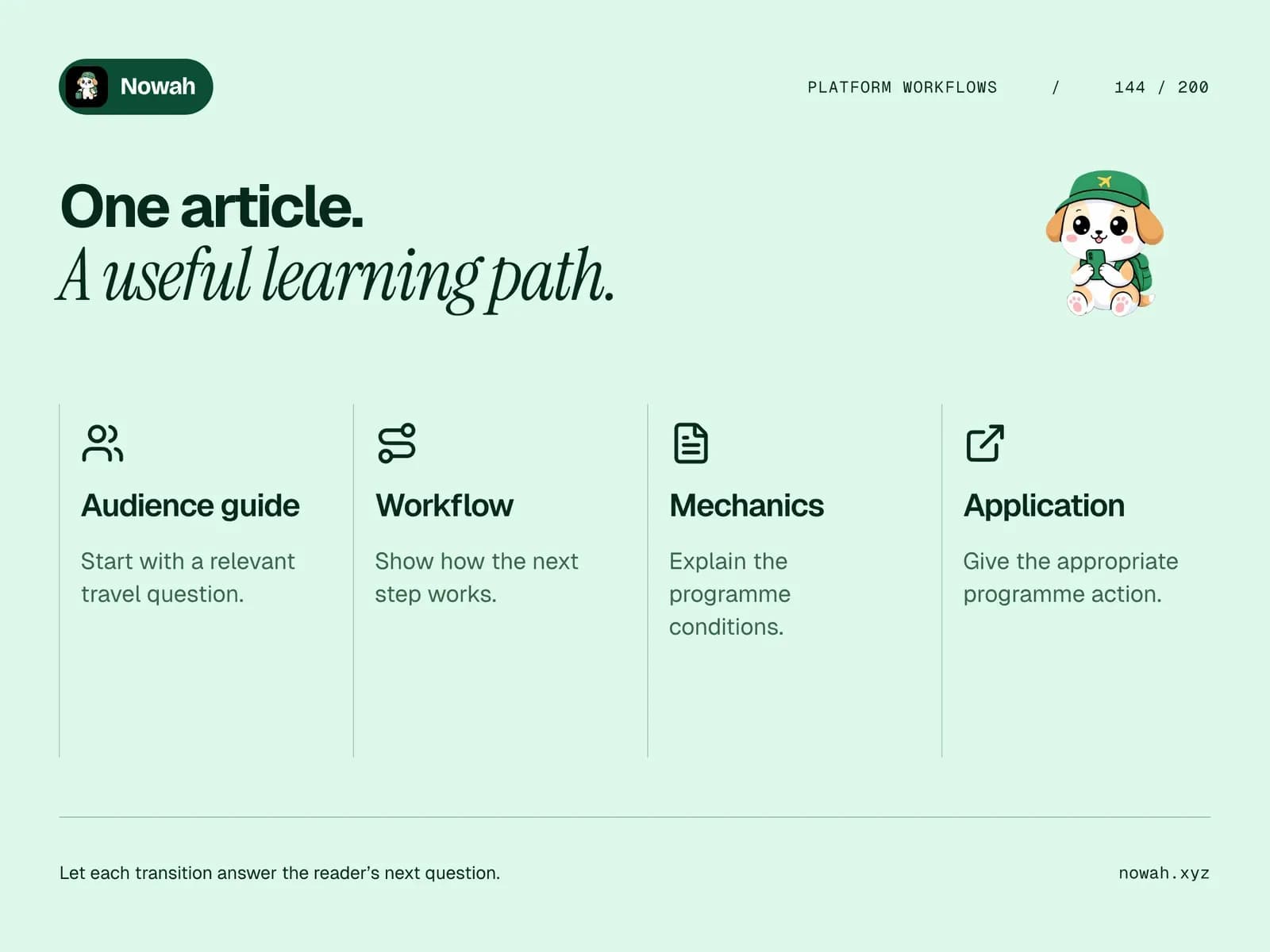
A useful path can distinguish four jobs: understanding audience fit, learning a content workflow, examining program mechanics and deciding whether to apply.
An audience guide explains the creator's relevant travel questions. A workflow guide shows how to produce a useful recommendation. A mechanics guide explains the earning or attribution conditions. The application destination lets an interested creator take the appropriate program step.
These jobs can connect without becoming four near-identical articles. Give each page a specific useful output: a brief worksheet, a production plan, a calculation explanation or an application preparation note.
Do not force a reader through every page if they already know what they need. A well-labelled contextual link lets them choose the relevant next task.
Nowah can be integrated throughout the path by showing why its planning workflow and offer fit the question at each stage, rather than repeating one generic promotional conclusion.
Map the next question for each article
Create a content-path worksheet. For every page, record the question it answers, the practical output it provides and the most likely unresolved question after reading.
Then identify the page or official destination that answers that next question. Write a sentence explaining the connection. If you cannot explain why the destination helps, the link may be decorative rather than useful.
For example, a guide to family rooming content may leave the reader asking how to demonstrate a brief without exposing private details. A workflow article can answer that. The reader may then want to understand which new traveller accounts qualify, leading to a focused mechanics explanation.
Do not use the worksheet to manufacture extra pages for synonymous questions. If two pages answer the same task with the same example, consider whether one stronger article would serve the reader better.
This is an editorial method, not a claim that Nowah automatically builds your content architecture or measures the complete journey.
A fictional family-creator path
Imagine a blogger building resources for creators who explain practical family travel decisions. This is a hypothetical publishing example, not a report of rankings, applications or earnings.
The starting article helps readers identify useful family questions, such as rooming requirements and the pace of a day plan. Its output is a brief worksheet rather than a broad claim that every family should choose the same trip.
A linked workflow article explains how to turn a bounded question into a fictional Nowah demonstration. It shows how to describe the party's needs without publishing private identity or booking information.
A relevant mechanics article explains eligible new-account attribution and the distinction between a click, a signup and a qualifying booking. The reader can then examine the official offer before deciding whether to apply.
The application destination is clearly labelled as a creator action. It is not presented as a traveller referral link.
The path is useful because each page solves a different question. It does not depend on a fabricated conversion rate or an assumption that every reader will follow every step.
Write contextual links inside the reasoning
A useful link explains why the next resource matters at that point. It can appear when a question becomes relevant in the prose, rather than only in a list of unrelated articles at the end.
For example, a production guide discussing audience questions can point to a method for creating a fictional brief. An earning example can link to the definition of net revenue beside the calculation.
Avoid using the same vague anchor everywhere. A description of the next task helps readers decide whether to leave the current page or continue reading.
The context-before-commission-link guide develops the same principle for commercial recommendations. Internal educational links and partner destinations have different roles, but both benefit from a clear explanation of purpose.
Check the destination itself. A well-written anchor cannot fix a page that answers a different question from the one you have promised.
Keep the two commercial journeys separate
The learning path in this article serves creators evaluating or using Nowah Partners. Their appropriate next step may be the official overview or application portal.
A traveller following an approved creator's recommendation has a different task. They may want to explore a trip through the active partner route supplied after the creator's approval and onboarding.
Do not imply that a general creator application URL attributes travellers to a publisher. Do not send a holiday researcher to an unexplained application form simply because it is the main commercial destination in your creator resources.
The creator-versus-traveller journey guide explains that distinction in more detail.
A page can discuss both journeys if the relationship is clear. The reader should always know which action applies to them and what the destination is intended to do.
Place program mechanics where they answer a question
Program conditions should not be hidden until the application step. Relevant explanations belong near the claims they qualify.
If an article discusses the 35% share, state that the base is Nowah net revenue, not the traveller's booking total. If it discusses continuing attribution, explain the valid new-account introduction required before later qualifying bookings can generate earnings.
The Nowah terms require an eligible traveller to follow an active partner link and create a new account within 30 days of introduction, with successful tracking. Existing accounts and self-referrals are excluded.
Hotels, flights and paid eSIMs are the documented qualifying categories. Completion, supplier settlement and the applicable hold and payout conditions remain relevant; no booking volume or income is guaranteed.
A focused mechanics page can provide depth without every workflow article repeating the entire terms document. The link should make the relevant qualification accessible at the point where the reader needs it.
Audit the path as a first-time reader
Choose a starting page and read the sequence without relying on your knowledge of the whole site. Does each page fulfil its title? Does the next link address an actual unresolved question?
Check for loops that return readers to the same general explanation without adding value. Also check for jumps from a beginner question into a mechanics detail that has not been introduced.
Nowah's article about the twenty-tab planning problem offers background for thinking about fragmented travel research. Your creator resources should likewise make their connections purposeful rather than multiplying unexplained choices.
Record problems in the worksheet and fix the relevant page or link. Do not interpret a confusing path as proof of a tracking failure or a lost commission.
Maintain the path as the library develops
Review the path when you add an article, change a destination or update a program explanation. A new page should earn its place by answering a distinct question, not merely by offering another title.
Keep source-dependent facts current and make the commercial relationship clear where recommendations occur. A good learning path does not remove the need for accurate individual pages.
If you want to build useful travel content around Nowah, apply through the official partner portal. Prepare a clear explanation of your audience and the questions you intend to help them answer.
Then connect the resources you publish deliberately: audience need, practical workflow, relevant mechanics and an appropriate application action. That gives each page a useful role while keeping the Nowah recommendation integrated into the learning rather than appended to it.




