Put Useful Context Before Your Nowah Partner Link in a Travel Blog
Write travel blog recommendations that explain the reader's decision before a Nowah partner link, with relevant context and clear disclosure.
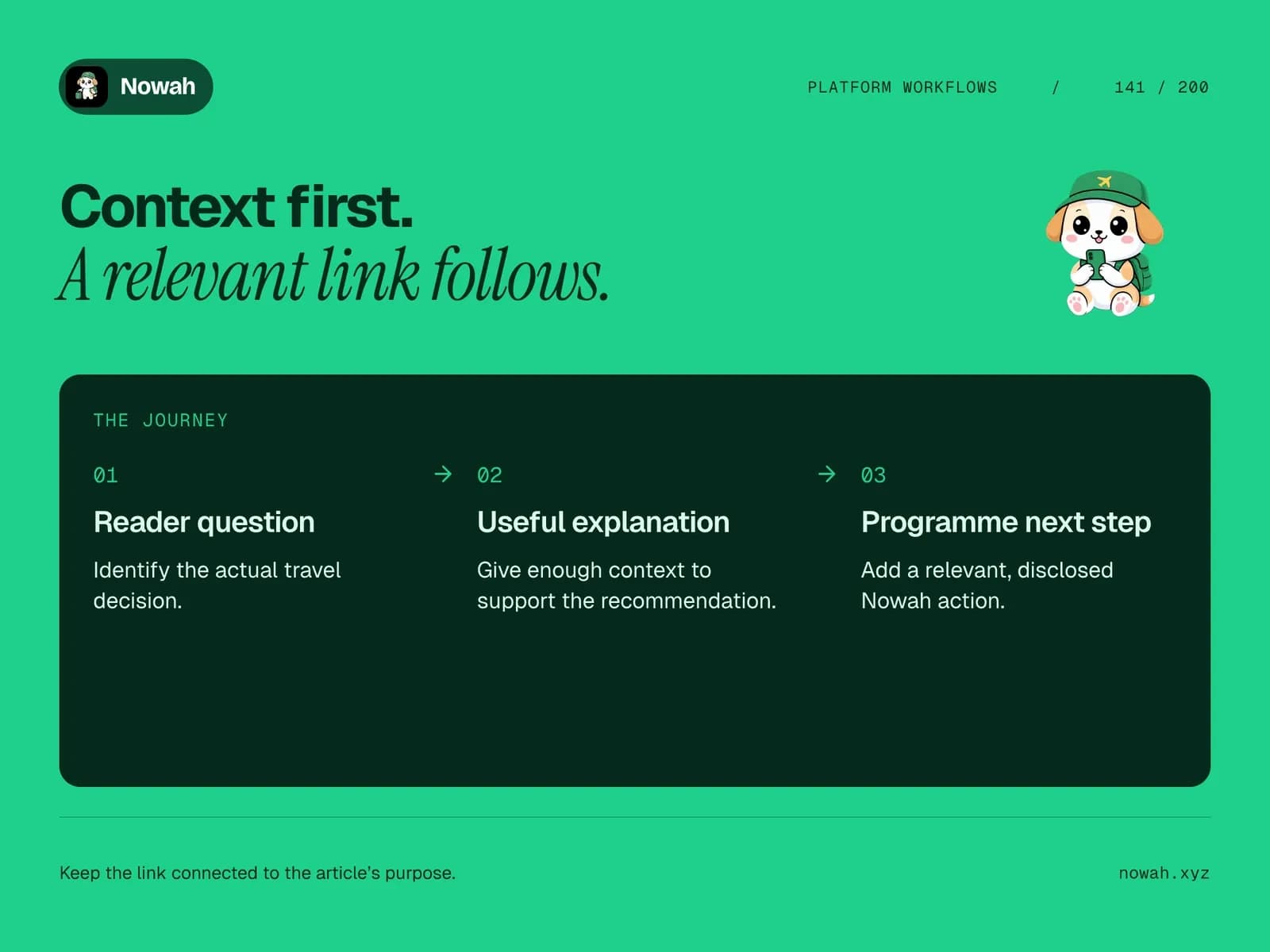
A travel blog reader usually arrives with a question, rather than a wish to inspect your affiliate arrangements. If the article helps them understand a hotel choice, an arrival constraint or a trip structure, a relevant Nowah recommendation can become a useful next step.
The recommendation is stronger when the reader can see why Nowah belongs in that particular decision. Approved Nowah partners can earn 35% of Nowah net revenue from qualifying bookings by eligible new accounts they introduce. That commercial opportunity should follow an explanation worth reading, rather than replace the answer with an unexplained link.
This guide focuses on the paragraph around the recommendation: the question it answers, the context it supplies and the task its destination promises.
Start with the reader's unfinished decision
Write the question your article needs to resolve. “Planning a city break” may be too broad. “Should a short break use one hotel base or two?” gives the piece a specific decision.
Identify what the reader needs to know before acting. They may need to understand the consequences of a hotel move, the assumptions in a comparison or which supplier facts require current evidence.
This becomes the article's useful explanation. Do not rush from a broad introduction straight to a partner destination before providing it.
The decision also gives you a test for relevance. If a proposed paragraph does not help answer the question, establish evidence or explain a necessary next step, consider whether it belongs elsewhere.
A useful commercial article can still recommend Nowah confidently. The confidence should come from showing the product's role in the reader's task, rather than asserting that every traveller should choose it for every purpose.
Give the recommendation a specific job
Decide what the Nowah destination helps the reader do next. A traveller might investigate a brief, explore a planning question or research relevant travel. A creator might examine the program and apply.
These are different actions. Do not send a traveller to an unexplained creator application or imply that a general application address attributes future bookings to you.
For traveller recommendations, use the active partner route supplied after your approval and onboarding. For content teaching creators about the program, the official overview and application portal are appropriate destinations.
Name the task in the surrounding sentence. A description such as “investigate your own arrival constraints” is more informative than a vague invitation to “get the best deal,” especially when the article does not establish a lowest-price claim.
The relevant landing-destination guide can help you evaluate that promise more closely.
Write the reasoning before the link
A useful paragraph explains the tradeoff, identifies the reader priority and describes the next investigation. The link belongs where that task becomes relevant.
For a hotel-base article, the reasoning might explain that a second base changes packing, check-in and daily movement. The next task is to investigate which structure fits the reader's own timing and priorities.
Do not imply that a planning example confirms a room, a transfer or a price. If the next step requires current supplier information, say what needs checking.
Nowah's article about why three options can be more useful than three hundred offers background on making choices understandable. Your recommendation should still be justified by the specific decision in the article.
The surrounding explanation should remain useful if the reader chooses not to click. That is a practical test of whether the paragraph serves the audience or merely creates space for promotion.
Use a paragraph-to-destination audit
Review each commercial recommendation with a short audit:
- What question has the reader just been considering?
- What has the article actually established?
- What uncertainty remains?
- Why is Nowah relevant at this point?
- What task does the destination promise?
- Is the commercial relationship understandable here?
- Could the wording imply a result the evidence does not support?
Write the answers in your editorial notes. If the link's purpose is unclear, revise the explanation or remove the link rather than adding another generic promotional sentence.
The audit should examine the actual destination as well as the anchor text. A label can sound useful while the page reached serves a different audience.
Use the same process when updating older articles. A recommendation that once fit the surrounding material may become confusing after the article or destination changes.
A fictional hotel-move paragraph
Imagine a blogger explaining a short break with one fixed evening event. This is a hypothetical writing example, not a real reader or campaign result.
The article first explains the shared brief and the consequences of adding another hotel base. A recommendation paragraph might then say:
“With limited nights, the extra hotel move is worth investigating against the rest of the trip. If reducing transitions is your priority, start by exploring a one-base plan and identify which daily journeys it would involve. A Nowah planning example can help organise that brief, while current hotel and transport conditions still need checking.”
The paragraph gives the product a useful role without pretending that the example has confirmed an offer. An approved creator can then place the appropriate active partner route with a clear relationship statement.
A different article aimed at creators would need a different next action. Its paragraph could explain why useful planning content fits the program, then link to the official overview and application. Those two contexts should not be treated as interchangeable.
Keep your worked example honest
A fictional brief is a useful teaching tool when it is labelled clearly. It should not become a supposed testimonial or a claim that a follower booked and generated commission.
Use inputs that matter to the decision. Party, available time, fixed commitments and priorities can explain a planning task without exposing private identity or booking data.
Where you describe an actual stay, keep first-hand observation separate from supplier facts and hypothetical planning. A room you filmed does not establish every room category or future rate condition.
If you demonstrate Nowah, show behaviour you can verify in the current product. Do not invent a lead-management tool, a commission alert or a booking guarantee to make the paragraph's promise sound stronger.
The luxury blog evidence guide develops those source distinctions for accommodation content.
Make disclosure part of the recommendation
Tell readers that you are a Nowah partner and may earn commission from qualifying referrals. Place the explanation where it helps them interpret the recommendation, rather than relying on an unrelated page they may never visit.
Keep the wording consistent with the actual arrangement. A separate hosted stay, sponsorship or content-licensing agreement should not be described as the same thing as a Nowah referral relationship.
A disclosure does not make an unsupported claim accurate. “Guaranteed savings” remains a claim needing evidence even if the article openly identifies the commission interest.
The clear partner-disclosure guide provides a more detailed review of the wording and placement task.
Design the article so the explanation remains readable. Do not hide important qualifications in tiny text or a distant section while the recommendation itself implies an unconditional result.
Explain the earning model without distracting from the article
The Nowah program terms state that an eligible traveller follows an active partner link and creates a new account within 30 days of introduction. Tracking must successfully reach Nowah. Existing accounts and self-referrals are excluded.
After valid attribution, later qualifying hotel, flight and paid eSIM bookings may produce earnings for the account's lifetime. No future travel or income is guaranteed.
The partner share is 35% of Nowah net revenue, not the traveller's booking total. Completion, supplier settlement and the applicable hold and payout conditions remain relevant.
A travel-planning article does not need to become a long terms recital. It does need to avoid a headline, example or link label that contradicts those conditions. Where the reader is another creator, link to the more detailed program explanation.
Check the complete article path
Read the article in order and note each decision it asks the reader to make. Internal links should support those decisions rather than interrupt the explanation with unrelated destinations.
A contextual link might lead to a deeper comparison, a relevant workflow or a program-mechanics answer. Explain why the next page helps instead of placing an unexplained collection of links at the end.
Check the final destination and the article's commercial wording together. If the page reached no longer matches the promise, revise the route before promoting the piece again.
For your next article, choose a different reader question and useful output. A good content library contains distinct decisions, not the same promotional paragraph repeated under new destination names.
If evidence-led travel explanations fit your publishing work, apply to Nowah Partners. Build the first recommendation around a question you can answer well, then make the product's role and the next step clear. That gives the link context the reader can actually use.




