Refresh Older Travel Blog Recommendations with Useful Nowah Context
Refresh older travel blog recommendations with current evidence, useful Nowah context, accurate program terms and working destinations.
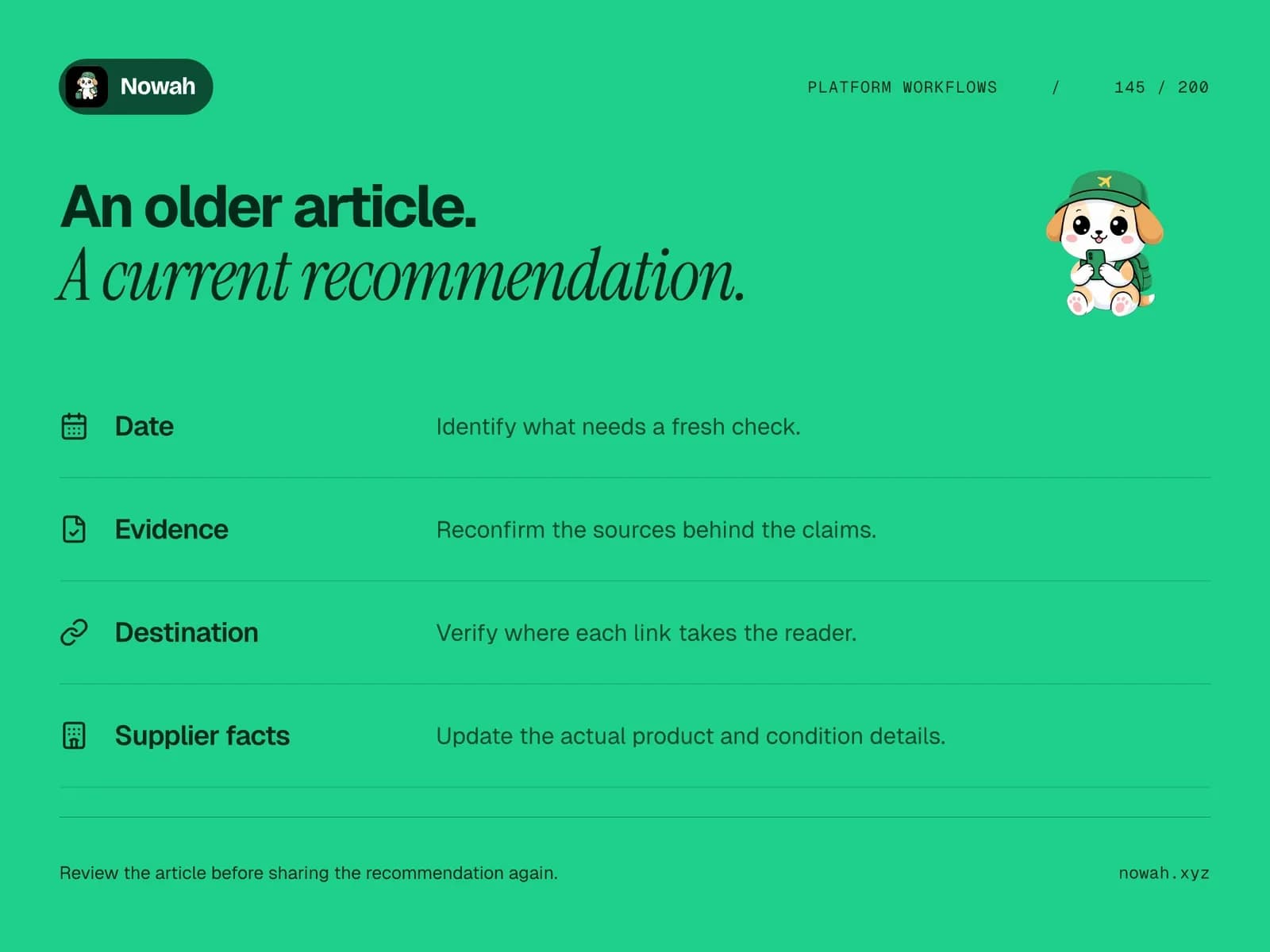
An older travel article can still answer a valuable question while its details become less reliable. A supplier fact may have changed, a link may now serve a different purpose or an earning explanation may use incomplete wording.
Refreshing the article is a chance to improve the reader's decision, not simply replace the date. If Nowah fits the task, add or revise a practical planning explanation and a relevant, disclosed recommendation. Approved Nowah partners can earn 35% of Nowah net revenue from qualifying bookings by eligible new accounts they introduce.
The update should stand on current evidence. It should not imply that rewriting an old page guarantees rankings, creates new attribution for existing accounts or turns earlier readers into qualifying referrals.
Decide why the article needs a review
Start with a specific trigger. A changed program term, an outdated supplier statement, a redirected source or a destination that no longer matches the promise are substantive reasons to investigate.
A new content series may also reveal that the old article leaves an important question unanswered. Perhaps it describes a hotel but never explains how the location relates to a traveller's brief.
Do not assume every paragraph is wrong because the page is old. Separate durable reasoning from facts that depend on the current product, offer or supplier information.
Record the trigger and the reader problem it creates. “A link opens a different program page” is more useful than a vague note to “make the article fresh.”
This focus prevents a superficial edit from appearing to be a comprehensive review when important claims have not actually been checked.
Build a sentence-level refresh ledger
List the statements that matter to the recommendation. For each, record the current wording, supporting source, checked date, relevant conditions and the action required.
Use practical actions: keep, qualify, replace, investigate or remove. Not every uncertain sentence needs a new confident statement. Sometimes the honest update is a narrower claim or an explicit research question.
Include destination promises in the ledger. A sentence telling readers to investigate their trip should be checked against the page it actually reaches.
Keep examples separate from real evidence. A hypothetical Nowah brief can remain a useful teaching device if it is labelled clearly, but it should not be presented as a real follower result in a new version.
The ledger is an editorial tool you maintain. Do not imply that Nowah automatically certifies the accuracy of an older article.
Recheck the supplier facts that affect the decision
Prioritise details that could change the reader's choice. Room category, occupancy, inclusions, cancellation conditions or arrival arrangements may matter more than a decorative description.
Use current, appropriate evidence for those statements. An old review or saved image does not establish the offer available for a different date or party.
If the article contains first-hand observations, preserve their actual scope. You can describe what you observed without pretending that the same conditions apply universally today.
A generated illustration should remain an illustration. Do not update its caption so it appears to document a real stay, room or travel outcome.
The luxury review evidence guide develops a claim-to-source approach for property content. Use the same principle when the article concerns another kind of travel decision.
Check the recommendation's purpose again
Read the article as a new visitor. What question does it answer, and what should the reader be able to do next?
A Nowah recommendation should fit that task. A short-break article may benefit from a fictional day-structure demonstration. A hotel-area comparison may need a clearer brief and a list of supplier checks.
Do not add a general product pitch merely because the article now has a commercial goal. Show why Nowah helps investigate the specific decision.
If the reader is a traveller, the next step should explain the relevant active partner route supplied after approval. If the article teaches creators about the program, the official overview and application information serve a different purpose.
The context-before-link guide helps evaluate that paragraph-level connection.
A fictional hotel-comparison refresh
Imagine a blogger reviewing an older article about whether a short trip should use one hotel base or two. This is a hypothetical editorial example, not a report of traffic, bookings or income.
The article's core tradeoff remains useful: another base adds a hotel move but changes where part of the trip begins. However, the old text contains a supplier-dependent statement that the blogger cannot currently substantiate.
The refresh ledger marks that claim for investigation. If suitable current evidence is unavailable, the blogger removes the assertion and replaces it with a clear question the traveller needs to verify.
The blogger then adds a labelled fictional Nowah demonstration showing how a fixed evening event affects the day structure. The example explains the reasoning without inventing rates, transfer durations or confirmed availability.
Finally, the blogger checks the destination and the partner explanation. The update gives the reader a clearer comparison and next task, rather than simply adding a new date to unchanged advice.
Review program language against the current terms
Check any earning statement against the Nowah program terms, especially if the older page uses a short promotional phrase.
The partner share is 35% of Nowah net revenue, not the traveller's total booking spend. If the old article leaves the base ambiguous, correct it where the rate appears.
Eligible new-account attribution requires a traveller to follow an active partner link and create a new account within 30 days of introduction, with successful tracking. Existing accounts and self-referrals do not qualify.
Valid attribution can support earnings from later qualifying hotel, flight and paid eSIM bookings for the account's lifetime. That rule does not promise repeat travel or a guaranteed income.
Completion, supplier settlement and the applicable hold and payout conditions also matter. Remove any suggestion that a click or pending booking produces immediate cash.
The changing-facts review guide provides a wider framework for keeping evidence dates and verified terms visible.
Do not rewrite the history of the article
An update should not turn past uncertainty into a fictional success story. If an earlier example was hypothetical, keep it hypothetical.
Do not invent reader bookings, application results or creator earnings to make the refreshed page appear more authoritative. If you report an actual outcome, it needs real supporting evidence and appropriate context.
Likewise, do not suggest that an existing traveller account becomes newly attributed because the article or link has changed. The program's eligibility conditions remain separate from your editorial update.
Keep a brief change summary in your records. State which claims were revised, which sources were checked and what the updated recommendation now helps the reader do.
This makes future maintenance easier and helps another editor understand why an old statement was narrowed or removed.
Test the actual destinations
Open the sources, contextual internal links and commercial destinations that the article relies on. A page can still load while no longer supporting the statement beside it.
Check whether each destination matches its label and the surrounding explanation. An old application route, a redirected source or a resource with a changed purpose may require different wording.
Keep traveller and creator actions distinct. Prospective partners can use the official application portal. Approved creators recommending travel use their supplied active partner route.
Make the partner relationship understandable with the recommendation. Do not rely on the assumption that readers have seen another page explaining how you may benefit.
Nowah's article about hotel cards, images, prices and trust offers background for examining how the presentation of a travel option affects understanding. Your refresh should make both the claim and its evidence clearer.
Check the article as a complete argument
After revising individual sentences, read the full piece again. A collection of accurate fragments can still leave an inconsistent conclusion.
Does the opening promise the same task that the body answers? Does the example preserve its assumptions? Does the Nowah recommendation follow naturally from the decision, and does the destination continue it?
Check any graphics or captions as well. An illustration containing an older rate or an overconfident winner label can contradict the revised prose.
Avoid adding more links merely to make the article look updated. Each contextual destination should help answer the reader's next question. If two pages now cover the same task, review whether the library needs both.
Make the refreshed article useful enough to recommend
A meaningful refresh leaves the reader with a better explanation: current evidence where needed, a clear brief, honest qualifications and a relevant next step.
Keep the refresh ledger so future reviews can focus on what actually changes. Trigger another check when the product workflow, supplier evidence, program terms or destination purpose changes.
If you want to build a maintained travel-content business around useful recommendations, apply to Nowah Partners. Describe the audience you help and the decisions your articles can clarify.
Then make the commercial recommendation part of that usefulness. A refreshed Nowah example should help someone investigate their own trip or understand the program, rather than simply attach a new promotion to an old page.




