Why a Nowah Booking Is Not the Same as Settled Partner Earnings
Distinguish a Nowah qualifying booking from settled partner earnings, keeping booking value, net revenue, the hold and payout stages separate.
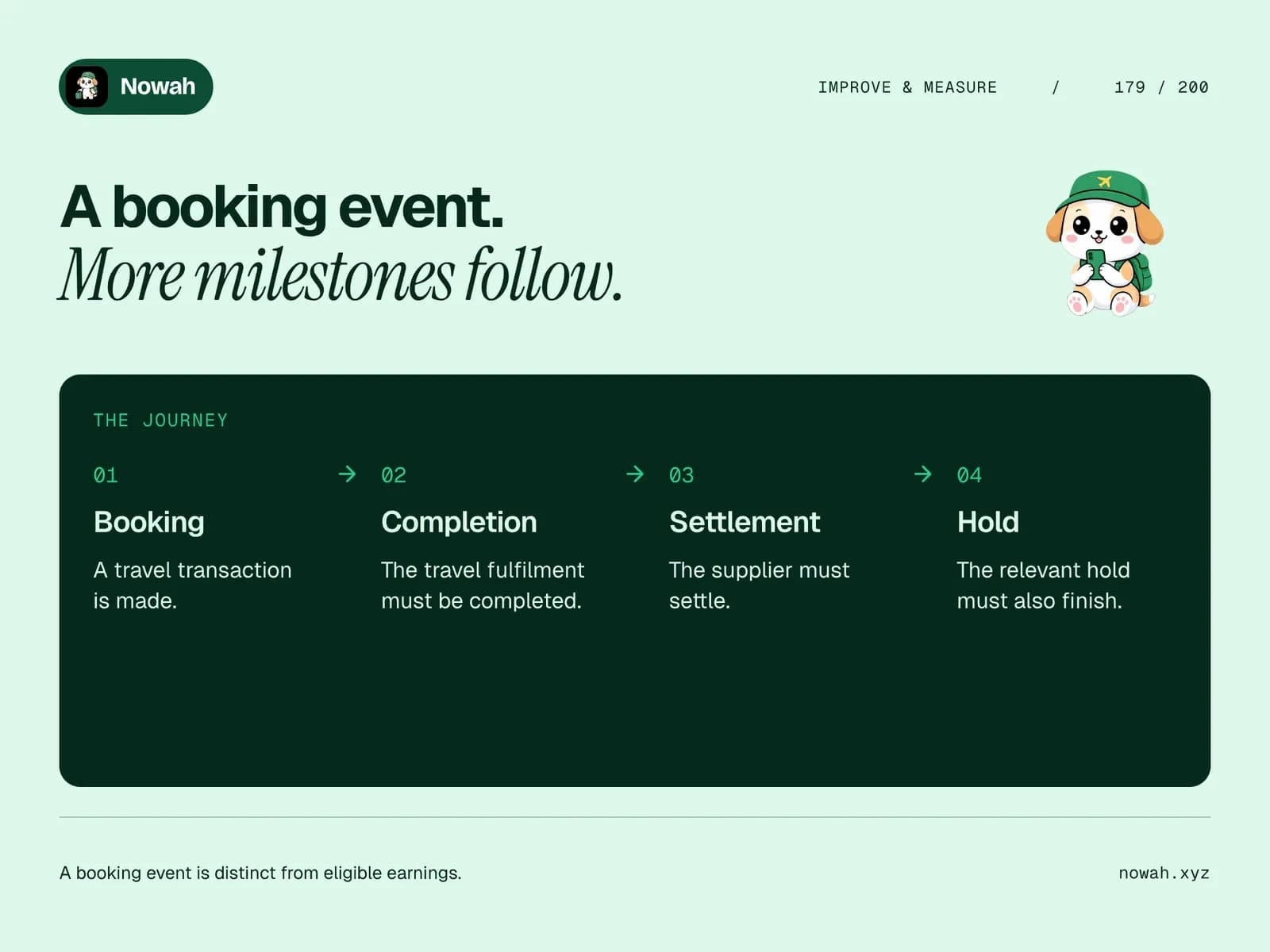
A booking can be an important commercial event without being an immediate payout. For a creator explaining Nowah's earning opportunity, the stages between the booking and bank receipt need to remain clear.
Approved Nowah partners can earn 35% of Nowah net revenue from qualifying bookings by eligible newly attributed accounts. The program terms also require completion, verified supplier settlement, the hold and the remaining payout conditions.
A booking total, a calculated partner share and settled earnings are different figures. This guide helps creators review the sequence without turning a pending plan or traveller spend into a fictional income result.
Establish the account and booking conditions
The traveller must follow an active partner link and create an eligible new account within 30 days of introduction, with successful tracking.
Existing accounts and self-referrals are excluded. The first valid recorded introduction determines attribution, and the account cannot be reassigned.
After valid attribution, later qualifying hotel, flight and paid eSIM bookings may generate earnings for the account's lifetime. Future travel and income are not guaranteed.
Do not describe a general application URL or a public content interaction as proof of this relationship. Use actual program evidence for the event it establishes.
The new-accounts-versus-bookings guide develops that earlier distinction.
Keep the booking total outside the commission base
The traveller's booking spend is not Nowah net revenue. A creator cannot apply the 35% rate to the total holiday bill and call the result commission.
The terms define net revenue using revenue actually received by Nowah for the booking, less the permitted direct deductions. General overhead, salaries and general marketing are excluded from those deductions.
A premium-looking trip does not establish the input. Nor does the fact that the traveller booked through a useful recommendation.
For a real amount, use the relevant record and identify what it represents. Do not infer a margin from a hotel price or another creator's hypothetical example.
The net-revenue guide explains that base in detail.
Use a booking-to-earnings ladder
Create an explanatory ladder with separate stages:
- A valid eligible account relationship.
- A qualifying booking event.
- The defined net-revenue calculation and partner share.
- Completed travel and verified supplier settlement.
- The hold beginning after the later event.
- The separate currency threshold and other eligibility conditions.
- Transfer to the connected Stripe account.
- The later bank payout and arrival question.
This is a creator-maintained teaching tool, not a claimed Nowah portal interface.
Do not assume that reaching one stage proves every later one. A booking event does not establish completion or settlement, and a transfer does not by itself establish bank receipt.
Keep the evidence needed for each conclusion visible in your notes.
Fictional case: the only number is booking value
Assume a hypothetical traveller booking total of $1,000. This is an illustrative input, not a real booking or statement.
That figure alone does not establish Nowah net revenue. Multiplying it by 35% would not produce a valid partner-share calculation under the stated definition.
The correct next question is what the actual program record establishes about the relevant base and conditions. A creator should not invent a margin to complete the example.
The booking total may describe the traveller's spend in the scenario, but it does not become paid creator income.
Keep that distinction readable if you use the example in a graphic. A large booking-value number beside a commission percentage can imply an unsupported result even when a distant paragraph explains the limitation.
Fictional case: a share can be calculated
Now assume, solely for teaching, a qualifying booking with $60 in Nowah net revenue. At 35%, the illustrative partner share is $21.
The arithmetic answers what the rate produces from that assumed base. It does not establish that a real booking exists or that the amount has completed the earning and payment stages.
Completion and verified supplier settlement still matter. The 30-day hold begins after whichever of those events occurs later.
Monthly processing also depends on the separate per-currency threshold, relevant verification and the other conditions in the terms.
The hold-start guide develops that timing rule. A correct calculation should remain separate from a promise of immediate money.
Review completion and settlement as two requirements
Do not treat a planned travel date in the past as proof of every condition. The actual record needs to establish the relevant events.
Likewise, a settlement-related amount does not automatically prove that the traveller has completed the booking.
The later event is the anchor for the hold. Do not select the earlier one because it produces a more convenient expected payment date.
For a real uncertainty, identify the booking or statement reference and the specific event needing clarification. A general article cannot decide the individual's status from an anecdote.
Keeping both requirements visible makes the earning sequence more understandable without inventing a supplier settlement duration or a guaranteed release day.
Keep monthly eligibility separate from bank receipt
A balance can raise a threshold question without establishing the entire transfer process. The terms assess theUS $50-equivalent minimum separately for each settlement currency.
Do not merge different currency balances into one apparent qualifying total. Relevant Stripe verification, available settlement funds and unresolved exceptions also matter.
A transfer to the connected Stripe account is distinct from a bank payout and its arrival timing. Provider-dependent conditions remain relevant at that later stage.
The transfer-versus-bank-arrival guide explains that final distinction.
This is why an earning report should use accurate stage labels instead of describing every amount associated with a booking as “paid.”
Leave room for documented corrections
Refunds, disputes and corrected supplier statements can affect earnings, including amounts connected to a previous payout.
Do not treat a calculated share as immune from later review. Use the actual evidence to understand whether an adjustment occurred and what it concerns.
The terms record corrections in statement history and offset them against unpaid earnings. A negative adjustment does not authorise an automatic debit from the partner's bank account.
The corrections guide develops that process without inventing the cause or outcome of an individual case.
A hypothetical correction teaches the rule; it does not establish what happened to another booking or guarantee how a specific enquiry will be resolved.
Write a stage-specific commercial review
Describe the event the evidence supports. If a real record establishes a booking, call it a booking. If a calculation is illustrative, label it as such. If bank receipt is not established, do not imply it.
Keep the amount and currency with the stage. An unexplained total assembled from different records can look persuasive while saying little about qualifying earnings.
Do not invent a creator testimonial, earnings notification or conversion rate to make the review appear complete.
Nowah's article about what “best” means in travel comparisons offers background for examining apparently simple figures and claims.
A clear review can identify progress and uncertainty at the same time. It does not need to turn every intermediate event into a final result.
Use a complete example without inventing a completed journey
A teaching example can record several stages while leaving some unresolved. For instance, an illustrative review might state that the account and booking conditions are assumed valid, that the net-revenue input is hypothetical and that completion or settlement is not established by the example.
The useful output is a list of evidence questions, not a manufactured payment result. The reader can see why the calculation is separate from the hold and why a bank-arrival claim would require another basis.
For an actual record review, replace assumptions only with the facts the records support. If the net-revenue base is unknown, preserve that gap. If completion is known but settlement is not, do not merge the two into one completed condition. If a transfer is established, keep its currency and stage distinct from later receipt.
This approach lets a creator describe meaningful progress without overstating it. It also makes a follow-up question more precise: the next review concerns a particular missing event or amount, rather than a general demand that a hypothetical timeline must apply to every real booking. Use the official route with the relevant reference, and keep bank credentials and private identity documents out of ordinary email.
Keep the audience recommendation useful
The earning ladder should support an honest commercial explanation, not replace the practical travel lesson.
Show why Nowah helps investigate a brief, a rooming question or an arrival constraint. Verify product behaviour and keep supplier-dependent facts supported.
Tell the audience that you are a Nowah partner and may earn commission from qualifying referrals. Use the active traveller route supplied after approval and onboarding, and check the actual platform surface used for the next action.
Prospective creators can apply through the official partner portal. Explain the audience you help and the decisions your content can clarify.
The opportunity is a defined share from qualifying travel under the terms. A booking can be one meaningful stage, while completion, settlement, hold and payout evidence determine what can accurately be described as later earnings or payment.