Why New Nowah Accounts Are Not the Same as Qualifying Bookings
Understand why a valid Nowah attributed account is different from a qualifying booking, and how to review the next stage without promising conversion.
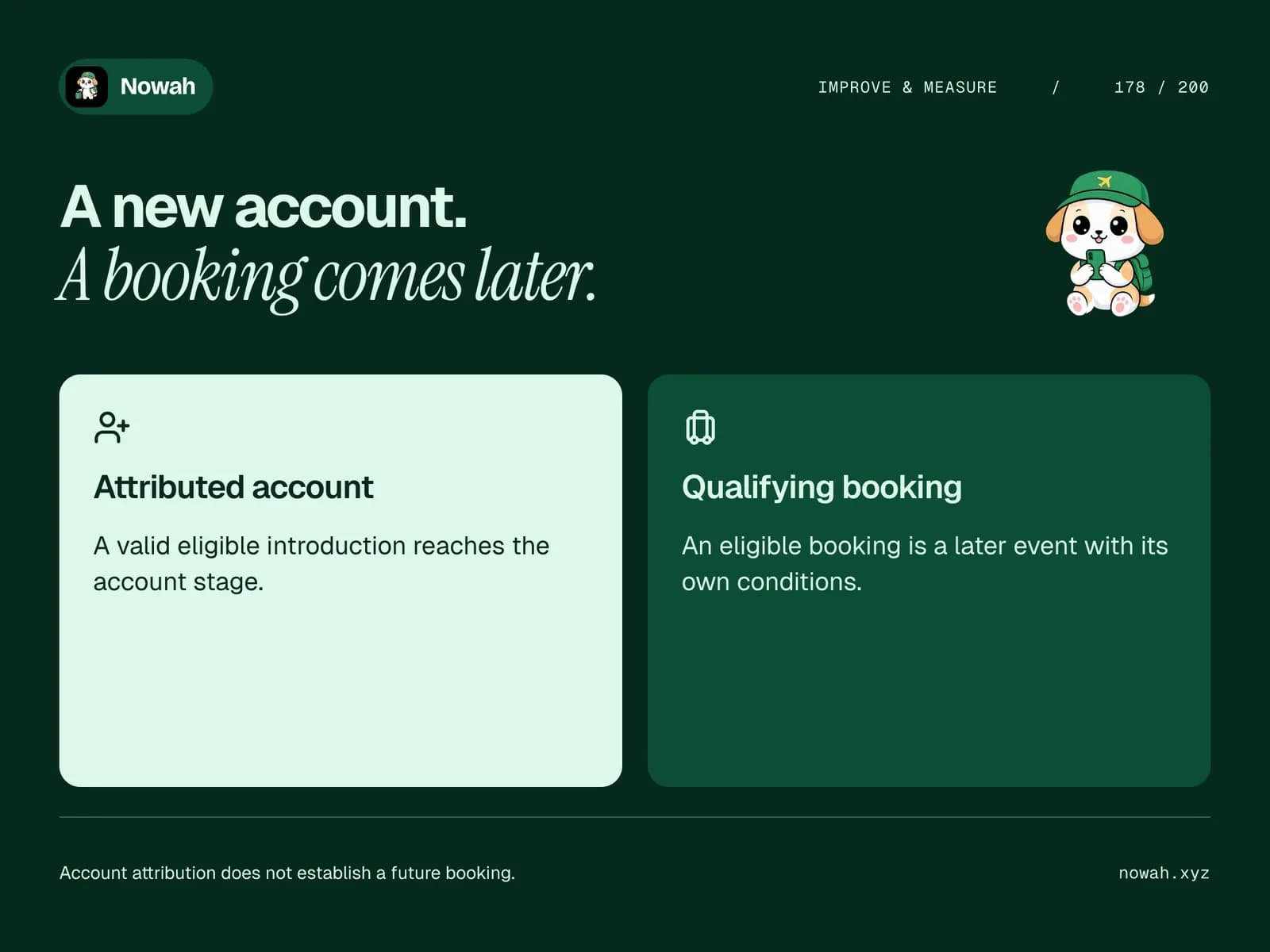
A validly attributed new account is an important stage in the Nowah partner journey. It is not the same thing as a qualifying booking, and it does not by itself establish partner earnings.
Approved Nowah partners can earn 35% of Nowah net revenue from qualifying bookings by eligible accounts they introduce. After valid attribution, later qualifying travel may generate earnings throughout the account's lifetime.
That continuing opportunity does not guarantee that a new user will book immediately, return for another trip or generate a particular amount of income. A creator's review should preserve the distinction between an account event and the booking conditions that come later.
Establish what the account record means
The program terms require a traveller to follow an active partner link and create an eligible new account within 30 days of introduction, with successful tracking.
Existing users and self-referrals cannot establish a qualifying new-account relationship. Where attribution is valid, it follows the first recorded eligible introduction and cannot later be reassigned to another partner.
Do not assume that a public comment, general account interest or a link click establishes every condition. This article's later examples assume valid attribution only when that is explicitly stated.
The clicks-versus-attribution guide develops the earlier evidence question.
Knowing which stage has been established helps you describe progress without making an unsupported commercial conclusion.
Treat booking as a separate event
A traveller can investigate a trip without making a qualifying purchase. A useful planning example does not require an immediate booking to have educational value.
Do not invent a reason for every gap between signup and booking. A general article cannot determine an individual's plans, readiness or account behaviour from incomplete evidence.
Likewise, do not call a plan, enquiry or saved idea a booking. Use actual records for the event they establish.
The next question is whether qualifying travel has occurred under the program terms. That question needs different evidence from the eligible-account introduction.
This distinction lets creators discuss the opportunity honestly while avoiding pressure based on a false promise of guaranteed conversion.
Preserve the product scope
The documented qualifying categories are hotels, flights and paid eSIMs. Complimentary flight-perk eSIMs are excluded.
A traveller may consider many other activities while planning. A restaurant, event ticket or cruise featured in content does not automatically become a qualifying Nowah purchase.
Keep the specific travel task visible in your recommendation. A food-neighbourhood guide may lead naturally to accommodation research without claiming commission on meals.
The eligible-booking categories guide provides a practical content-to-product map.
An attributed account is not a reason to expand the earning scope beyond the documented categories.
Use an account-to-booking worksheet
Record:
- The event actually established by the programme evidence.
- Whether the account attribution conditions are resolved.
- The relevant travel question or content context.
- The qualifying product category, where a booking exists.
- The evidence establishing the booking event.
- The completion, settlement and later payout conditions.
- The outcomes that remain unknown.
- The specific next question to investigate.
This is a creator-maintained review method, not a claim that Nowah provides a particular conversion dashboard.
Keep account and booking fields separate. A complete account row should not automatically populate the booking row.
For public teaching material, use fictional cases rather than exposing an individual's private account or travel data.
Fictional case: a traveller is still researching
Imagine a creator publishing a rooming-question checklist for family travel. This is a hypothetical editorial example, not a real follower story or campaign result.
Assume an eligible new traveller follows the active partner route and valid attribution is established. The traveller then has a clearer brief to investigate.
The content still leaves supplier-specific questions open, such as actual occupancy conditions and the category available for the party's dates. The example does not pretend that creating an account resolves those questions.
No qualifying booking has been assumed. The account relationship and the useful planning lesson can be described without a fabricated earning amount.
A creator reviewing this case should not turn the unresolved booking question into an allegation that tracking failed or a promise that the user must purchase soon.
Fictional case: qualifying travel happens later
Now assume a hypothetical validly attributed account later makes a qualifying hotel booking. The continuing account relationship can apply under the terms.
The timing of that later booking is separate from the original introduction-to-signup window. Do not impose a false rule that every future purchase must happen within those first 30 days.
The booking still needs its own qualifying conditions and later completion, settlement, hold and payout evidence.
No amount can be inferred solely from the hotel price. The 35% share applies to Nowah net revenue, not the traveller's total spend.
This case illustrates the model without forecasting how often a traveller returns or how much a creator will earn.
Keep content usefulness separate from conversion claims
A worksheet, comparison or demonstration can help the audience understand a decision before any booking outcome is known.
Review whether the content explains the relevant inputs, demonstrates verified product behaviour and identifies supplier checks honestly.
Do not manufacture a testimonial or a completed-booking screenshot to make a research example appear commercially successful.
Nowah's article about hotel recommendations beyond star ratings offers background for connecting requirements to a recommendation. Your own example should still supply a specific practical lesson.
Use genuine audience questions to identify confusion where available, while keeping those observations separate from account and booking evidence.
Avoid false urgency in the next action
The account's signup window should not become an invented deadline for booking a whole holiday. Explain the actual rule rather than using it to pressure a traveller.
Check the destination and the account's available linking tools. The instruction should describe a task the audience can actually find.
Approved partners use the active traveller route supplied after approval and onboarding. A creator application page serves a different audience and should not be presented as an attribution shortcut.
Explain the commercial connection where the recommendation appears: you are a Nowah partner and may receive commission when referrals qualify. The viewer should understand that relationship while evaluating the next step.
A clear next step can be an investigation, a planning question or a relevant official resource without a guaranteed-purchase claim.
Separate booking from settled earnings
Even a qualifying booking is not the final payment stage. Earnings require completed travel and verified supplier settlement.
The hold begins after the later event. Monthly processing depends on separate currency thresholds and the other requirements, including relevant verification and available funds.
A transfer to the connected Stripe account is distinct from a bank payout and arrival timing. Refunds and corrections can affect earnings according to the terms.
The bookings-versus-settled-earnings guide develops that next distinction.
A creator should not compress the entire sequence into a statement that a new account or pending booking has produced paid commission.
Write a review that names the evidence
Use stage-specific wording in your content review. Identify what the record establishes, what remains unknown and why the proposed next check is relevant.
Do not calculate an imaginary booking rate from unrelated observations or turn a small anecdote into a universal forecast. A public comment, a website visit and an attributed account are different events.
If an actual programme record raises a question, use the official support route with the relevant reference. Keep private identity or bank information in the secure process provided.
A fictional example helps explain the sequence but cannot certify another person's account or booking status.
Choose the next useful resource from the travel question
If the original content introduced a rooming problem, a follow-up resource can explain which occupancy and category questions require provider evidence. If it introduced a fixed event, the next resource can examine the surrounding day structure. The choice should come from the traveller's unresolved decision, rather than a demand to make every new account book immediately.
Keep the resource useful to someone researching independently. Explain the inputs, show verified Nowah behaviour where relevant and identify what current supplier information is still needed.
Do not present that editorial sequence as proof of a conversion effect. It is a reasoned way to provide more relevant help, and its actual outcomes remain unmeasured until supported by evidence. This gives a creator a constructive next task without inventing the cause of an individual's decision not to book.
Build a recommendation worth investigating
Choose a genuine travel decision and show why Nowah helps the audience think through it. Verify the product behaviour, label illustrative inputs and keep supplier-dependent facts supported.
For the next piece of content, offer a different useful output rather than repeating the same promise under another destination name.
Prospective creators can apply through the official partner portal. Explain the audience you help and the questions your recommendations can clarify.
The commercial opportunity begins with a valid introduction and can extend to later qualifying travel. Keep that promise accurate: an attributed account is a continuing relationship under the terms, while each booking and earning event needs its own evidence.




