How Midrange Travel Creators Can Earn With Better Comfort Tradeoffs in Nowah
Explain midrange comfort choices through location, room requirements and flexibility, with a useful Nowah partner workflow.
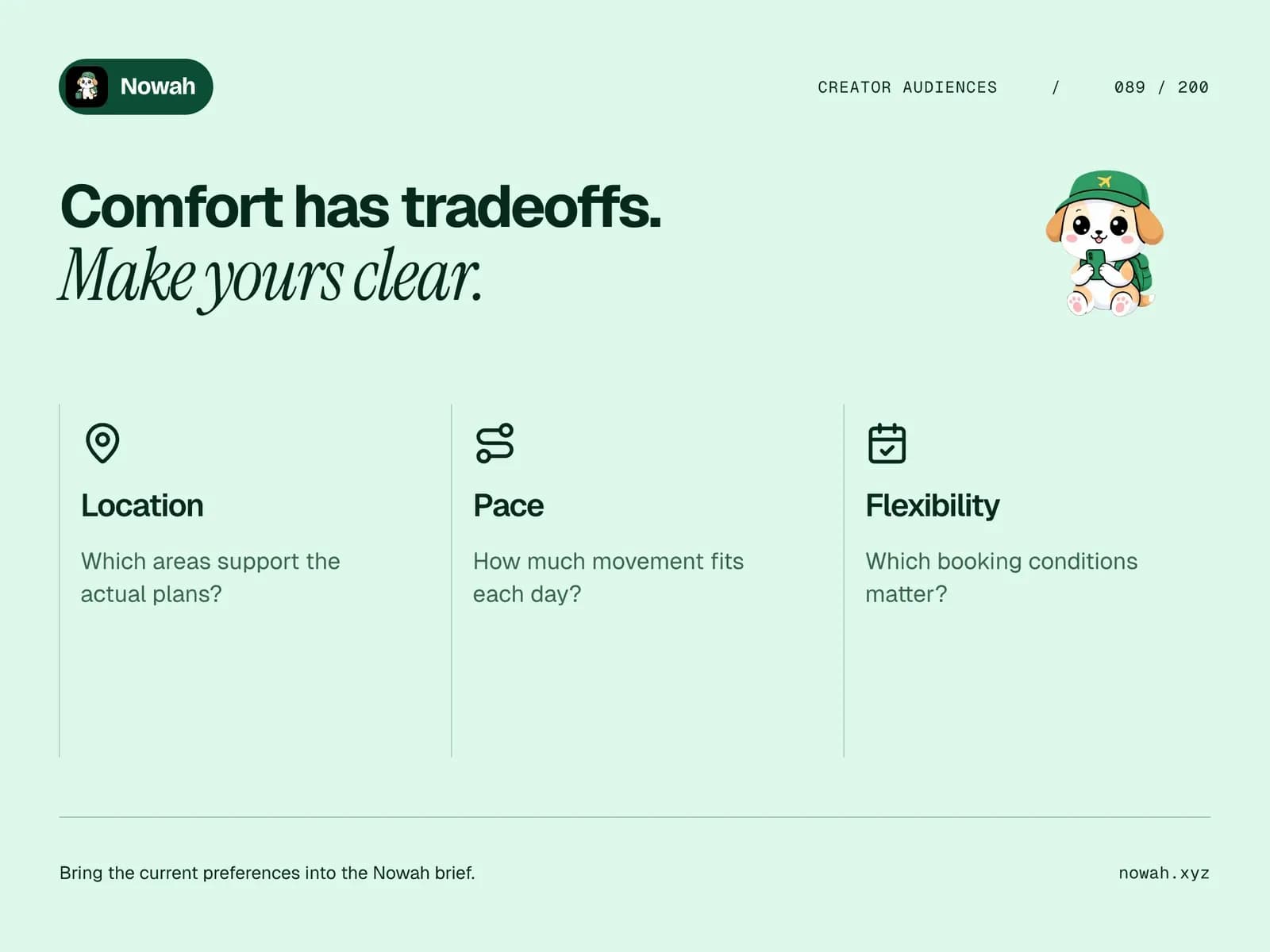
Midrange travel content becomes useful when it explains what a traveller is choosing to prioritise. Location, room requirements and flexibility can pull a decision in different directions, even when several options appear affordable. Approved Nowah partners can connect that explanation to a useful planning demonstration, a disclosed referral and potential earnings from qualifying bookings by newly attributed travellers.
Nowah is a strong fit when a creator turns a broad request for value into a current brief. Show which requirement matters most, explore a direction and explain what changes when the traveller adjusts a preference. The recommendation then offers a practical next step rather than a generic list of supposedly best-value stays.
The partner receives 35% of Nowah net revenue from qualifying bookings under the program terms. The traveller's booking total is not the calculation base. A midrange price label does not establish either suitability or a particular commission, so the content should explain the actual tradeoff before discussing commercial results.
Define comfort in the traveller's own terms
Start with what the audience actually needs. Comfort might mean a room arrangement, a location that supports the trip, a lighter movement schedule or an offer condition the traveller values. Do not assume it means the same amenity list for every person.
A public demonstration can use a fictional three-night traveller with one fixed commitment and a preference for keeping the daily route simple. Explain which details are teaching assumptions and which would need current evidence before booking.
Avoid assigning a universal price band to midrange travel. Budgets, dates, currencies and requirements differ. The useful question is how this traveller chooses among priorities within the scope they have stated, not whether an option qualifies for a label according to an invented threshold.
Separate location, comfort and flexibility
Give each consideration its own place in the brief. Location raises questions about how the accommodation relates to the places the traveller wants to investigate. Comfort concerns the actual room or stay requirements. Flexibility concerns the documented conditions of the specific offer.
Do not let one attractive feature stand in for all three. A property appearing well placed does not establish the room arrangement. A comfortable-looking room does not establish cancellation conditions. A rate described broadly as flexible still needs its actual terms understood.
The cancellation-flexibility guide addresses that third consideration in more depth. Link when the traveller's uncertainty makes the offer conditions relevant instead of simplifying flexibility into an unsupported promise.
Build a priority-and-evidence matrix
A useful matrix can make the comparison manageable without manufacturing a numerical score. Suggested fields include:
- The traveller's stated priority.
- Why that priority changes the decision.
- The current evidence for each research direction.
- The relevant fact still missing.
- The tradeoff the traveller would accept.
- The next question to investigate in Nowah or with the provider.
Do not assign weights that imply an objective company ranking unless you have an actual basis for that claim. The matrix is a creator's explanatory tool for this brief, not a universal suitability engine.
Keep the evidence source beside the claim. A personal observation, current supplier information and a fictional illustration do different jobs. An appealing image should not make an unresolved field look confirmed.
Demonstrate the choice in Nowah
Use Nowah to explore the fictional brief with the fixed commitment and preferred rhythm visible. Explain which consideration you are testing first and why it matters to the traveller.
Review the proposed direction. If it assumes a different room arrangement or adds movements that conflict with the brief, identify the mismatch and revise the question. If an inclusion or offer condition remains unverified, mark that point rather than building the conclusion around it.
This shows the practical reason to recommend Nowah: the audience sees a travel question becoming more specific and a plan changing when the inputs require it. It does not imply that a planning conversation certifies every supplier condition or current offer.
The budget cost-scope guide helps when the traveller's stated budget is unclear. A comparison of comfort tradeoffs is less useful if one option uses an accommodation-only amount while another assumes a wider trip budget.
Work through two directions from the same brief
Imagine the fictional three-night traveller is comparing a location-led direction with a stay-led direction. The first prioritises the relationship between the accommodation and the fixed commitment. The second prioritises a particular room or property requirement that the traveller has identified.
Keep the dates, party and scope consistent. Do not declare the first direction faster without current route evidence, or assume the second includes a benefit that has not been verified. Explain what each direction needs the traveller to investigate.
Then change one preference deliberately. If the traveller decides the room requirement is essential, show how that changes the priority-and-evidence matrix. If the location remains the deciding factor, explain why the other requirement can be relaxed. The point is to make the reasoning visible rather than defend the creator's first choice.
A useful conclusion can identify the direction worth the next stage of research without claiming that every detail is settled. That is still a concrete outcome the audience can adapt to its own brief.
Check the actual offer before calling it value
When the comparison reaches specific accommodation offers, identify room category, occupancy and relevant rate conditions. Do not infer meals, charges or flexibility from a property's overall image.
The rate-inclusions guide provides a method that applies beyond premium audiences. The useful principle is to compare the actual offers on matched scope and preserve missing information as a question.
If a visual shows a headline amount, keep its scope and evidence visible. Avoid a guaranteed-savings claim when the comparison uses fictional inputs or incomplete information. A lower displayed amount can be a reason to investigate, but it is not an automatic conclusion about the traveller's whole trip.
Give the recommendation an honest partner context
When recommending that the audience continue the relevant research through an active Nowah partner link, explain that you may receive commission from qualifying referred bookings. Put the relationship beside the action so the traveller understands both its purpose and your commercial connection.
The Nowah terms require an eligible traveller to follow an active partner link and create a new account within 30 days of the introduction. Existing accounts, self-referrals and artificial accounts do not qualify. Tracking must reach Nowah successfully; a saved comparison or link click is not proof of attribution.
Once valid attribution is established, it can remain for the lifetime of that traveller account, including qualifying later bookings. That offers a potential continuing relationship, not guaranteed future travel or income. A creator application is a separate journey from a traveller referral, so give each audience the appropriate destination.
A useful follow-up is to ask which of the three considerations could change without making the trip unsuitable for the stated brief. If the room arrangement is essential, it stays fixed. If a location preference is negotiable, the creator can investigate a different direction while retaining the other requirements. If flexibility matters because one commitment is unsettled, the actual condition needs evidence before it can support the conclusion.
This makes the tradeoff practical without pretending the traveller has received a numerical suitability score. Record the decision in plain language beside the evidence. A short content cut can show that sentence and the unresolved question, while the companion article holds the matrix. Keep the same assumptions in both formats so the shorter comparison does not suggest stronger certainty than the full explanation supports. The audience can then adapt the method instead of treating one midrange recommendation as a permanent answer for every trip.
Explain the earning base without changing the recommendation
Nowah lists qualifying hotels, flights and paid eSIMs as eligible categories. Other services appearing in a trip story are not automatically commissionable because they are part of the content.
The partner share uses Nowah net revenue after the direct deductions defined in the terms, rather than the traveller's booking expenditure. A labelled hypothetical $60 of Nowah net revenue produces $21 in partner earnings. That does not estimate the return from either midrange accommodation direction or justify steering the traveller toward extra spending.
Completion, supplier settlement, the applicable hold and payout conditions matter before earnings become eligible. Keep attention, a valid new account, a booking and a paid amount distinct when discussing performance.
The older Nowah article on what “best” means in travel recommendations offers background for making criteria explicit. Your priority matrix turns that idea into a practical creator resource.
To participate, apply to Nowah Partners. Applying is free, applications are reviewed and there is no minimum follower count. Start with one meaningful tradeoff, demonstrate how Nowah helps explore it and give followers a transparent route to investigate a trip that reflects their own requirements.




